

I will be using the following benchmarks: SiSoft Sandra 2004, PCMark04, 3DMark2001SE, 3DMark03, Quake 3, Serious Sam 2, and Unreal Tournament 2003. I will be using an Abit NF7-S Rev 2.0 to compare against the motherboard and a Power-Color Radeon 9200SE to compare against the onboard GeForce 4 MX400 video. My system is running Windows XP with SP1 with DirectX 9b and is freshly formatted. I used Nvidia’s 3.13 unified drivers for the motherboards and onboard video and ATi’s Catalyst 3.10 for the Radeon. Below are the rest of the hardware specifications for the benchmarking. Sisoft Sandra testing was done at 166FSB while the synthetic and game benchmarks were done at 133FSB.
I wanted to use the Power-Color Radeon 9200SE rather than a higher end video card because the onboard video is not a high end solution. If I were to put in a really good video card the comparison really wouldn’t matter. I wanted to see how two low end budget effective solutions would do against each other to give a better comparison. I also tested the 9200SE on the Abit NF7-S to compare the two motherboards effectively.
Test Bed
- Albatron KM18G Pro
- Abit NF7-S Rev 2.0
- 1800+ Thoroughbred
- 60GB Seagate Barracuda IV HDD
- 1024MB PC3200 Corsair TwinX
- Onboard GeForce 4 MX440
- Power-Color Radeon 9200SE
- Koolcase’s Panther
- Plextor 40x12x40 CDRW
- SilenX 400w PSU (review to come)
- AOpen AC7L2 heatsink (review to come)
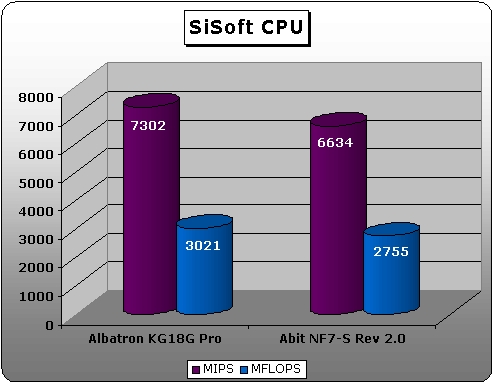
SiSoft Sandra 2004 professional has a lot of great informational modules and benchmarking tools. The first benchmark I ran was the CPU benchmark which will output the MIPS and MFLOPS for your CPU. To my surprise the Albatron KM18G Pro did a little better than the Abit NF7-S with in both areas of this test. This surprised me because in my past experience Albatron was in no way near the quality of an Abit board. It seems that Albatron has done a great deal of work recently to step it up a notch.
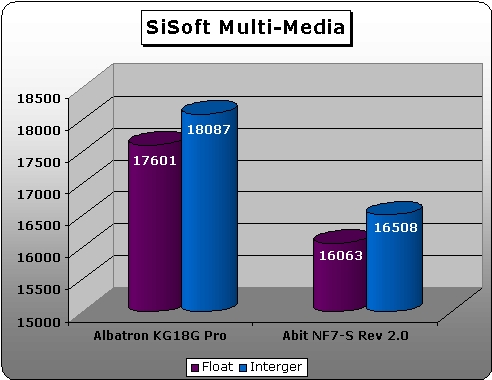
Sandra can also benchmark the multimedia ability of your system outputting the Integer aEMMX/aSSE and Floating-Point results from your system. Again the same situation holds true where the results vary between the FSB because of the CPUs overall speed. Again the Albatron board does better than Abit’s, more so than with the CPU benchmark. Though the results differences are not extraordinary there is a clear difference between the two.
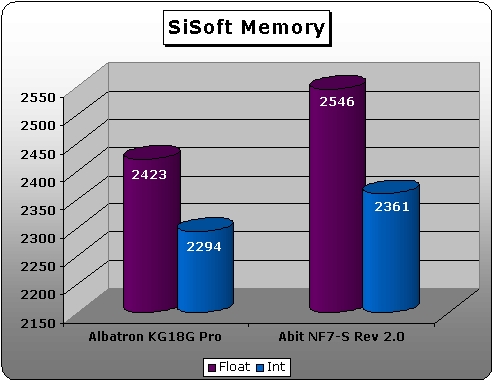
SiSoft is renowned for memory bandwidth benchmarking, I used 1024MB (2×512) Corsair 3200LL which is one of their dual channel kits. All of the speeds were set to the fastest (2-2-2 1T) in the BIOS so that I would get the best performance possible. The testing was done at 166 with the DDR:CPU ratio being set to achieve 400MHz with the RAM. In this test however the NF7-S does better than the Albatron board, this is probably due to it having much more memory tweaking options.


2 comments
Why did you choose a ten year old post to comment on?
FOr me it won’t turn out good even if your mother board is good then your fiber optic cables is garbage. You want all things part of it have the quality.
Comments are closed.