

Professions are your way of contributing to the economy of Warcraft, but are not required in any way. Professions may actually slow your progress more than you realize, but in the end-game portion they will pay off with highly useful and high demand items you can make. And if you are just on the gathering end of the jobs then you only have money to gain, but possibly not as much and for more time spent.
*NOTE: To use a profession you just click the spellbook icon and then click the icon of choice. I like to hot bar my professions, potions, and other seldom-used items to the right. You can add action bars through the options menu.*
You can have any of two main professions, and everyone can have the same sub- professions. Here are the material professions, or “mats” for materials used in the production professions:
- Herbalism – collect herbs from plants.
- Mining – pick away at deposits.
- Skinning – rip the flesh from dead animals.
Here are the producing professions, where you turn the mats into something:
- Alchemy – turn plants into potions.
- Blacksmithing – create weapons and armor from ore.
- Enchanting – disenchant rare items into things to buff other items.
- Tailoring is the best second profession as most of the green items can be made purely from killing humanoids.
- Engineering – make things out of other things. Mainly ore.
- Leatherworking – turn skins into leather armor, mail armor later. Also some armor kits to enhance all armor.
- Tailoring – make clothes out of cloths. Cloths are found off dead humanoids, but to a lesser degree you need some leathers.
- Jewelcrafting – turn ore into stuff. Burning Crusade needed.
- Inscription – create glyphs and buff scrolls. The least popular but probably the most profitable. Need herbs.
Here are the sub-professions everyone can have:
- Fishing – gather fish.
- Cooking – make food for buffs and health.
- First Aid – the most useful where you turn cloth into bandages.
- Riding – go faster, but costs a ton.
Obviously the gathering and producing professions go with each other. Like it would be very difficult to take on alchemy and engineering because you would have no way to get the mats for either unless you find them in small quantities from dead enemies or shell out the dough at the auction house or trades. Keep in mind that mats are always expensive on average, with the rare cheap auction for high-demand mats.
Only enchanters have no true collecting counterpart, as all you have to do is find green or higher items like anyone else does. Tailoring also requires none of the gathering professions, so those two solo professions are made for each other, as you can sew up items to disenchant!
The only truly useful sub-profession is first aid, where fishing and cooking require a lot of secondary effort, and first aid can be the only way some classes can heal themselves consistently.
Hunters really must take on fishing and cooking to feed their pet.
Early on it’s cheap to add professions, so you can pick up a few, see what they require and drop for whatever you may want instead.
Late in the professions all of them will require the others to advance. This does not mean you can’t advance or need to take them up, it just means you’ll need to rely on other players, the auction house, or your guild to help you acquire what you need.
Secondary Profession Tips
Now we will go a bit further into how the professions work. First are lesser professions because everyone can use those.
First Aid ———
The reason to get this is to make bandages. You can’t use them while fighting or while doing anything, you must be still. They allow you to not have to wait for your health to regain, and put your cloths to good use.
Just like tailoring, making bandages relies on you getting dropped cloth from enemies, usually humanoids or in chests. And that’s it, find the cloth, locate the first aid trainers, and make bandages. You’ll need to find the trainers to go beyond the base skill max.
Cooking ——-
Cooked food does more than just heal you between battles, some foods can give you temporary buffs. Cooking is totally optional, but it’s a must for hunters to make food for your pet.
You must be near some source of heat to make food, and there is always one by the cooking trainers, but you can find others and can make your own fire.
You start by just making bread using the cooking supplies, even through the yellow colors until bread is green. Don’t forget to pick up and use the few recipes you get so you can turn things like spider legs and meat into cooked food, which are at least more valuable to sell. It’s simple enough to start cooking, but keeping your skill up requires a little extra work for a little extra benefit.
Fishing ——-
Fishing does two things: get fish to cook and sometimes pick up rare items.
You fish by finding a trainer, buying a rod from a vendor, equipping the rod, and then clicking the fishing icon in your spell book. With the lure in the water you just wait for it to shake and then right click it to try and catch. Best to be in a quiet place and the sound turned up, and always have your finger ready to push at any moment.
As you level up there are more fishing supplies to buy that help you in your efforts. Remember, to best take advantage of fishing you need to pick up cooking so you don’t eat raw fish.
*NOTE: Hunters need food for their pets. You check the pet tab to see their diet and then you can know what to focus on. Remember that the better quality of food the more happiness gained when you feed it.*
Riding ——
Riding allows you to move faster. Most of the time spent in Warcraft is on getting from one place to the next. So any speed advantage reduces the time spent to level up and reach end-game content.
To ride you need to be at level 30, then locate your race’s trainer, and finally spend about 40 gold on buying a mount and getting the training. As of now you can buy any mount from any race.
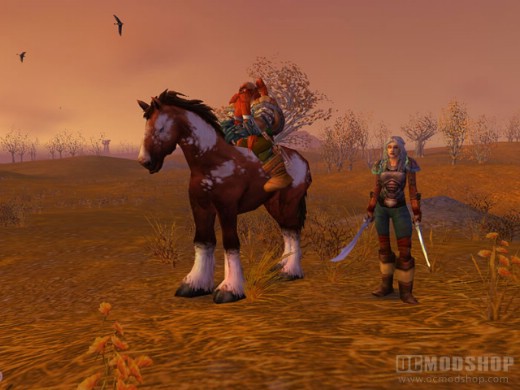
I believe warlocks and paladins can summon their own mount, and engineers can make them at higher levels. But the upper level of mounts require hundreds of gold and level 60.
*NOTE: You can buy spurs to equip to your boots, and find the carrot on a stick to increase speed. The carrot is obtained by visiting Mirage Raceway in Thousand Needles, getting the quest to kill the Zilla monster (I forget it’s name), and going into Zul’Farrak and killing him at the pool.*
Talents
Talents are things you can advance into once you are level 10, the icon will be on your action bar. With every level up you gain a talent point. With this you can advance up (technically down) any of the three talent trees. All levels of the tree require 5 spent in the previous levels of the same tree.
All classes have three different talent trees meant to guide your character to an end where they are better at one talent set than the others. Since you start at 10 and can end at 80 there are 70 talent points to spread around. Keep in mind that original end-game talents required 40 points. So now you can get a decent end skill while advancing fairly high up the other trees. But of course there are higher level talents added to each tree, but you can still reach the new ends. It’s your choice to go up one tree alone or spread around the points to get at least a few of the other options.

An example is that as a rogue I started up the stealth tree, but then took to the combat tree, with only a few points in the finishing move tree. As a DK I spent 30+ in blood, 10 in unholy, and the rest in frost, and I plan to focus on blood from here on out with an eye on somehow getting that ghoul from unholy. As a hunter I have all points in marksmanship, with I believe like two points in some other tree (not the first one).
Some trees lead to new abilities, and most talents have different ranks. Usually the ranked talents require multiple points to get complete 100% effect of the talent, or at least the best of it.
Starting Over
It’s wise to pick abilities wisely to start, but if not then you simply need a gold to cancel all your talents and get all the points back. You do this by visiting your class trainer, selecting the unlearn talents option, and then paying the gold. You get all your points back and can spend them as you wish. Keep in mind that ranks of your learned abilities through the talent tree will stay. So if you get the ability you learned in the talent tree back you will get the ranks you bought from the trainer.
You can unlearn your talents as much as you like, but it gets more and more expensive, so try to get it right with as few of tries as possible.
Don’t forget that purchasing glyphs may also affect how you obtain talents.
Colors
The color scale goes: gray, white, green, yellow, orange, red, blue, purple, or at least as far as I can tell. This applies to skills, items, and quests.
Skills only operate on the gray, green, yellow, orange scale. Gray means it’s easy and awards you no skillup points. Green means it should be easy so you will rarely skillup. Yellow gives you a 60% chance to skillup, and oranges will always skill you up. Your skills usually work in 5’s or 10’s, meaning you must get 5 or 10 skill points in order to move onto the next set of things to do.
*NOTE: weapon skills and lockpicking maxes only move up by five as you level.*
Items go on gray, white, green, blue, purple, and the ultra-rare, end-game orange items. Gray is broken so you can toss it. White is normal and not very good. Greens are where you should be at for the most part as they are better than normal and give nice little buffs. Blues are that next tier but will also be hard to come by. You get blues either at the auction house, a reward for a big quest, or very rarely in a drop. Purples are super hard to find but by the time you get to the end game stuff you will probably get a few. There are also purples as rewards for battleground success at level 60. Oranges are things I haven’t seen.
*NOTE: Don’t forget that if you hit battlegrounds hard, you can visit the reward house to buy nice items and mounts. This is different from the quartermasters at the zones of the battles. Like Alterac Valley, you can hit these places to buy an epic mount at level 60.*
Quests work on a gray, green, yellow, and red scale. Gray means it gives only a fraction of the experience upon completion. Green means you have only a limited time until your level is too high and the quest is almost worth dropping, but you should make an effort to clear your greens. Yellow means you probably can do the quest on your own, and you get the proper experience for turning it in. Red means you should not do the quest, but completing it gives more EXP than normal.
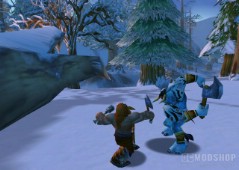
There are also gray, green, yellow, red, skull, and ?? levels of enemies. Gray means killing that enemy yields no EXP, green a little, yellow the standard amount, and red more. Skull and ?? enemies probably require a raid or are just not killable on your own or through normal means.
Gray doesn’t mean to toss the item, thing, or not do the skill, it just means you’re not getting the most out of it. Some gray quests should be finished just so you can keep the quest link going. Gray items can be sold, and at higher levels they are worth at least a couple of flights worth of silver. And of course a lot of gray skills will be useful far beyond skilling you up.



5 comments
Briefly buzzed over your article, there are over 8 dailies with the Argent tournament ones and all the faction, you could fill up your limit of 25 if you wanted…
@Linexeus: Have you SEEN how many really long and complete guides Brad has written? He is definately a video game authority. Come back once you've written over a thousand pages of game guides.
@Gruppa: Isn't yo mama like 4 years late?
This article is FULL of incorrect statements. Obviously written by someone who has played only a minimal amount of WoW. Next time maybe get a long term player to write the article.
Isn't this article about 4 years too late?
Comments are closed.