

The automatic clock control will be of over clocking interest, as it means the CPU will have a few unlocked multipliers. By purchasing a 200 (800) FSB Pentium 4 with this technology, one could turn down the multiplier and turn up the CPU speed by increasing the bus to 266 (1066) FSB while still having all expansion busses running in sync.
Of course, you may be wondering about the availability of said processors. All of them except the Pentium 4 F series are pretty available, as those are server processors.
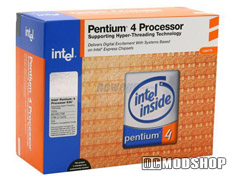
There are some common misconceptions about AMD64 and EM64T being true 64 bit CPUs. Some say that only AMD64 is true 64 bit, while others argue that both are. The correct answer is that neither of them are, at least not by a strict definition. To be fully 64 bit, a CPU must meet a few criteria:
- 64 bit Integer calculations in hardware. Both K8 and Prescott E0 have this capability.
- 72 bit IEEE-1180 Floating Point calculations in hardware. Virtually all CPUs have this.
- 64 bit virtual address space. Neither K8 nor Prescott E0 have this capability.
There are a few true 64 bit CPUs around, but for all intents and purposes the Intel and AMD CPUs are both 64 bit. However, the argument stems from their different approaches to this. K8 extends 32 bit to 64 and allows use of more registers and more computation units, making it perform better in 64 bit than 32. Prescott extends its existing 32 bit capability to 64 bit in a more traditional manner, making 64 bit calculations run modestly slower than 32 bit. Traditionally, all CPUs when going to 64 bit have used this method. The third is used by the Itanium and Itanium only, which is a CPU that only has a 64 bit mode and must use an older 32 bit instruction set when operating in 32 bit mode at a significant performance penalty.
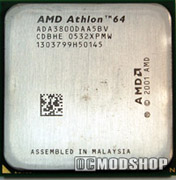
So now that we’ve gotten that out of the way, using the common definition you may ask what 64 bit CPUs are available. There’s a short list:
- Intel Pentium D.
- Intel Xeon “Nocona”
- Intel Itanium processors
- AMD Athlon 64
- AMD Opteron
- Sun UltraSPARC processors
- Fujitsu SPARC64 processors
- IBM POWER processors
- IBM PPC970/Apple PPC G5 processors
- DEC/Compaq/HP Alpha processors
- HP PA-RISC processors
- SGI MIPS processors
And there are many others, but those are the ones you’ll run across the most.

