
Unfortunately at the time of testing I did not have any other PC4000 modules available for a direct head-to-head comparison. However, these modules are the same Ballistix PC4000 modules without the LED’s. So for all intensive purposes the performance testing included in this review is to verify that the modules do run at their rated speeds. Although, being as curious as I am I went ahead and tested the modules at various speeds and timings to give an overall picture of the memory’s versatility.
Testing of the Crucial Ballistix Tracer memory was conducted on the following system:
- MSI K8N Neo2 Platinum s939
- AMD64 3200+ 90nm Winchester
- ATI Radeon 9800 Pro 256meg
- Western Digital 36.7GB WD360DG Raptor Drive
- Western Digital 160GB 1600BB 2MB Cache
- Lite-On DVD-RW
- PC Power and Cooling 510 Deluxe
Speed and Timings
The following table represents the highest memory speeds and latencies attained with the memory in dual channel mode. Note: These are maximums, not fully stable speeds.
|
Timing
|
Max Speed MHz
|
|
2.0-2-2-5
|
218
|
|
2.5-3-3-6
|
271
|
|
2.5-4-4-8
|
273
|
|
3.0-3-3-6
|
283
|
|
3.0-4-4-8
|
290
|
|
3.0-5-5-9
|
294
|
Just from looking at this table you can see that the Ballistix PC4000 chips are very versatile and can offer a wide range of speeds and timings to anyone who likes to get every ounce of performance out of their hardware.
At the stock timings I was able to boot into windows and do limited testing at 273 MHz (DDR546), 23 MHz higher than the memory’s rated speeds. Not bad for unmatched pairs. I was also able run the memory at CL2-2-2-5 up to 218 MHz, and reach a maximum speed of 294 MHz at CL3-5-5-9 (although I may have been hitting the maximum speed of the board as I have never had this board that high before). One thing I would like to note however is that I was unable to get the modules to run at a 1T command rate. So all testing was done at 2T command rate.
After some testing I found the sweet spot of this memory with my setup to be 268 MHz at timings of CL2.5-3-3-9.
Memory Bandwidth
After discovering that this memory was capable of CL2-2-2-5 timings, I decided to compare against PQI Turbo PC3200 with Samsung TCCD memory chips, some of the fastest memory available. The PQI memory runs at CL2-2-2-5 and a command rate of 1T instead of Crucial’s 2T. Unfortunately this memory tends to be a bear to work with on many nForce3 chipset boards so comparison is limited only to 200 MHz.
CPU speeds were held constant at 2 GHz, with the exception of 268 MHz settings. The CPU had to be slightly overclocked as only full step CPU multipliers are available on the AMD64 platforms. So results for those settings may be on the high side if compared to results when the CPU is not overclocked.
Timings tested were as follows:
- PQI Turbo PC3200
- 200 MHz x10 – CL2.0-2-2-5 -1T – 2.8v – HTTx5 Crucial Ballistix Tracer PC4000
- 200 MHz x10 – CL2.0-2-2-5 -2T – 2.8v – HTTx5
- 250 MHz x08 – CL2.5-4-4-8 -2T – 2.8v – HTTx4
- 268 MHz x08 – CL2.5-3-3-10 – 2T -2.85v – HTTx4
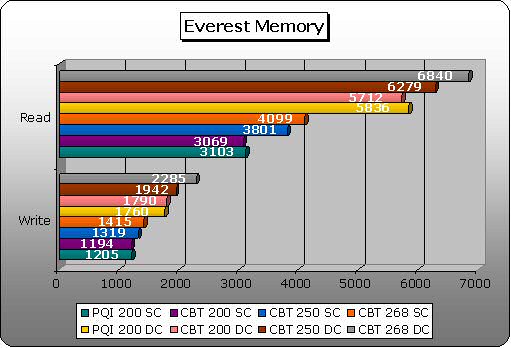
In the following tables (SC) denotes Single Channel configuration and (DC) denotes Dual Channel configuration. The Crucial Ballistix Tracer PC4000 definitely scales well across the board in Everest Home benchmarks. It even keeps up with the ultra fast PQI Turbo running at a 1T command rate. Not bad if you would like lower speeds and tighter timings.
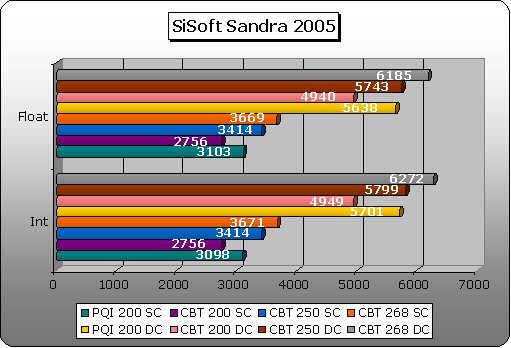
The scalability is still present in SiSoft Sandra 2005. Although it seems that the PQI pulls away a bit in these tests putting up much better numbers at 200 MHz. The faster command rate may be helping the PQI in these tests. One word keeps coming to mind in terms of performance and that’s versatility. If you want to try different speeds and different timings, then these modules should live up to your expectations. Besides being unable to run at a 1T command rate on this particular setup, the modules scale very well at and above their rated speeds of 250 MHz.