
Alrighty, so I’m going to give this thing a test run and see what it can do. I’ll be testing it with a basic multimeter from Radio Shack. This is going to be put into my personal computer, which consists of the following components:
- 350GB SATA HDD 7200RPM
- Sapphire Radeon HD 4670 GPU
- Athlon X2 3800 (OC’d to 2.2Ghz)
- 2GB Samsung DDR2 RAM
- NZXT LCD Fan Controller
- DVD-RW DL optical drive
- 4 120mm Fans, 3 92mm fans
- GMC X7 X-Station Gaming Case (read our review)
I threw all the things in there that are always running to show the amount of electricity that is typically being used when I have my PC powered up. Most of the time I am either editing video or working on 3D modeling, which is intensive on the internal components and can seriously pull from the PSU during rendering times. Gaming is another power-sucker that I do on this PC, though not nearly as often as the other stuff.
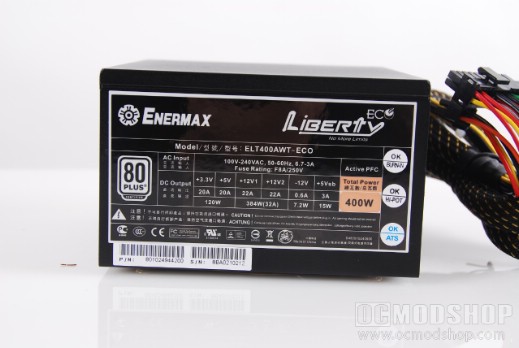
I have to say that of most components I install regularly, PSUs are one of the quickest and easiest. A few screws, plug some stuff in, and you’re done. Testing them is a little more time consuming than most, but I guess that’s just the universe’s way of evening things out for us reviewers. Once I had the unit installed in my case and everything plugged in, I switched it on. Right away I noticed the difference in noise compared to my usual Corsair TX750 PSU (reviewed here). It has to be one of the quietest I’ve ever heard.
Another difference between my Corsair and the Enermax is the rated temperature at which it should be used. The Corsair is rated at 25C for 24/7 operation, whereas the Enermax is rated at a staggering 40C internal case temperature recommendation for 24/7 usage. A quick glance at my LCD, which has by now warmed up to its usual operating temperature, is 30C. I’m starting to think that maybe I should rethink my Corsair when I am done with this review.
Okay, I’m sure you’re all wondering what the internals of this thing are made of. So here’s what I found out about the Liberty Eco 400W. The main capacitor was born of the geniuses over at Hitachi, and rated for 330uF, 400V, and 85°C. It has a huge choke coil in there, and the main bridge rectifier is just to the right of this, toward the back of the PSU. Two separate heatsinks run down on each side of the main capacitor, rather than the one large one that we see in many PSUs today. The entire setup is crafted to fit snugly inside the casing, while still leaving plenty of cooling space. And as expected of Enermax, very solidly constructed. If the internal components are any indication, then this unit is going to perform like a dream.