
There are three plays: run, pass, and play action. All have their own formations, and those formations can themselves be used to trick the defense. Ace formations favor running plays but leave open passes. I-formations mean you will run and weakly keep open the ability to pass. Shotguns mean you are passing, so it’s usually a good idea to really run it up the middle.
Your goal is to gain 10 yards in three plays and at some point get to the endzone for a score, and if you break a big play then so be it. A successful drive makes it between both 40 yard lines. When on the 40 it may be a wise idea to go for it unless you’ve mastered how to punt the ball out of bounds, or keep it out of the endzone for a touchback.
The biggest mistake would be to get near the red zone and not get at least 3 points. Sure, if you get to a 4th and 1, go for it, but you would be surprised in how many close games where you would say “had I only kicked that FG way back when I would have won this game instead of going into overtime” or something like that. Two field goals and one stop on defense is as close to a touchdown as it gets.
Running Away ————
The Run – You can run iso up the middle and just push forward. You may notice this will net less and less yards if you keep running it. That is when you need to look for lateral runs, but only if your RB is fast. You have the stretch, the pitch, sprints, the toss, counters, and the other plays that don’t go straight up the middle. If your guy is super fast, perhaps you can out-run the safeties and other players to the sideline and then turn the corner to go up the field, or maybe you see a hole through your blockers and turn it up field, or maybe you feel lucky and decide to juke back and reverse your field (not wise).
In order to improve your running, I want you to go to practice mode, choose normal, play as the Chargers, call either a power-O or iso in the I-formation, then have the defense run a zone play, and have at it. There are several things to keep in mind.
- Don’t sprint as soon as you have the ball. Going slow can draw the defenders to you, maybe into blockers, and then you can explode, maybe.
- Know where you are supposed to run through your blockers, and see how they are blocking at that point – which means whether or not the d-linemen are being pushed into the hole. If so, you may need to run AROUND the side of your blocker, not straight into the defender.
- Keep an eye on the LB’s; if they are up close, you need to try and bounce it outside.
- If you are running up the middle, you need to dance around. That doesn’t mean use a ton of moves, but don’t run into oncoming defenders. You can try to spin away, juke, or just run in the other direction. If you go up the middle, you may be surprised how well running in an “S” and then spinning works.
- If you want to run outside, you must not touch the blocked DE or he will do a “Magnet Tackle”, something these Madden games are famous for.
I say run this as many times as you can until your realize that using moves at random works pretty well, and that simply running at weird angles up the middle works remarkably well. One thing that is hard to explain is once you are on the other side of the d-line, try to run parallel to them at their backs, or just do a spin move. It sounds crazy and doesn’t work often, but if done right you may let all your blockers get a defender, and then you can slip free. Basically, when in doubt use the spin move (if your guy can do it that is).
After you run this play over and over, try running against man coverage, then 46, then whatever. The idea is to get a sense of running correctly. Not all plays can work, no matter how well drawn up, but so long as you keep your running instincts each time your run, there will always be that chance of a modest to great gain. A bad run is 1-3 yards, a good run is 4-6, and a great run is anything over 6 yards. Keep in mind, calling ten run plays in a row does not work. You need to mix up your calls between pass and run, and then between all the formations.
As far as formations, each run play depends on how many defenders are crowding the line of scrimmage. If there are six defenders close to the line, even if you have an I-formation, it may be wise to call a play action or pass. If you have a shotgun and the defenders are spread out, audible a run, which is hopefully a draw. And even a perfect call could fail, but at least you’re making the defense think.
In Madden, I say to counter all the cheapness of the CPU against the run, feel free to run goal line sets. Of course you can’t overuse these either, but if you notice how perfectly higher level defenses defend even the best of running games, all’s fair in my mind. Once you do get these plays to work, feel free to start using more traditional formations.
It’s best to realize what kind of defense you are up against. Strong d-lines and/or LB corps mean you need to pass more than run. Yes, it’s not true to real football, as everyone can run to some degree on everyone else, but there is no “outsmarting” the defenses on this game. And know that most big runs are from complete flukes of someone breaking 5 tackles or so, so feel free to use those moves.
Here are my big tips for successful running:
*When running through blockers, take your time, which means don’t hold down sprint from the start. You need to develop vision where you see the defenders and where they are coming from. If you are running up the middle, maybe it’s best to juke to the outside if the LB’s are crashing in; maybe for a stretch you need to try and run to the sideline and turn the corner instead of cutting through blockers. But if there is a hole, hit it with the speed. Just know that sprinting is meant for catching up to receivers on defense and then outrunning defenders after catching a pass. As a RB, you only sprint when pursuing tacklers are behind you.
*Mix up your calls between up the middle plays and runs that go outside. If the defense is in man coverage, a stretch/toss/pitch will usually work really well. If the defense is spread out, like for zone, a run up the middle may be best.
*The spin move is your best friend as it seems to do more than just spin I’ve noticed. Sometimes I’ll press the spin move too late, but my RB will still break the tackle. I’ve also noticed that the spin move works much better than juking. Just know you have to press the button before the tackler goes into his tackle animation.
*Juking, highlight stick, and spinning increase your chance of fumbling, so use in moderation during a single run. Pressing up on the highlight stick seems to protect the ball, so do that when being tackled is your only option. However, I can attest to how little these moves make your fumble. I’ve fumbled more by normal tackles than using these moves while being tackled, so I say use them as much as you need.
*Of course having a fast QB means all plays can be runs for your team, but just like in the real game, a scrambling QB can fill up the highlight reel while filling up the loss column. You need to pass the ball.
*Whenever running, use your blockers. If a slow lineman is running with you as best you can, but there are some defenders incoming, it’s a good idea to slow it down and not turn on the jets. There is no right way to go as the blockers could do nothing, but again, just make a sound decision rather than just sprinting on every run.
Passing the Rock —————-
The Pass – Passing can be to set up the run, or running to set up the pass. Passing is not wise when the defense is in zone coverage. Sure, there are holes in the zone, but those holes are extremely small as the difficult defenses are faster and your receivers are slower. The best time to pass is in man coverage, when the receiver has the defender beat and it’s just a matter of placing the ball in front of the receiver, given that no other defender could intercept the ball.
It’s possible to pass all the time, just spread out your formations and have a wide variety of playcalls and routes, but you need to mix in runs, even small runs to open up the receivers. Ideal passing is when your blockers have picked up a blitz, which means someone is most likely open.
*NOTE: If you have a run called and see defenders crowding the line of scrimmage, audible a pass or play action. The opposite is true as well.*
Don’t be afraid to air it out, but only wisely. Don’t throw 40 yard bombs every other play because a lot of shorter routes can be expanded to longer plays with much less effort. Usually your long passes will be open in the middle of the field, but only in the area between the safeties and linebackers, and don’t be surprised if those passes are knocked out of the air a lot. In the NFL, some of your #3 or 4 wideouts can outrun their defenders, so keep that in mind for go routes in man coverage.
I like short passes. It’s the same problem the Indianapolis Colts face in that defenses would rather let you nickel and dime your way up the field than let you have the deep pass. Slants, crossing routes, and posts are easy routes to know if they are open or not. Every now and then you may want to try a deep pass, but when you do, always have a few backup routes if the play falls apart. In Madden, quite out routes are your best friend, but they are only open at the receiver’s cut.
The pass rush determines your pass selection while the play is happening. It’s a bad idea to look at your line to see if it’s broken, but you do need to maybe see if anyone has broken through at the start of the play. If every defender has dropped back in coverage, usually the four pass rushers won’t reach you for 3 seconds, so you have some time to let a route develop for a guy to get open. If defenders are blitzing, someone is open so find them and let it fly. Whether the pass rush is close or the blitz is on, having a QB that can run out of the pocket can extend passing plays, on top of being able to run with the QB. It’s even better to already have two buttons in mind and have those routes as main options, and it’s always nice to have one route ready if you see those corners blitz.
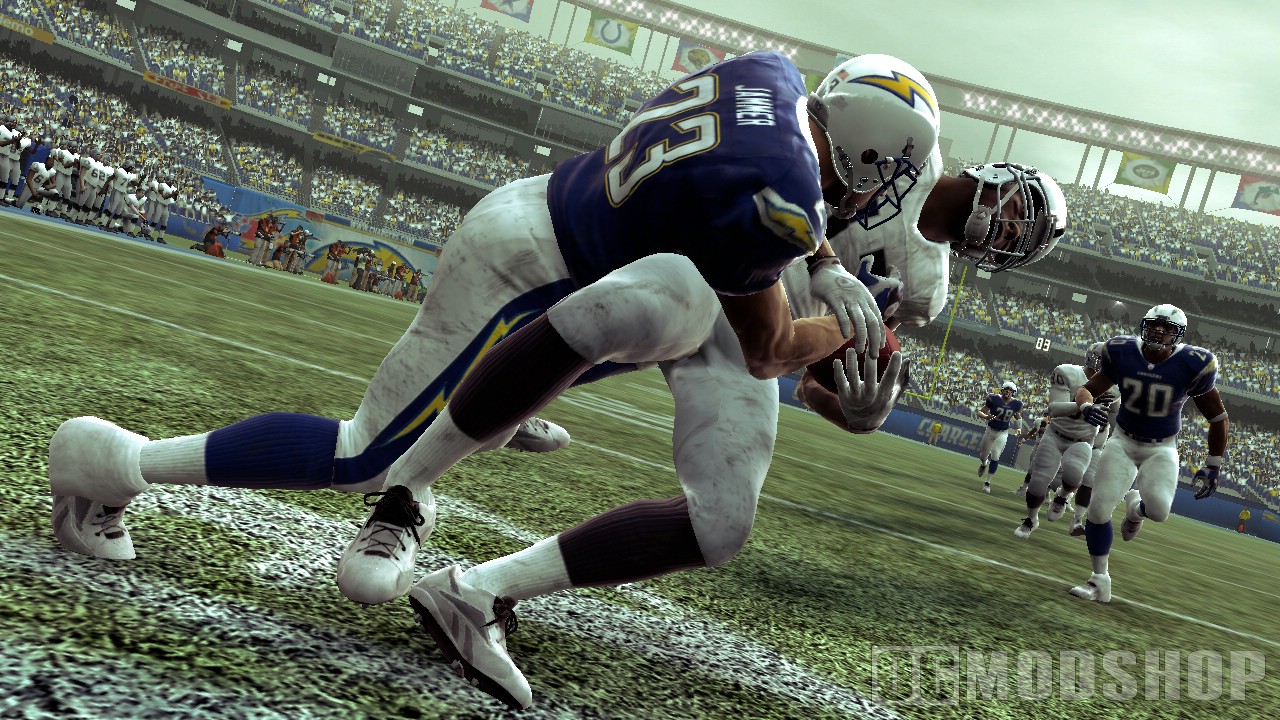
My tips to successful passing:
*Hesitation is the mating call of bad passing. If you see a guy open, throw it. Of course “open” means there is no one in front of him. So if a guy is open and you see him open, pass or else he won’t be open for long.
*To extend the first tip, most passes are open right after the snap, especially some slot routes. On a similar note, most passes are open only as/before the receiver makes a cut in the route. Reacting to an open receiver is usually not wise, it’s best to trust his running and have the ball waiting in the open area.
*Slant routes are your best bet to get the passing game going. Slants to big, elite receivers are gold, especially if nothing else is working for you. It’s a matter of trust of course, so have some way of forcing the near-side safety to go away.
*I love to make decoy routes to open up crossing or slants routes. What this means is I send two receivers on one side up the field. This creates an open area where they just left if the defense is in zone. So wouldn’t it be great if a receiver or RB were to catch a pass in this empty area? Yes, but again it’s only against man coverage, with very limited success against zones (probably the decoy routes are your best option against zones).
*It’s less important to shift your o-line in this game as the defenders are super fast and could break through from the side you slide away from. Good for bootlegs or plays you intend to pass out of the pocket.
*You only lob a pass, tab the pass button, when the receiver is streaking down the field and no one is ahead of him. Other than that, just throw bullets with touch.
*Touch is never precise, and it may not be in this game, but I’m pretty sure it is. Touch is when you are throwing a ball to a spot, rather than directly to the receiver. If your man is running a slant with a defender behind him, and the pass would hit the defender, the best thing would be to throw the ball a bit ahead of the receiver so he is the only one to catch it. To do this you simply hold the LS in the direction you want the pass to go. Again, it’s not precise or exact. You can try throwing high to where your guy has to jump to get a pass in traffic, and of course his pain is only virtual. Low passes can be just as effective, but of all of this, never apply touch to make a pass worst.
*Check-downs are passes to either your tight end, half back, or full back that is parallel to the line of scrimmage. They are worthless if a defender is following them, but if there is no one covering the checkdown, throw it because it will ensure you gain yards. Aside from positive yards, you extend the drive, wear out the defense, and maybe your checkdown can gain a lot of yards.
*Comebacks, hitches, curls, and screens have low success rates. Comebacks only work on man coverage, and only if the right touch is applied. Screens rarely work for many reasons. For one, the developers of this game thought it wise to occassionally let the linemen flow out with the RB about 50% of the time. Secondly, even if you get the pass cleanly to the RB, your blockers usually just let the defenders get you, and/or go block linemen who would never catch you. These plays are trash, so don’t even use them, and thank EA if you don’t like it.
*Just recently I have found the short, crossing patterns to be most effective. For one, there’s little risk as you should clearly know whether it’s open or not. And secondly, defenses tend to back up to cover the deep passes, and that usually leaves all the short stuff open. Ace and shotgun packages will have plenty of plays with crossing patterns for either the TE or a WR. If the defense is in man, the pattern will work, usually. Of course if the crosser is far from the QB, the chances of completion are less, so you’ll have to put touch far ahead of the receiver or the defender could jump the pass and score a TD.
*Master your hot routes and sending players into motion pre-play. If the default play gives you few options, hot route a few receivers; if you sense a blitz or a mis-match, tell someone to go straight and toss them the ball the moment you see the blitz coming; and if your RB can catch, send him out there too.
*A cheap way to buy time is to keep drifting back. Of course it reduces how far upfield you can throw it, but it helps buy time for short routes to get open, and so long as no pass rushers are chasing you, you can frustrate the defense all day. Really make them mad by reading the rush and going through your linemen so the defenders are blocked yet again.
*The key to my offense is what I creatively call the “running receiver”. It could be from my Sundays of seeing Brian Westbrook double as the Eagles’ best running and receiving option. I like calling a hot route and either giving my RB a slant or fly, and then send him to the side of the field to either act as a decoy or make sure he will be open in that slant on the other side of the field. If you got a fast back that can catch, there is no linebacker that can keep up. Do this a lot against real players and you can really mess with their heads’.
*NOTE: For hot route RB’s, you can even keep them in the backfield and call slants. It’s like a flat route only it means the RB will be going more upfield than a normal flat.*
*Trust me, the CPU doesn’t like it when you pass all over it. It’s wise to start running the ball after a bunch of successful passes because you’ll start to see defenders make phantom plays to intercept you. You need to believe me on this because slow defenders will start to run faster as the ball is thrown to give the illusion that they are playing good D. So please, run the ball a little. Of course sometimes you get the good bounces, but not often.
Faking It ———
Play Action – If you are mixing enough runs and plays, the play action is always on the table. A play action, or PA, pass is one where you fake a run play which is really a passing play. It’s a better play in real life because real players would bite on the fake, but in this game it only buys you a step or two for your receivers at the most. There is no such thing as a broken play where someone is wide open for no good reason.
It’s pretty simple, if it’s 4th and 1 and you’ve had mucho success running the ball, call a PA and toss it to the FB running in the flat, or run with your QB if possible. The only time I would second-guess a PA is at the goal line where there is little room to pass, but it’s possible.
There is just one thing to think about when considering a PA: perhaps it’s better to call a shotgun play where the field is spread and opens up the QB to run in most cases. Why? Because what defense would call zone coverage if you need a yard? The defenders would follow your guys and the QB should be free to run if not being spied. Just something to consider.
*NOTE: When playing the CPU, don’t be so naive to think they don’t know what play you’re running and won’t let a DT come free. So on 4th and inches, unless you have a great running QB to make something happen, just know the CPU isn’t above pulling a fast one.*



1 comment
You call this a guide? It's more like a weak attempt at a review than anything. I got more out of reading the in-game description than could be gleaned from this garbage. Your knowledge of the game is apparently as shallow as your appreciation for good football, since you bag on the best team in NFL history. The interweb is running out of space & it shouldn't be wasted on your drivel.
Comments are closed.