
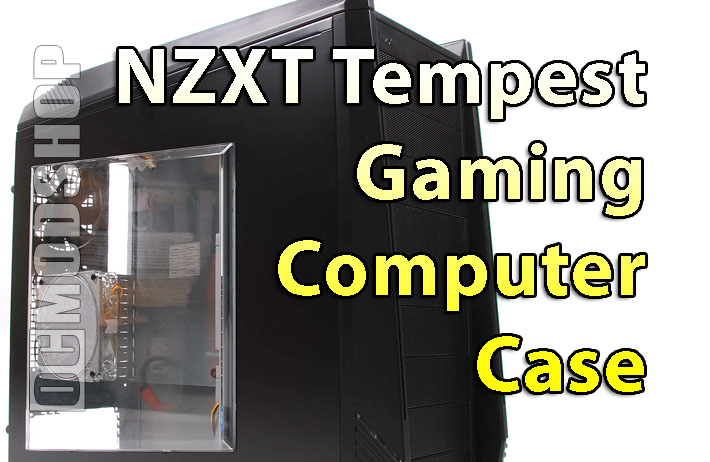
Now that we have gotten the outer beauty out of the way, it’s time to check out the glory of the guts. Two thumb screws hold the case’s side on. A few turns and a pull on the outward-swinging siding, and we can see the glory that is the interior Tempest Evo. The six 120mm fans are right there in your face, just begging to be turned on so they can move some air. The third optical bay has a small sliding bay built into it for those of you who still have a floppy drive or a small pet dinosaur who would like to make his nest in there. They’re both from the same period, right?
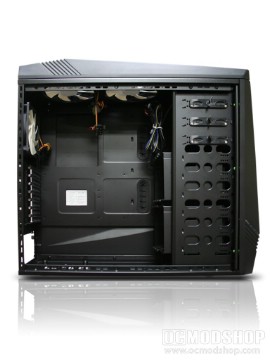
There is a small white box stuffed into one of the uppermost HDD drive bays. It contains the side attachments that allow your HDDs of choice to slide in and out of the server-style bays with easy. A quick squeeze of the side snaps and your HDD is in your hand and fast as it went into the case. Gotta love the fact that we are moving away from internal screws. All of the small ends of the wiring were lovingly stuffed into a foam bag for safe keeping during transit. In the back of the case, where the motherboard would be, we see the two rubber-lined three inch slits that NZXT thoughtfully installed. This is access the expanded space behind the motherboard. These holes were cut specifically for hiding wires where they are typically connected to the motherboard.
The other side of the case comes off, revealing access to the rear punch-out behind the motherboard plate. It was put there for easy access to the back of the CPU heatsink screws. No more taking out the motherboard just to change heatsinks. Why is it no one thought of that before, huh? Hell, I had that idea like six years ago. I even pitched the idea to a vendor. Nothing.
Anyway, on top of the six huge fans already installed, there is also space on the bottom of the case for a seventh fan, should you feel the need to add that little bit of extra airflow. The additional holes for a second water-cooling system is something you don’t see often enough. Most cases I review have only one set, but I think most manufacturers fail to realize that gamers sometimes want to use water cooling on their GPU as well. So, thank you again, NZXT.
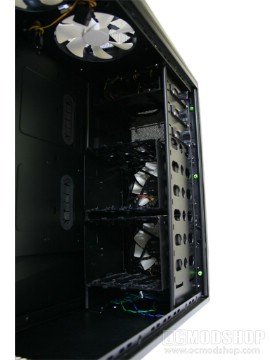 The main things to test on this case are the sturdiness, which speaks for itself as it’s made of solid steel except for the front bezel, and the airflow from the redesigned fans. NZXT took their 9-blade fans and claim they made them more powerful and quieter at the same time. I hooked up a 12 Volt power supply to the fans in a daisy chain to if what they were claiming was true. The fans are a bit quieter than the ones that came with the NZXT case I currently use. I noticed a definite drop in sound when I put the side on the case. But the airflow really picked up at that time.
The side of a case closes a gap in airflow. If you pump water into an empty barrel with a hose attached, but no lid on top, the water will pretty much go where it wants until the barrel fills up and it spills out. If you were to make that barrel air tight and have that outflow hose in the water, it will continue out the hose and the water level would stay the same in the barrel. The side of the case does the same for airflow. Fresh air comes in, is drawn directly across the components that need it most, and then is pushed out before it has time to warm up dramatically. No still air means no warm air. And the airflow in the Tempest Evo is very powerful with the side on.

1 comment
i like the gammer cases that are in this site.im takong some ideas from it in order to pimp my case…thanks-)
Comments are closed.