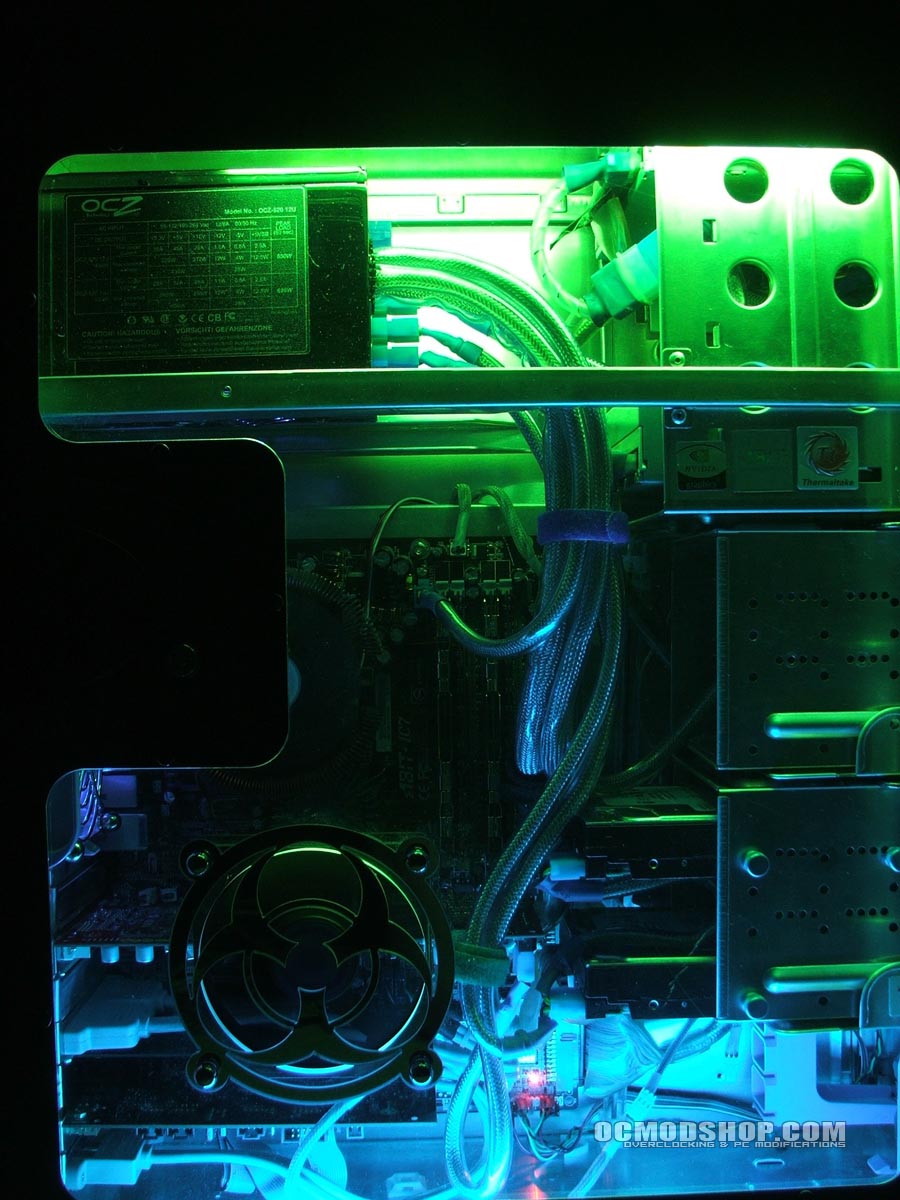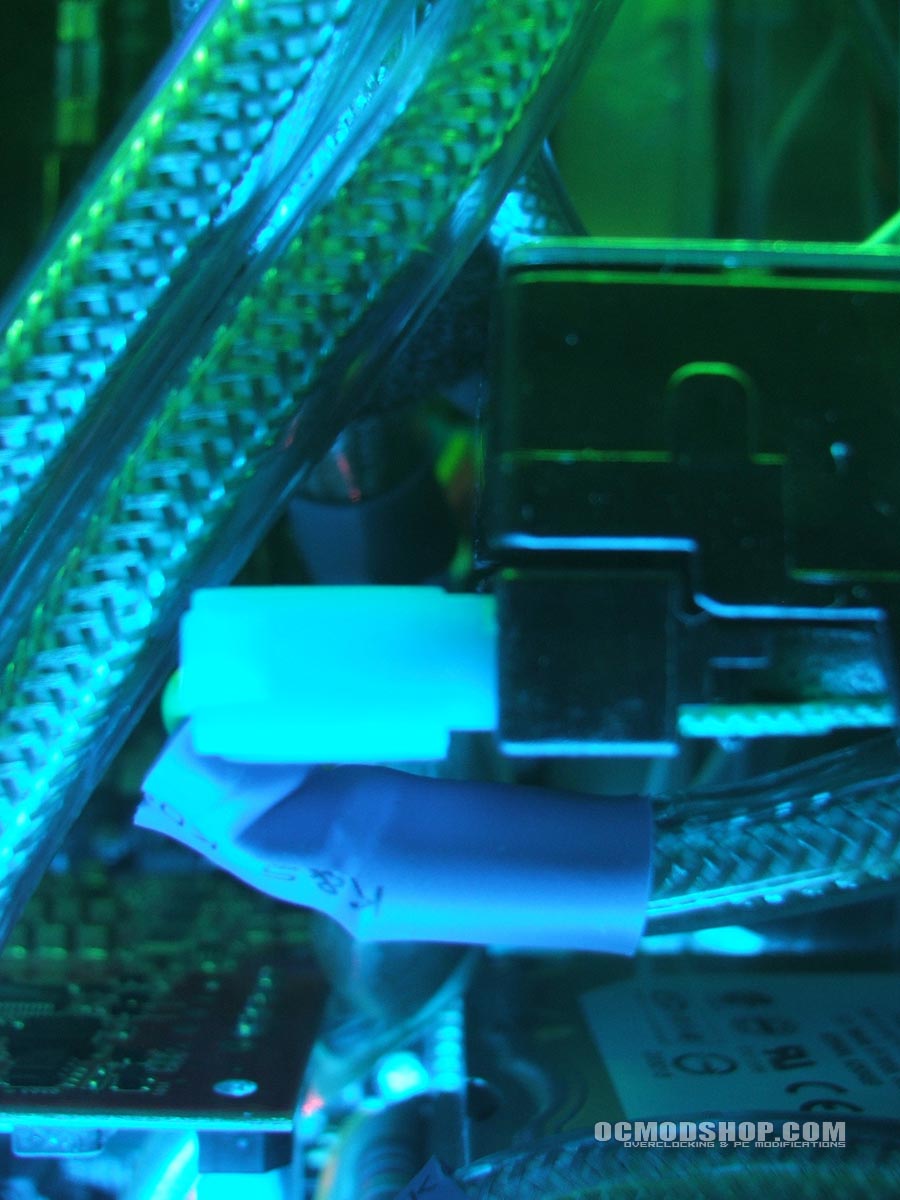
Normally I don’t list every fan and little piece of equipment in my setup, but every little bit counts when testing a power supply. Each USB device takes up 5 watts of power (especially when the device is powered directly from the bus). The Chenming case offers plenty of airflow, and the list of peripherals is common in many enthusiast’s systems.
| Test system | |
| Chenming Aluminum case | Abit IC-7 motherboard |
| Intel Pentium 4 2.8Ghz 800FSB | 4x 512MB DDR400 RAM (2GB total) |
| MSI GeForce FX 5900 | Soundblaster Audigy sound card |
| LiteOn 8x DVD writer | LiteOn 16x DVD drive |
| 3 PCToys tri-LED 80mm fans | 1 92mm fan |
| Zalman CNPS7000Cu heatsink | Waffer PC Aircon 400 |
| 2x Western Digital 120GB HDD | Microsoft cordless Desktop Elite |
| Wacom USB tablet | Logitech USB Wingman cordless game pad |
| 3 cold cathode lights | Zalman ZM-MFC1 fan controller |
| Hewlett-Packard iPAQ Pocket PC | Creative Labs Nomad Zen Xtra |
The following table lists the wattage requirements of various PC equipment and which rails they use. This is a guide only, but generally faster drives and more advanced processors and video cards will consume more power than ones listed.
| Component | Requirement | Line(s) Used |
| AGP Video Card | 30 – 50W | +3.3V |
| Average PCI Card | 5 – 10W | +5V |
| 10/100 NIC | 4W | +3.3V |
| SCSI Controller PCI Card | 20W | +3.3V and +5V |
| Floppy Drive | 5W | +5V |
| CD-ROM | 10 – 25W | +5V and +12V |
| DVD-ROM | 10 – 25W | +5V and +12V |
| CD-RW | 10 – 25W | +5V and +12V |
| 7200rpm IDE Hard Drive | 5 – 20W | +5V and +12V |
| 10,000rpm SCSI Drive | 10 – 40W | +5V and +12V |
| Case/CPU Fans | 3W each | +12V |
| Motherboard (w/o CPU or RAM) | 25 – 40W | +3.3V and +5V |
| RAM | 10W per 512MB | +3.3V |
| Pentium III Processor | 38W | +5V |
| AMD Athlon Processor | 70W | +12V |
| Pentium 4 2.8Ghz | 89W | +12V |
| GeForce FX 5900 | 85W | +5V and +12V |
| Waffer PC Aircon 400 | 52W | +12V |
| USB | 5W each | +12V |
| Cold cathode light | 10W each | +12V |
Some may not understand how the negative rails are used, or why they are even necessary. Power supplies generally don’t offer much output (usually 1 amp or less) on each of these negative rails, and they are usually consumed only by the motherboard. Negative electricity sounds like an abstract concept, but is really a reference to how it is measured. While positive rails are measured on a sine wave from ground to voltage, negative rails are measured from the voltage to ground, and therefore shown as a negative value.
How we tested
Power readings were taken by back-probing the individual rails with a multimeter using the PC’s aluminum case as ground. Temperatures were taken from the back of the unit using a Radio Shack IR thermometer. I used several quick scans and recorded the highest temperature. System temps were taken from one sample inside the case using the same thermometer. Load was simulated by running 3dMark 2005 with all fans running at full blast. Full load was simulated using the heavy-hitting Waffer Aircon, fans at full blast, copying a DVD movie and running 3DMark 2005. 514 watts estimated use under this configuration, utilizing the PSU at 97%.
| +3.3 | +5 | +12 | -12 | -5 | temp | system | |
| idle | 3.36 | 5.09 | 12.16 | -12.3 | -5.07 | 95 | 88 |
| Load (~70%) | 3.32 | 5.11 | 12.09 | -12.39 | -5.09 | 103 | 88 |
| Extreme load (~97%) | 3.33 | 5.13 | 11.80 | -12.3 | -5.09 | 110 | 89 |
| Loose Tolerance | Tight Tolerance | |||
| Desired Voltage | Min. (-10%) | Max. (+8%) | Min. (-5%) | Max. (+5%) |
| +3.3V | 2.97V | 3.63V | 3.135 | 3.465 |
| +/–5.0V | 4.5V | 5.4V | 4.75 | 5.25 |
| +/–12.0V | 10.8V | 12.9V | 11.4 | 12.6 |
Many power supplies fluctuate after 70% load, but there was none in the OCZ ModStream, even at 97% load, which is a testament of its clean power. The readings on all rails remained stable throughout the test, even during extreme load. Under this heavy load the ModStream only varies by 2%, and only by 1% under normal conditions. Other power supplies that advertise a 1% margin cost over $200. There is a decent amount of air released from the back of the PSU, but generates virtually no noise because of the large amount of space in the back grill. I even put my ear right up to the unit and could hear no noise, as 120mm fans move alot of air while being very quiet.