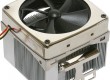
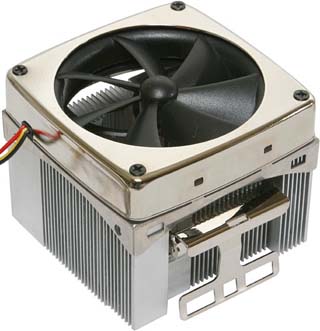
The fan is rather unique in design and functionality. The fan is not driven from a motor in the center like most other fans, but pushed from the tips. The impeller blades are surrounded by a ring studded with 12 magnets, which are acted upon by four coils located at the corners of the fan’s frame. The fan assembly looks much like a wagon wheel, with the sturdy fins as its “spokes”. The smaller fan hub reduces the “wind shadow” in the middle of the fan. A traditional fan’s motor hub uses 75% more space in the center, and therefore air circulation is reduced by 30%. This design also increases the torque, as I discovered when trying to stop the fan with my finger. This point cannot be understated: it will happily bruise your finger with no effort at all.
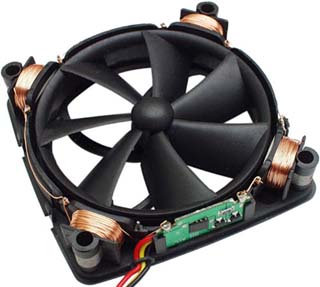
TMD Detail
The fan spins at 5600 RPM outputting 38dBA and 35.5 CFM. Based on specs, it appears that most 80mm fans output more CFM with much less noise. Although the specs indicate this fan to be very loud, I found it to be MUCH quieter than the 37dBA Dragon Orb 3. It uses a very unpopular 70mm form factor, so it’s not very interchangeable with another heatsink.
Installation
In case you’ve never installed a heatsink before, Vantec has included a small fold-out manual. Details for both the Pentium 4 and Athlon models are enclosed. Place a small drop of thermal grease on the processor core. Hook the 3-pronged clip under the socket A hooks, and then push the heatsink flat. Now secure a flathead screwdriver in a notch on the hinged side of the clip, and force down until the clip attaches to the socket. The heatsink felt secure, and I didn’t feel like I was about to break the processor. The Pentium 4 cooler is installed differently, by placing the cooler on the processor, and then simply pushing the 4 clips in place.
Testing Method
I used a Radio Shack IR thermometer along with Motherboard Monitor to validate the core temperatures. The IR thermometer monitors surface temperatures very accurately, and provides a good validation against the motherboard’s temperature sensors. The processor was left idle for 5 minutes before taking the idle reading. An Athlon 2000+ was used for the Athlon model, and a Pentium 4 1.5Ghz for the Pentium 4 model.
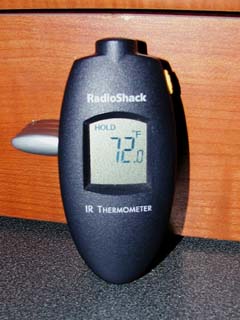 IR Thermometer
| Cooler | Case Temp | CPU Temp |
| Thermalright SK6 | 82o | 102o |
| Vantec Aeroflow (Athlon model) | 82o | 98o |
| ThermalTake Dragon Orb 3 | 82o | 112o |
| Stock Pentium 4 | 80o | 116o |
| Vantec Aeroflow (P4 model) | 80o | 103o |
Conclusion
I was very surprised at the performance of this seemingly lightweight cooler. I have always been skeptical of Al/Cu hybrids ever since my experience with the horribly disappointing Dragon Orb 3. The Vantec performed on par with some copper heatsinks without the weight. This is an excellent product, as it is machined and lapped very well. It is very sturdy, yet very light. A newer copper heatsink may perform better, but at the cost of added weight. Overclocking freaks should probably look for a pure copper cooler. Everyone else should grab the Vantec and feel proud to have it.
Pros
- Extra thermal compound
- Sturdy 3-pronged mounting clip
- Fantastic looks
- Manual included
- Extremely efficient fan
- Very powerful for its weight
Cons
- Some copper coolers can be had for same price ($30)
- No fan grill (almost took my index finger off!)
I would like the thank Vantec for sending us these heatsinks for review!