
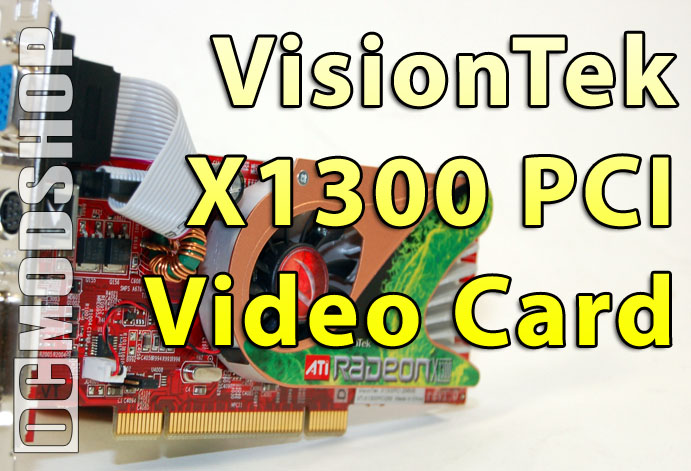
In addition to a change in this card’s architecture, the chip also deviates from its original clock speed. The average Radeon X1300 board comes with both clock and memory cores clocked at 400MHz, but they are boosted significatnly on this PCI version. The core is clocked at 450MHz and the 256MB of DDR2 memory is clocked at 533MHz. This is a rather amazing feat considering that the card gets all power from the PCI bus (3.3 volts).
The board’s VGA port is attached using a ribbon cable, so it can be easily removed for use in half-height cases. The card’s single-slot active heatsink is made of aluminum and is typical of other X1300 boards, covering the chip. The VIVO port (S-video) is sandwiched between the VGA and dual-link DVI port.
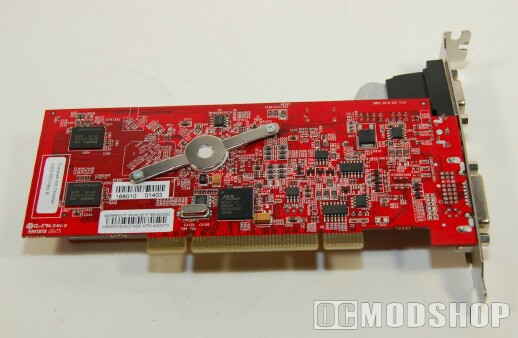
There are four memory modules on the back of the card, as well as the PCI to PCI-Express bridge chip. This bridge chip was manufactured by PLX technology (part number PEZ8111), and is equipped with a single PCI-Express lane, making this card a PCIe 1x equivilant device. The maximum peak bandwidth for the entire PCI bus is 133MB a second, which is well within PCIe’s 1x limitations. This chip does not get very hot, so no heatsinks are required for this seperate chip. There are four DDR2 modules from Hynix, rated at 533MHz.

Test Bed
- Intel E6600 Core2 Duo
- 2048MB Crucial DDR2 PC2-5400
- Asus P5W Deluxe Motherboard
- Western Digital 300GB HDD (SATA2)
- Gigabyte Radeon X1300 Pro (256MB) PCIe
- VisionTek Radeon X1300 (256MB) PCI
- Windows Vista Ultimate
 |
 |
 |
||||||||||||||||||||||||||||||||||||
|
3dMark 06
F.E.A.R.
Quake 4 (Low) No FSAA
Unreal Tournament 2004
|
|
||||||||||||||||||||||||||||||||||||
 |
|
 |
The tests show that the card is less than half as slow as the native PCI-Express version of the X1300 in every gaming benchmark. Even though the margin between these two boards was great, the VisionTek still managed playable framerates at 1024×768 resolution. To our surprise, even F.E.A.R. was quite playable with this card, with an average 40 fps at 1024 resolution (although it did get choppy during some intense moments). The regular X1300 managed nearly double the framerate, and experienced no slowdowns.
In the Home Theater setting, the X1300 PCI could not playback High Definition video without frame skips, and wouldn’t play at all in Media Center (I would get a generic “an error has occurred” message). I also had problems playing DVDs, and tracked down that the culprit was that the S-video port was enabled, which alerted Vista’s copy protection. Disabling the S-video output allowed for good DVD playback.
On average, the cheap ($60) X1300 PCIe card delivered over 100% more performance at half the price.