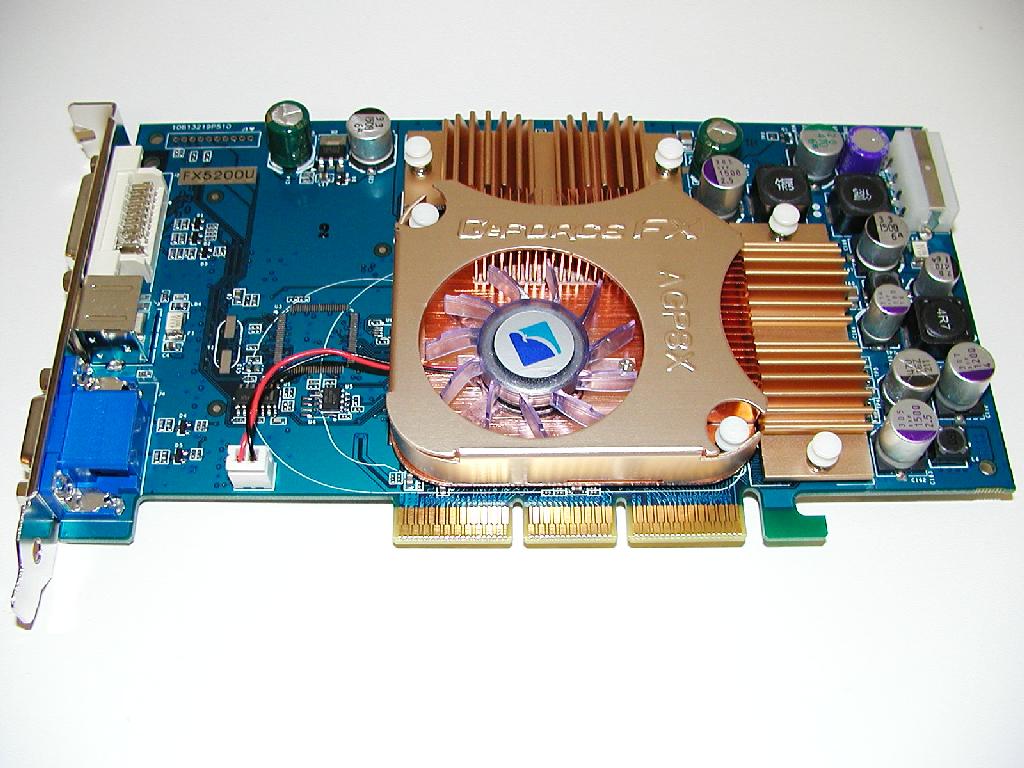
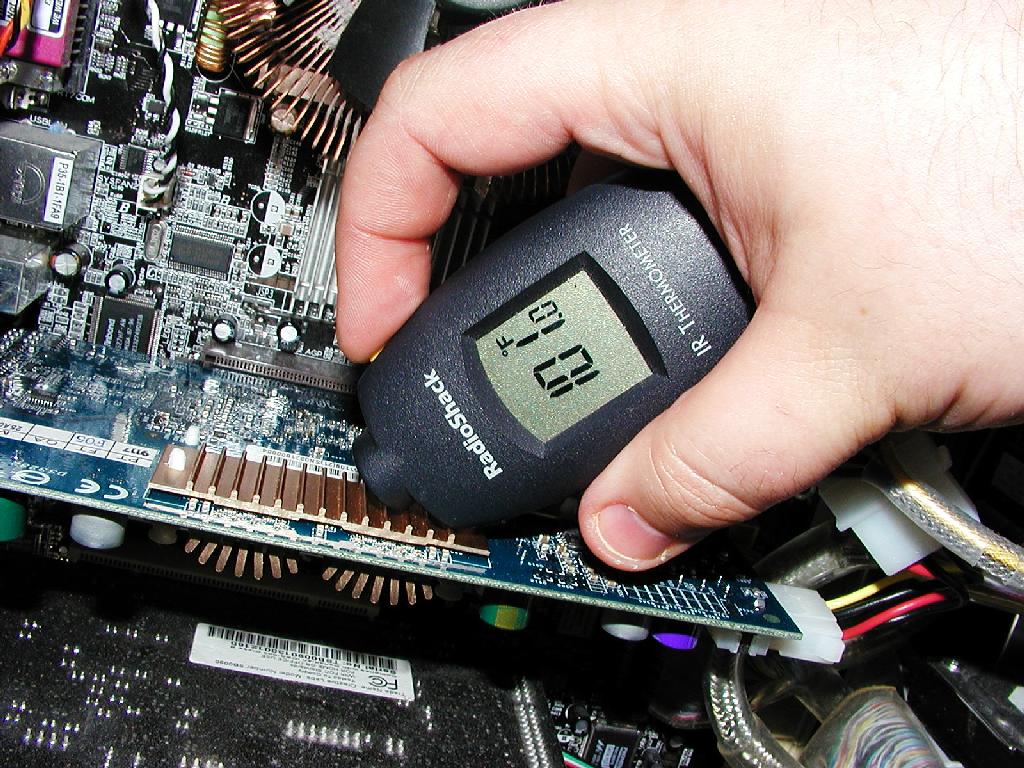
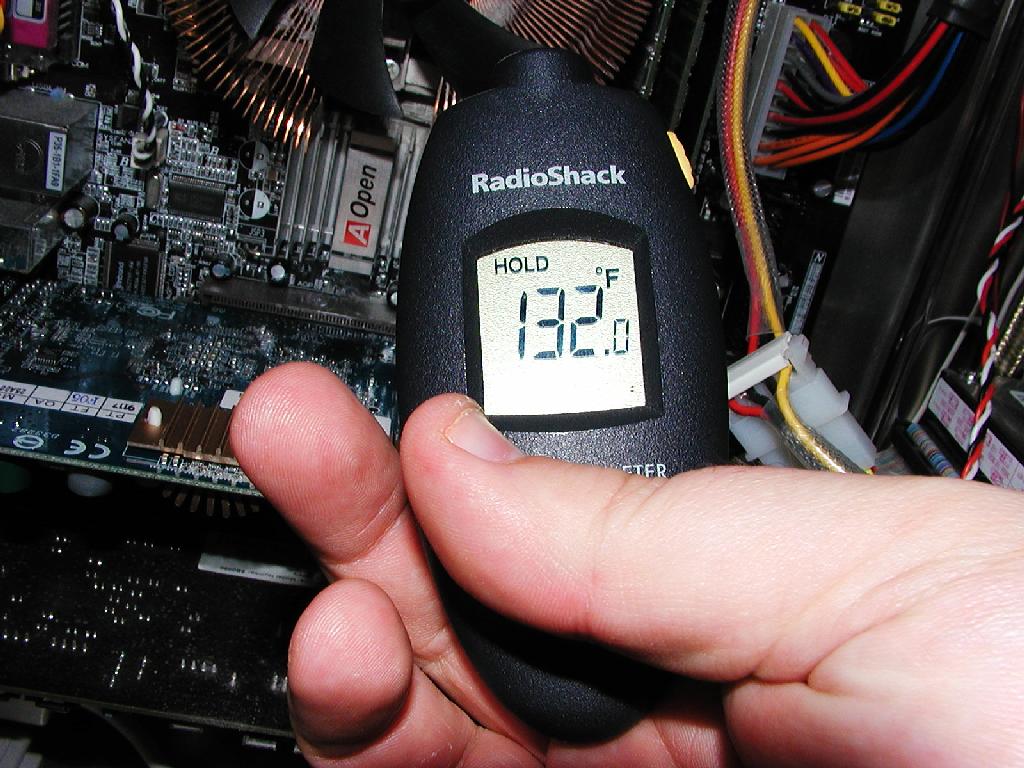
Since the FX5200 uses an older fabricating process, it is bound to generate more heat, even though it has fewer transistors than its siblings. To test, we used the trusty Radio Shack IR thermometer, capable of reading surface temperatures within 1% accuracy. Before taking a temperature reading, the card was run at full capacity for 5 minutes. The temperature was taken on the back of the card, right behind the chip core, and the memory heatsinks were also monitored. The average high temperature for the ram was 101°, and the core reached an average 132°. This core temperature is actually well within operating limits, and did not fluctuate greatly under a full load. When idle, the chip dropped to a much lower 105°.
Test Setup
The board was tested on the hardware listed below. There was no significant difference running the card at 4X AGP or 8XAGP. Each version of 3dMark was run 3 times and the averages taken from them.
- Pentium 4 2.53GHz
- AOpen AX4PE Max motherboard
- 1GB DDR 333 SDRAM
- Soundblaster Audigy
- 2x120GB Western Digital 1200JB Special Edition HDD
- Chenming Aluminum case
- Liteon 16X DVD-ROM
- Verbatim 2.4X DVD+R recorder
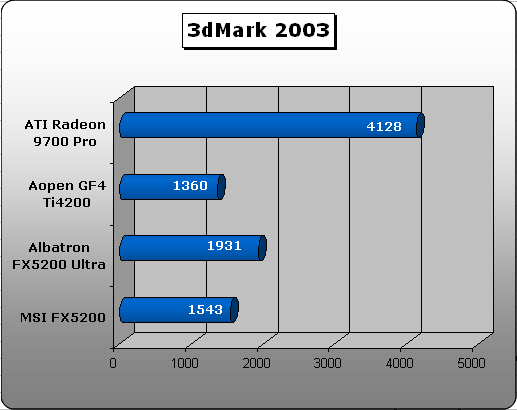
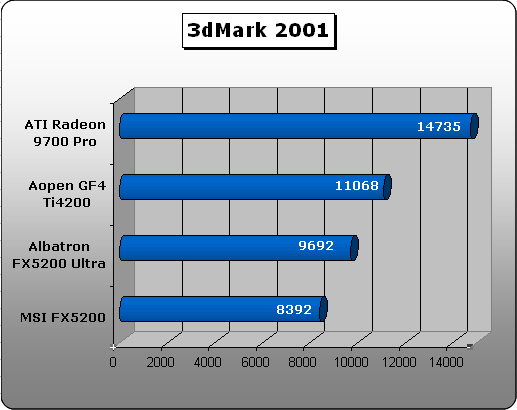
Everyone today still uses 3DMark2001SE to compare the raw performance of their comptuer setups, as it uses software technology still in use in most games today. Much debate surrounds 3dMark 2003, as many argue that the benchmark does not represent real-world use and not very accurate. At best, 3DMark03 is only useful to compare the DirectX 9 capabilities of today’s hardware, which will be utilized in the games coming out the holiday season. We compared the Albatron FX5200 Ultra against a competing product, the MSI FX5200, a GeForce4 Ti4200, and the popular ATI Radeon 9700 Pro. This is a good sampling of the cards available on the market today, and demonstrates the performance differences between a budget card and an expensive behemoth.
The 3DMark2001SE results are pretty much expected: This FX5200 Ultra card performs better than other budget cards of the FX line, but is easily ousted by more powerful cards over a year old! The GeForce 4 and ATI Radeon cards are just more powerful in DirectX 8 games. Benchmarks are fine and good, but no one will really be able to tell the difference if the two were playing side by side. Even the budget FX cards will play today’s games smoothly, which is saying quite a bit considering a GeForce 3 will choke on UT 2003!
The 3DMark03 results are not as straightforward, and require a little explanation. The same GeForce 4 that trumped the Albatron is now the slowest in the bunch. The GeForce4 just does not have any hardware support for DirectX 9. The FX5200 cards did a little better, but watching the benchmark run is not much better than a slideshow; they technically perform better, but no one would have a good gaming experience at these framerates. A card that can achieve around 4000 3dMarks or better should be able to play a complex DX9 game at around 30 fps, and currently the only cards that will do that cost around $500. You better start counting your pennies, boys and girls; or at least be real good for Santa this year. Half Life 2 and Doom 3 are coming…