
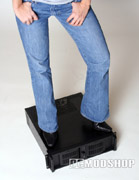
 Once the case is unwrapped we can see more of its quality. The case itself is thick 1.2mm SECC steel, which can easily handle a 120 pound woman with no sign of strain or buckling. The front bezel, pull handles and folding bay doors are made of thick aluminum that has been anodized black. The side of the case is clean with mounting holes for optional mounting rails. The case is slightly longer than a normal desktop or mini-tower case. The back of the case looks like any normal desktop case, with full-height slot guards, power supply, and I/O shield. 2U or smaller cases either require half-height cards, or an angle bracket which turns a PCI or AGP card 90 degrees to fit in the case (which then limits expansion to 1 or 2 cards).
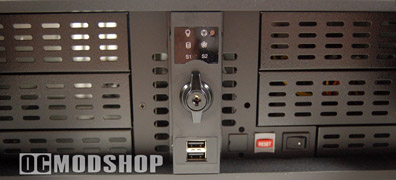
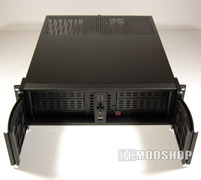
The aluminum bezel is very attractive and hosts two lockable doors. The center of the bezel houses most of the status information, as status LEDs are mounted behind a glossy black panel. A keyhole is also located here, which locks both front doors at the same time. When the keyhole is unlocked, the knob mechanism fluidly turns 90 degrees from horizontal (locked) to vertically (unlocked). The aluminum doors are hinged toward the edges of the case (the left door is hinged on the left, and the right door is hinged on the right), and swing open when pulled (you must grip the door underneath a lip opposite the hinge).
The power and reset buttons are located behind the right door. They are placed next to a 3.5” drive bay, making use of the extra space afforded there. The reset button is a bright red plastic push-button, while the power switch is a matte black rocker switch.
The alarm button is located on the center panel between both doors. The alarm functionality only works with the optional Monitoring board, which does not apply to us anyway. There are two fan monitoring lights which only work with the optional monitoring board.

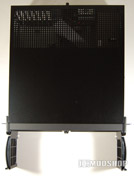
The case is enclosed by a top panel which has ventilation holes stamped in the top. Vent holes placed on the top can naturally expel heat through convection, but are usually not seen on rackmount cases, as these holes are usually blocked when installed in a rack.
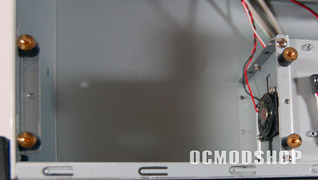
The top panel is secured by two black screws on the sides of the case and a thumbscrew in the back. Once these screws were liberated, the panel slides off easily. There was so much room inside the case that I thought I could hear an echo. There is an aluminum bar connecting the two sides of the case, which is where the optional 80mm case fans can be mounted for additional cooling. Unfortunately these fans must be installed to fan mounts which were not supplied, so we could not use any of the many 80mm case fans we have in our labs.
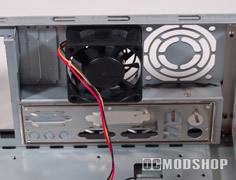
The back of the case has been stamped with holes for two 60mm exhaust fans, but only one is supplied and installed. An additional 60mm case fan can be purchased separately. The fan is a YS-tech fan, rated for 4200 rpm and 25CFM, which may be adequate but somehow the case feels incomplete without the additional fan.
Power supplies are usually not included with server cases, but this case comes with a 300 watt I-Star power supply. Much of the wattage needs of today’s power-hungry workstations comes from powerful graphics cards and overclocked systems. 300 watts should be enough to handle a decent server setup of 1 processor (or dual-core processor), 4 hard drives and an optical drive without strain. Keep in mind though, that power supplies generally run most efficiently when kept under 70% load, so should remain efficient with a maximum of 210 watts. We would recommend a beefier power supply for dual-processor servers.