
Okay, so now we’re going to see some benchmarks comparing this card and its older brother, the 9700 Pro. I used the newest Catalyst drivers from ATi, which was version 4.2. Here are the specs of the system used to test both cards:
- AMD Athlon XP 2400+ (Thoroughbred core)
- EPoX 8K9A2+ motherboard (KT400 chipset)
- 512 MB PC-3200 DDR from Corsair (1 stick)
- Sound Blaster Live! 5.1 Gamer
- 80GB Western Digital Caviar Hard Drive with 8MB cache
For the 9600 I turned on the Overdrive feature that comes with the new drivers, which will overclock the card a slight bit using input from temperature sensors on the card. I figured that this is how most gamers will be using it, so it’s fair to leave it turned on for these benchmarks.
As I said before, the 9600XT has a 500MHz core clock, with a 300MHz (600MHz DDR) memory clock. The 9700 Pro, which is made by FIC, is running at 325MHz core, 310MHz memory clock. The 9600XT has a much higher clock speed, so we’ll see how it compares.
We will be running each of the benchmarks in 1024×768, 1280×1024, and 1600×1200 resolutions. We will also be testing first without anti-aliasing and anisotropic filter, and then with 4x AA and 16x AF enabled. Sorry for the ugly graphs, I am using OpenOffice.org for my office suite, and I haven’t perfected the art of making nice looking graphs yet. They are quite informative, though, so that’s a plus.
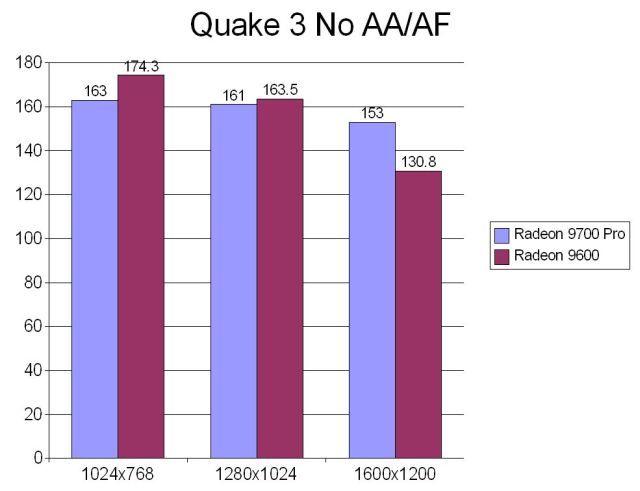
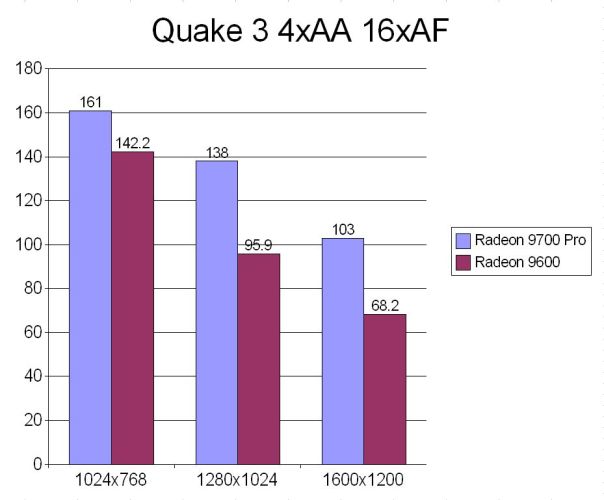
First up on our testbed is Quake 3 Arena. This test is good for testing pure speed, but it’s reaching its useful limit, so don’t be surprised if it gets phased out of testing in the near future.
All tests were run with the graphical settings maxed. You can see that at the lower resolutions the card is comparable to the 9700. However, when we enable antialiasing and anisotropic filtering, or turn up the resolution to 1600×1200 we lose a lot of frames per second compared to the older card.
I believe that the reason for this is the 128-bit memory interface compared to the 256-bit of the 9700. As the card needs to use more memory to transfer larger scenes and to sample more images for antialiasing the lower bandwidth becomes a bottleneck to the rest of the system.
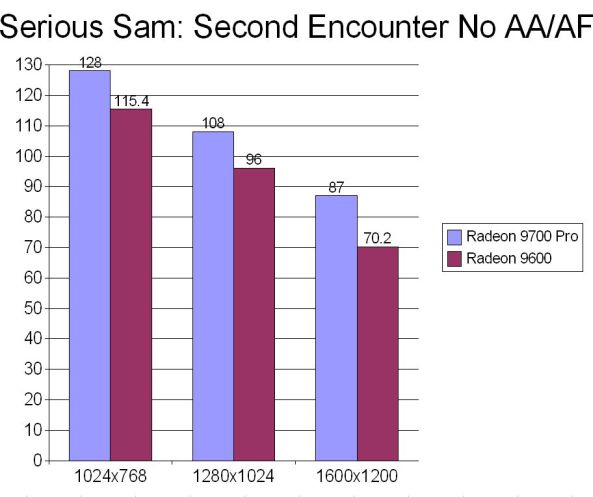
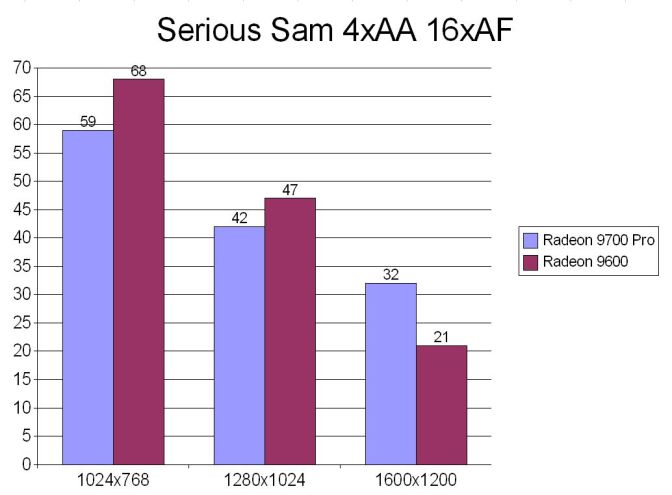
Next up is Serious Sam: The Second Encounter. This game has a nice bevy of options for benchmarking, which is why we use it. I maxed out all the graphical options in the advanced settings tab for these tests. As you can see, the two cards have a pretty normal difference, except when it comes to running at 640×480 with AA and AF on. This leads me to believe that the 9600XT has a better unit for doing the AA or AF than the 9700, but the lead only holds until the memory bandwidth is saturated, and then the 9700 takes the lead again. But these scores are still very respectable, don’t get me wrong. The 9700 still costs quite a bit more, and the 9600 shows very good scores as well.
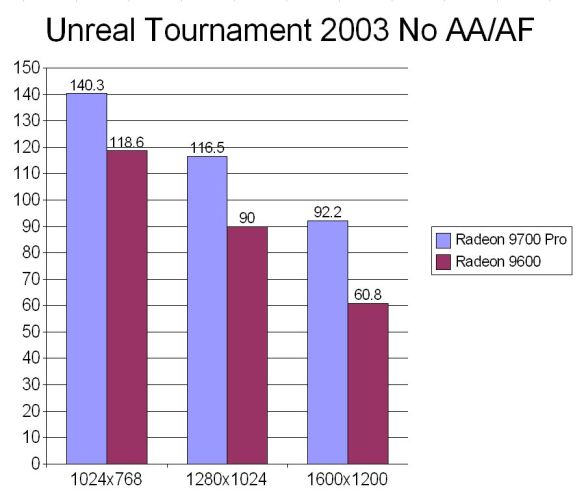
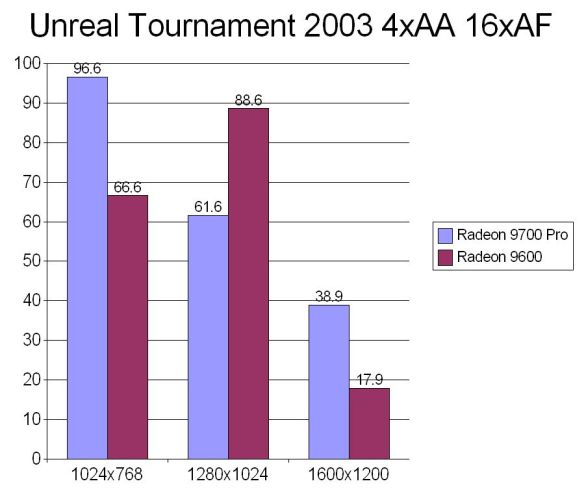
Now we run the test on a more modern game, Unreal Tournament 2003. This game makes nice use of the power of modern graphics cards, with graphics that are most excellent. We used the [H]ardOCP benchmarking program to run this test, which was run at High Quality over 7 maps, with the average scores being placed into the graph. That way we get a nice overall spread of how it should perform in UT2K3 and other games in its class. The 9600 runs great all the way up to 1600×1200 with AA/AF disabled. I’m not sure where the jump that you see at 1280×1024 with AA/AF enabled came from, but I ran the test multiple times and that’s what it gave me. Could be a driver problem or some bug in the testing software or the game itself, I don’t know.

1 comment
[…] things first, today I received a memo from “upstairs” saying that an old OCmodshop favorite, Trish Oliver is back to show us what good content is. Cool! Trish’s writing is immaculate and wonderful, and it’s […]
Comments are closed.