I will be benchmarking with Half-Life 2, FarCry 1.3, Unreal Tournament 2004, 3DMark03, and 3DMark05. The following is a listing of the demos that were used for each game benchmark. Half-Life 2: Hardware OC Coast, Unreal Tournament 2004: dm-rankin, as-convoy, br-colossus (averaged together), FarCry 1.3: BenchemallDefaultDemo. The first set of benchmarks will use no anti aliasing and no anisotropic filtering and the second will use 4x anti aliasing and 8x anisotropic filtering. For the remainder of the review anti aliasing will be referred to as AA and anisotropic filtering will be referred to as AF.
Test Bed:
- Gigabyte K8NS Pro
- AMD Athlon 64 3200+
- Corsair TWINX1024-3200LL
- Vantec Stealth 470w PSU
- Plextor PX-708A
- 60GB Seagate Barracuda IV hard drive
- Windows XP SP2, DirectX 9c, Catalyst 4.12 drivers
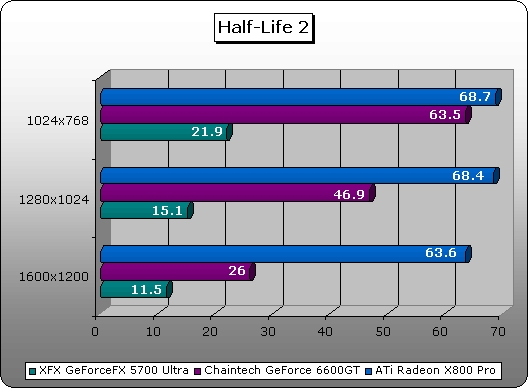
At 1024×768 the X800 Pro and 6600GT are very close in terms of FPS, however as the resolution is increased the X800 Pro pulls away. At 1280×1024 there is a significant difference between the X800 Pro and 6600GT. With the resolution at 1600×1200 the X800 Pro is still running strong at 63.6 FPS. The 6600GT and 5700 Ultra drop to 26 and 11.5 respectively, both would be unplayable by any standard.
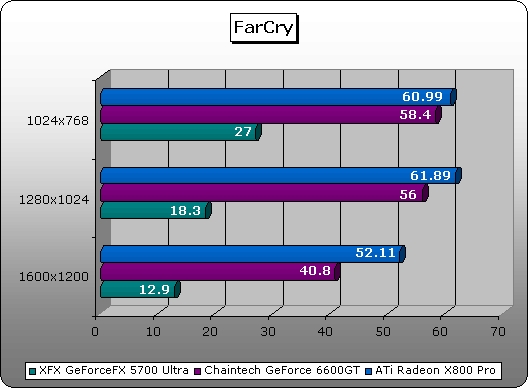
Benchmarking with FarCry produced similar results to that of Half-Life 2, however the differences were not as staggering. For the most part the 6600GT was able to keep up, with the exception of 1600×1200. Again, the 5700 Ultra, proves to be outdated and is far behind both other cards with each resolution.
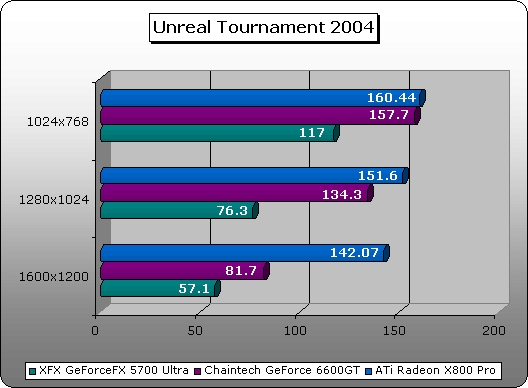
With Unreal Tournament 2004 all of the video cards did very well. The X800 Pro edges out the 6600GT at 1024×768 then dominates at 1280×1024 and 1600×1200. With the frame rate as high as it is, there will be no noticeable difference between them. However the higher the better because you will be able to add some AA and AF into the mix and still have a decent frame rate.
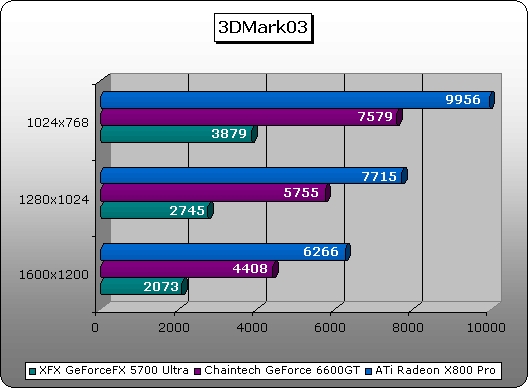
3DMark03 is a synthetic benchmark made by Futuremark as you probably already know. This benchmark runs a series of simulated game tests and gives you a score based on the performance. This X800 Pro was almost able to break 10,000 3DMarks and could easily do that with some tweaking and overclocking. The 5700 and 6600GT do not fare as well and this trend is evident with each resolution.
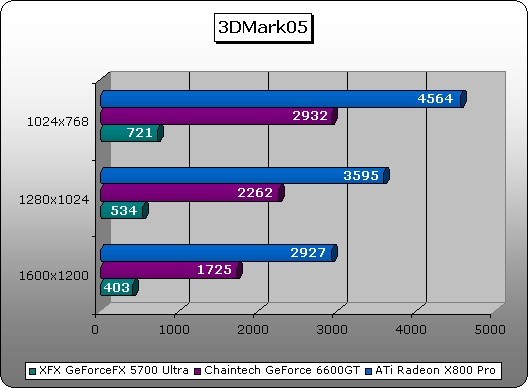
3DMark05 is the successor to 3DMark03 and throws much more at your video card than 3DMark03 does. All of these cards were able to successfully complete the benchmark but the scores are what matters. This X800 Pro worked the other two cards with all three resolutions. Although this is a synthetic benchmark and does not directly relate to how the video card is going to perform in real life gaming it does give a good comparison between cards.