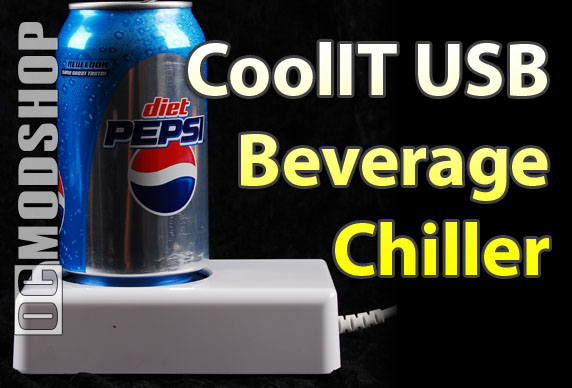
The small fan is actually rather quiet, and you really won’t notice it being on. There isn’t a huge amount of exhaust airflow, and it feels only slightly warm, so there is little risk of this unit overheating. Testing the underside heatsink with an IR thermometer showed us that is was 100 degrees, well within a safe range. The cooling plate reached a low of 48 degrees fahrenheight, which is a good amount of cooling for the modest heat generated.
48 degrees isn’t as cold as a refrigerator, but it is enough to keep your beverage within an acceptable range of quench-ability.
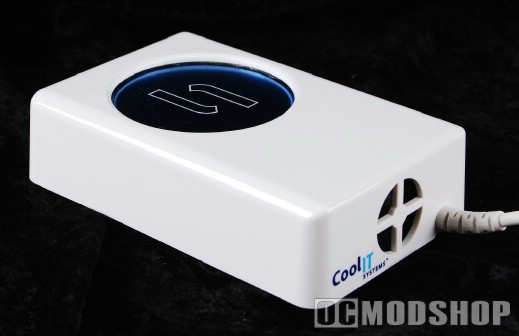
There is no on/off switch, or even a power light.. You just plug it in and go. Peltiers require a decent amount of power, and I’m amazed that someone has gotten one to work with USB’s 5-volt maximum. The unit is rated for 1.2 Amps, far beyond USB’s specification of 0.5 Amps. Because the unit requires so much power, it may not work with underpowered USB hosts, such as a passive USB hub or older laptops. Because there is no power light, the way to tell if the unit is working is to feel if the exhaust fan is spinning. You could also feel if the aluminum plate is cool to the touch, because the cooling effect is almost immediate.
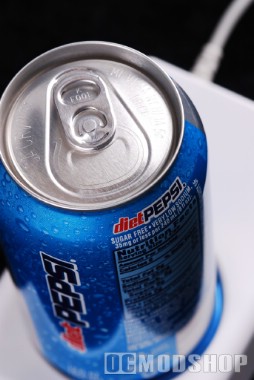

We tested the unit with an IR thermometer on several test beverages, and on the cold plate itself. The testing environment was an average room temperature of 70 degrees. At the start of testing, the refrigerated cans were at 43°F. In each session, one can was allowed to sit on the CoolIT Beverage Chiller, while the other was allowed to sit in the room naturally. The amount of liquid in each session was the same for both test subjects (completely full, half-full or quarter-full).
 |
 |
 |
|||||||||||||||||||||||||||||||||||
|
|
|
|||||||||||||||||||||||||||||||||||
 |
|
 |
The cooling effect of this unit is very minimal when you consider the 3-4 watts being consumed. In contrast, a typical coffee mug warmer provides about 25 watts of heating. Also take into account that most soda cans are concave (a design that allows the minimum amount of aluminum to be used but still stand up to the pressure inside the can), therefore making minimal physical contact with the cold plate. The condensation produced by the unit helps to transfer heat between the can and the Peltier, but not as effective as a flat bottom would be. The unit works best with aluminum cans, as glass bottles do not conduct heat very well.