
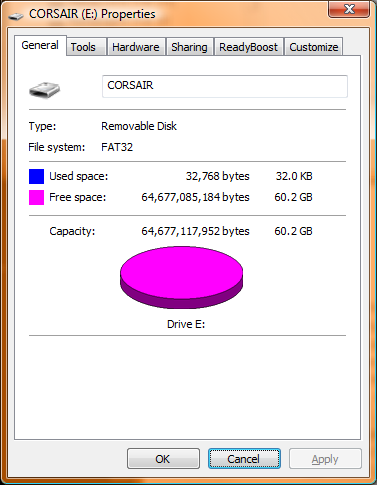
We plugged in the unit to analyze its inner workings. The Voyager has 64,667,085,184 bytes available (or 60.2 GB depending on how you calculate what a Gigabyte is). The unit is formatted in FAT32 by default, which means that you’ll be limited to 4GB file sizes. So if you have a large DVD image then you’ll have to format this in Windows’ NTFS file system, which will make it incompatible with Mac OS and Windows 9x.
Flash drives work differently than other storage media. They perform better with larger file sizes, so to get a feel of its performance in different situations, you need to transfer many file sizes. We use the ATTO benchmark because it benches transfers of varying sizes. From our experience, real-world testing (copying a file to and from the device) mirrors what this benchmark finds.
Your actual performance will vary depending on your computer’s chipset, drivers, processor and several other factors. We compared the Flash Voyager with several other flash drives we’ve tested, to show how they perform against each other. We used OCZ’s ATV 4GB drive, OCZ’s Rally2 Turbo 4GB drive (one of the fastest USB drives we’ve tested), A-Data’s convenient C702 16GB drive, and we threw in an iPod Classic 80GB in to shake things up. The computer we tested on had the following specifications:
- Intel E6600 Core2 Duo Processor
- Foxconn 975X7AB motherboard (Intel 975 chipset)
- nVidia 7800GT PCIe video card
- 4GB A-data Vietesta DDR2-800
- 300GB Seagate SATA HDD
- Windows Vista Ultimate 64-bit
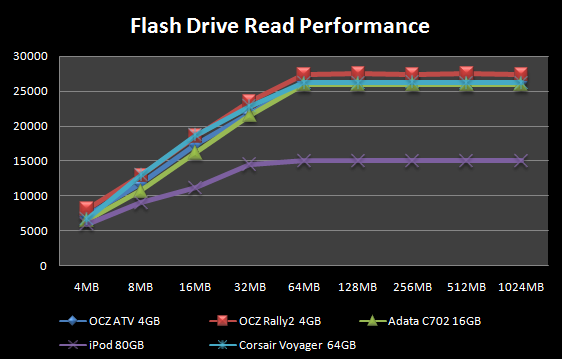
According to our tests, nearly all of the drives had about the same read performance, having the same performance arc and maxing out between 26MB and 28MB per second. The iPod had a top read speed of 15MB per second, which seemed odd for a HDD-based solution.
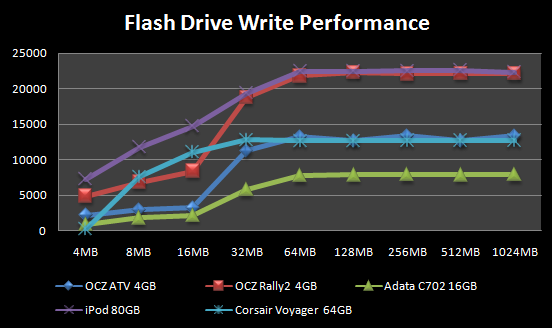
Things changed quickly when comparing the write performance of each drive. Each drive has a different sensitivity to smaller files, but all reach their peak at 64MB file transfers. The iPod and OCZ Rally2 had the fastest write speed of around 23MB per second. The A-Data C702 had a below-average peak of 8MB write speed. The Corsair Voyager and OCZ ATV had almost identical peak performance at 13MB/second peak write speed. The Corsair Voyager handles smaller files better than any other drive, as it nears its peak transfer rate with 16MB files (the others reach their peak with 64MB files).


1 comment
This drive quit on me after completely filling up the drive. Could not even format it. My theory is that there was a bad cell in there somewhere, and writing to it made the entire drive unusable.
It is under warranty, but buyer beware.
Comments are closed.