

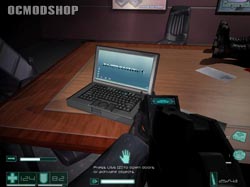
Other issues hamper FEAR’s settings. Each area—warehouse, ghetto, office complex, hi-tech facility—is generic fare for action games. While I never tired of the corporate headquarters, other more sterile environments started to grate. Many objects would repeat countless times. There were numerous identical hammers in different places and I desperately wanted to collect and use them like throwing axes. I still dream sometimes about being able to do that. You can’t even pick up the hammer, or any of the trinkets that are scattered about to make things look lived-in. This lack of interactivity is exacerbated by the “Look at me, I am a button, come and push me and see what I do!” texture that you’ll soon learn to recognize.
 |
 |
| So, avoid the burrito platter, then… | Let’s Roll! |
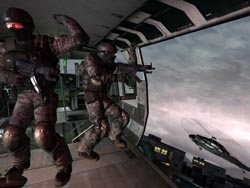
The staleness of the levels is unfortunate considering the general superiority of the game’s graphics. While not the best with interior design, the engine beautifully creates scenes of graphic destruction.
I would compare it to the Doom 3 engine—not in terms of screenshot quality, but in the way that it suits the game perfectly. It is also as cutting edge as they come and will gladly take any resources you give it above the recommended system requirements.
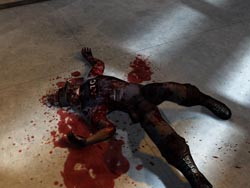
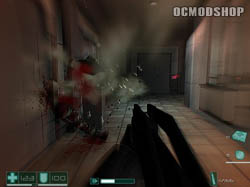
While in Call of Duty 2 you have to lob a smoke grenade to kick up an impenetrable cloud, this happens spontaneously in FEAR as grenades detonate and firearms discharge creating a haze of dust and debris. Spurts of blood splatter on walls and mist into the air. The models for your enemies and allies are detailed with high-resolution textures and good bump mapping.
The characters sometimes look a bit plastic, much closer to Doom 3’s than Half-Life 2’s, but are still excellent looking. Shining on all of this and creating realistic shadows are dynamic lights that add the life-like layer to the world that used to be missing from games. All of this looks even better in slow motion where the effects get to take front stage. When it is activated, everything blurs slightly, and bullet trails become visible. Distortion bubbles in the air caused by explosions are also easier to see and admire. The cumulative effect is that you feel like an action star amid the storm of bullets, fiery explosions, dusty haze and bloodied bodies.
 |
 |
| Product Placement : 5, Immersion : -1 | A man divided against himself cannot stand |
That is what the single player game ultimately comes down to: the quest to live a movie. In this regard, the developer, Monolith, scored a head shot. It took me about twelve hours to reach the game’s satisfying conclusion which was worthy of an actual Japanese horror film.
To get there I passed through 11 “intervals” that each had their own title like the levels in Half-Life 2. Also similar to that game is that you never leave the first-person perspective. This adds to the immersion and cinematic factor of the game as you let yourself become the character in long spans of play. What also helps is a development that I hope will become standard in more games—the presence of a body.
The range of melee moves may have initially necessitated this, but it is one of the best aspects of the game’s presentation. When you look down you can see your own body and to climb ladders you must press the use key, after which your character grabs onto the ladder with his hands. It’s a small, amazing step. There are multiple instances in the game where you stand up or are propelled and you see how your body is reacting and working, instead of having your view just float around disembodied—a key factor in achieving the suspension of disbelief.