

The Logitech Z-5300e speakers are packaged modularly in custom-molded styrofoam inside its box, and each speaker is individually wrapped for freshness. The cords are neatly wound, which become unweildy once the tie is unknotted. The heart of the package is the rather large (by PC standards) bass unit, which also serves as the main hub and amplifier for the unit.
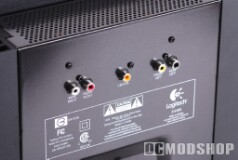
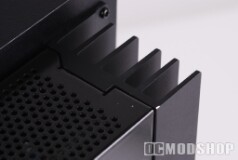
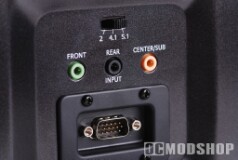
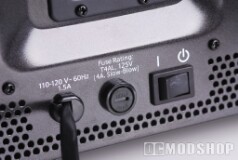
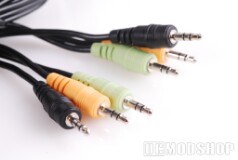
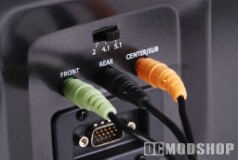
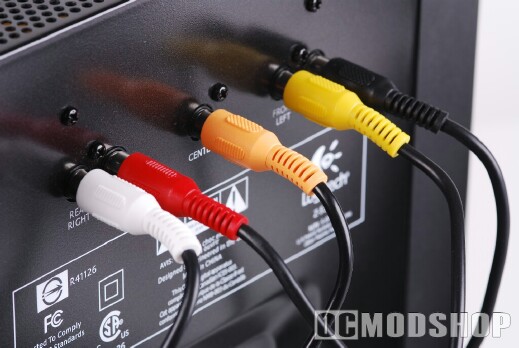
The bass unit comes with a pre-attached AC cord, 3 stereo input plugs, an input mode selector switch, 5 color-coded RCA mono jacks (which route to each external speaker), a 15-pin connector for the wired remove, and a safety fuse. Since the bass acts as an amplifier for all speakers, there is a sizable aluminum heatsink on the rear sides. Inside the bass unit are patented dual-chamber subwooder drivers, which push air through a ported hole in the left side of the cabinet.
The Input Mode switch allows you to use all of your speakers even if you have an older soundcard without 5.1 analog outputs. You could connect these speakers to a stereo console, for example, and adjust the switch so the amplifier knows to distribute the stereo signal to all speakers. The same goes for a soundcard with native 4.1 support (that only have two analog outputs, like the Soundblaster Live).
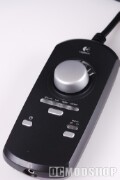
The wired remote is a great improvement over Logitech’s previous speaker generations, in which the remote was incorporated into the center speaker. This design made the center speaker much heavier (and harder to balance on top of an LCD monitor) because of all the extra cables tethering it to the bass unit. Now the wired remote is a seperate unit, which frees up the center speaker for more flexible placement. A 1/8″ headphone jack is also incorporated into the remote.
The wired remote features an On/Off switch, Matrix Mode button, a speaker selection button (with LEDs) and large multi-function plastic knob. The Speaker Selection button toggles through four different options: Volume, Sub, Fader, and Center. The knob adjusts these options depending on which option is indicated by the Selection LED.
| Option | Knob effect | |
 |
Volume | Adjusts overall volume of all speakers |
| Sub | Adjusts the subwoofer volume in relation to the main volume | |
| Fader | Adjusts the rear speaker volume in relation to the front | |
| Center | Adjusts the center volume in relation to the overall volume. |
The Matrix mode button is similar to the “Dolby Pro Logic” button on home theater amplifiers. It takes a stereo source and intelligently maps it to all speakers. It creates a more dynamic surround field, and works best with stereo sources, like MP3s or videos. You’ll want to turn this feature off when playing DirectSound games or watching movies with Dolby Digital or DTS.
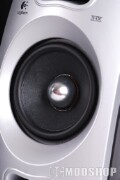
Each of the five satellites are made from hard plastic, and use a solitary 2.5″ aluminum phase plug driver. Although the driver is a single unit, it is actually a midrange driver and tweeter in one, complete with internal crossover. The tweeter is the small aluminum plug in the center (if you look very closely you can see miniature holes for sound to escape), and can deliver some rather crisp highs. The speaker is dual-ported to allow the midrange driver to push a little more air and sound a little deeper than it normally would.


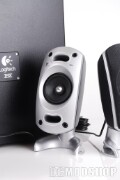
Each satellite speaker can deliver 35 watts of RMS, and the center speaker can deliver 39 watts (since you can drive the center louder in relation to the others). This may not sound like a lot individually, but the total power is equal to twice the RMS power, so each channel can output 78 watts, which is actually very loud for such a small speaker.


1 comment
Been used them for around 2 years sound is realy awesome The hardwired cables are just too short to be routed properly in an average room.
Comments are closed.