
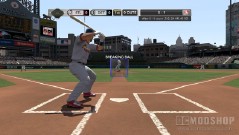
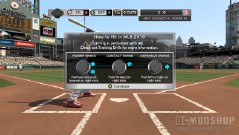
Critics have noted how previous MLB games struggle with hitting. Is that one of the things you concentrated on this year?
It’s almost an understatement to call that a primary focus. We knew that the core gameplay experience needed improvement across the board but in hitting and pitching. We created an entirely new experience.
Sean: What steps have been taken to help out pitchers?
We really just wanted to capture a realistic experience rather than trying to “improve” last year. We talked toa lot of pitchers and tried to make pitching as realistic as possible. There are different swing types and the ability to see what pitch is coming. If you press “X” after a pitch, then you bring up the analyzer that shows all sorts of stats. We’re not helping out pitchers so much as helping out the gamer who’s controlling the pitcher.
Jonathan: Pitching was simplified between 2k8 and 2k9. Is it even more simplified in 2k10?
We wanted to build on the simplified version of 2k9. You’ll never run into a situation where you’re trying to throw a slider and accidentally throw a curve ball. Now we can do a lot more with your stick gestures. If you over-rotate or under-rotate your curveball then it will affect that pitch.
What determines if the “batter’s eye” feature appears?
The problem we were trying to solve was that we’re trying to make certain players that were good inreal life about reaching base but didn’t have that skillset in the video game. The batter’s eye-rating drives the frequency of the Batter’s Eye. Guys that take a lot of walks have a higher Eye rating will see the Batter’s Eye more often.
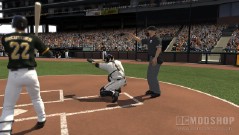
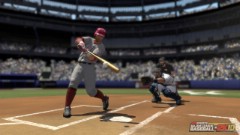
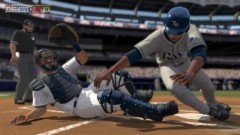
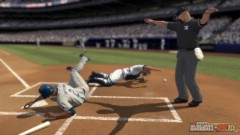
Sometimes the fielders just stand there when they should be making an effort. Has the fielding AIimproved?
Absolutely. All parts of the AI have been rewritten. We wanted all players to moveintelligently… so they react but they’re not running into each other. If one guys is going to trigger an animation we make sure that another guy doesn’t get in the way.
What are the considerations that went into the fielding changes? What is the learning curve like?
The biggest learning curve is the ability to pre-load a throw. Unlike previous years, you can start pressing the throw button before your fielder has gathered the ball, and that will trigger quicker animations. The biggest issue for veteran players is learning how to play the game differently, but I think it’s a lot more fun.
Why did you add the “My Pro” features in this year’s game?
It really seems like across the board that career modes are becoming a popular thing. We wanted to add this mode last year but didn’t have time. MBA also hade a “My Player” mode, and we felt like there was a hole we had to fill.
What makes it different from other “rookie to legend” career modes?
One of the big things is to really give you a bigger gauge of your progress. We wanted you to know where you’re at in terms of being called up to the Majors. We actually ahve a meter that shows how close you are, and there are certain set of goals to achive in order to get called up. Once you are called up to the Majors, you have a list of various goals in order to qualify for the “Hall of Fame”.
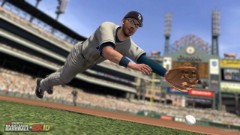
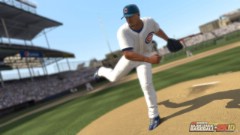
How to player ratings improve over time?
The focus is more on the in-game performance, so you’re definitely focused on what your player is diong in the game rather than advertising deals and contracts. We have a set of goals that help determine when you’re able to jump from the Minors to the Majors. You get batting, fielding, and base-running skill points, but it’s up to the player to choose which attributes to put in. If you want to make your players “Eye Rating” so you can see what type of pitches are coming, you can do that. If you throw all of your Batting points into your power rating to be a power hittter. If you want to be a speed demon, then you can assign points to that. It’s really up to the gamer as to how to mold what type of player you have.
Can you give an estimate on how long it takes to advance up to the Majors?
That can really vary. There’s so much flexibility in terms of how you want to play the game. You just play the game that your player is directly involved in. You can get through a game a lot quicker than you can in a basketball game, for example (about 5-10 minutes). You can also simulate games entirely to add to your player’s attributes, but it will take a bit longer. So the short answer is about 15-20 games, and how quickly you can get through them.