Test Bed
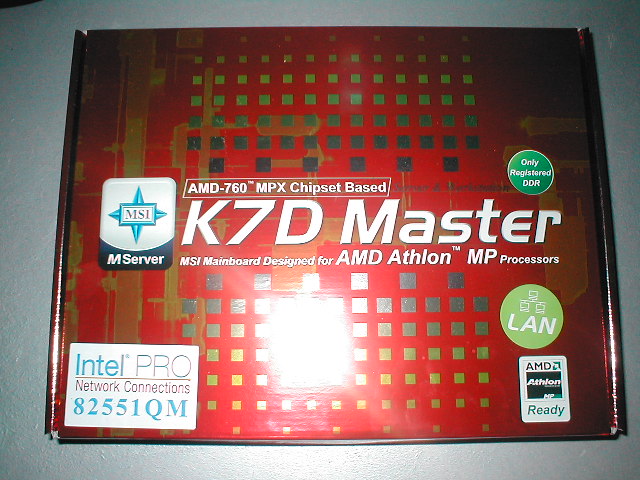
- MSI K7D Master-L
- 470w Vantec Stealth PSU
- Adaptec 19160
- 2 IBM Ultra160 07N6266 18GB, Ultra160 Wide LVD SCSI-3, 10,000 RPM (data)
- 30GB Western Digital 7200RPM ATA100 hard drive (boot)
- 52x Liteon CDROM
- Xelo Rage128 video card
- Blue Meany case
- 1GB registered ECC PC2100 from Corsair
- 2 Athlon MP 1.2GHz
- 2 Golden Gate heatsinks
Just a note on benchmarking I did them while the server had been up for 34 days. I did not want to reboot the server because it takes a while and didn’t want any downtime.
This is the first time I have benchmarked a server so I will be using different benchmarks because of that. Instead of usual game and multimedia benchmarks like 3DMark2001SE, Quake 3, and others I will be using more intensive benchmarks that will stress the CPUs and memory rather than video and other things. For benchmarking I used SiSoft Sandra 2003 Professional, Cinebench, and Science Mark.
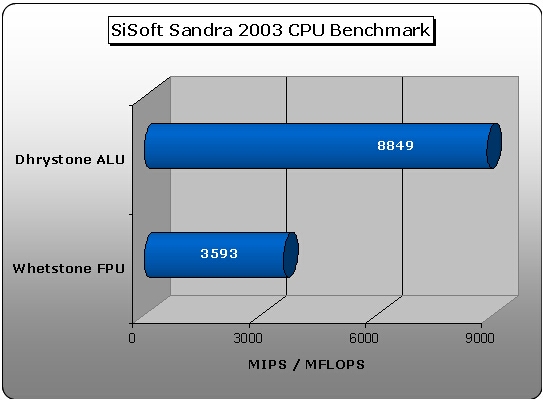
SiSoft Sandra 2003 professional is the newest version to the very popular benchmarking tool. This program has a lot of different informational modules and benchmarking tools. The CPU benchmark will output the MIPS and MFLOPS of the CPU or CPUs. Along with outputting the results it will show your results in comparison to other setups. With the 2 1.2GHz Thunderbirds in this motherboard this benchmark shows the ALU at 8849 and the FPU at 3593 which is a great score.
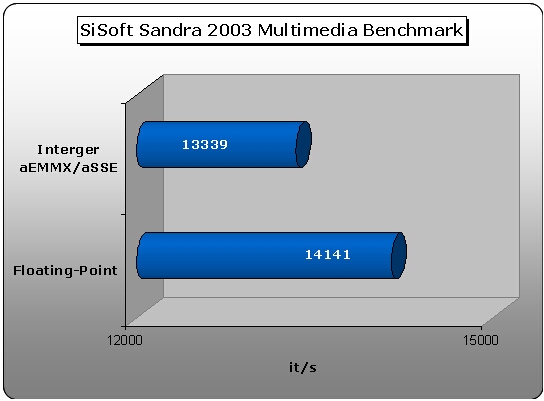
SiSoft Sandra 2003 professional has another benchmark module for a multimedia test. This benchmark will output the Interger aEMMX/aSSE and Floating-Point results from your system. The results from this setup was 13339 and 14141 both of which are really very high.
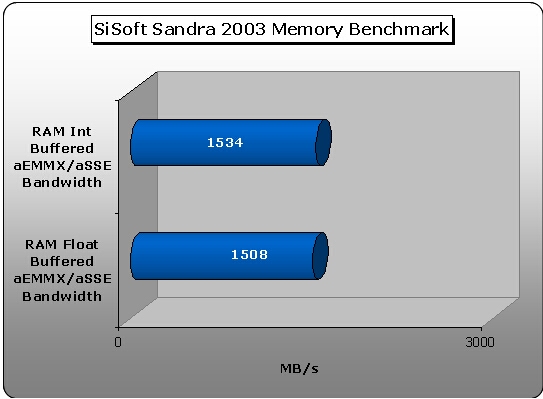
The last SiSoft benchmark I did was for the memory bandwidth. Memory bandwidth for a server is very important especially while under high load or while running powerful applications. This motherboard had 1GB of registered PC2100 which was provided by Corsair the Int Buffered score was 1534 and the Float Buffered score was 1508 both of which are really high.
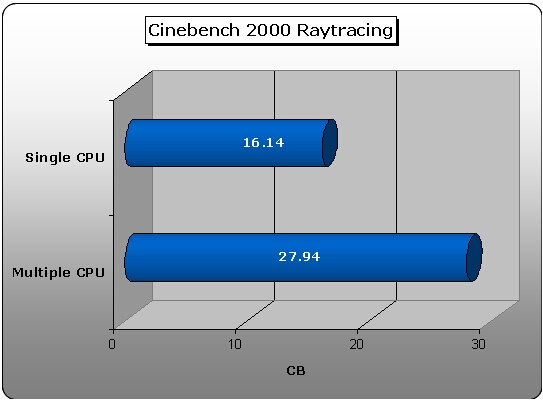
After running SiSoft Sandra 2003 Professional I ran Cinebench 2000 which is a CAD benchmarking program. The benchmark runs a few different tests but I was only concered with the single CPU and multiple CPU tests. As you can see the 2 CPUs are much better and perform 1.73 times faster than 1 CPU. This is just a good example of how a dual CPU system can help with multithreaded software.
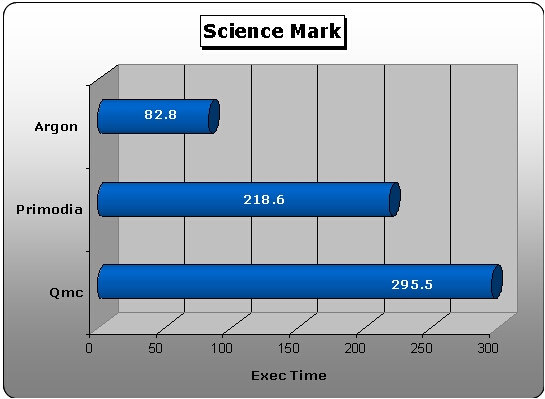
The last benchmark I ran was Science Mark which is a program that calculates very complicated scientific problems. It is a really good test to show how powerful your system is because the tests are so CPU intensive. This system did really well on all of the tests and if you would like to download the program to test your system against this server you can find it here.