
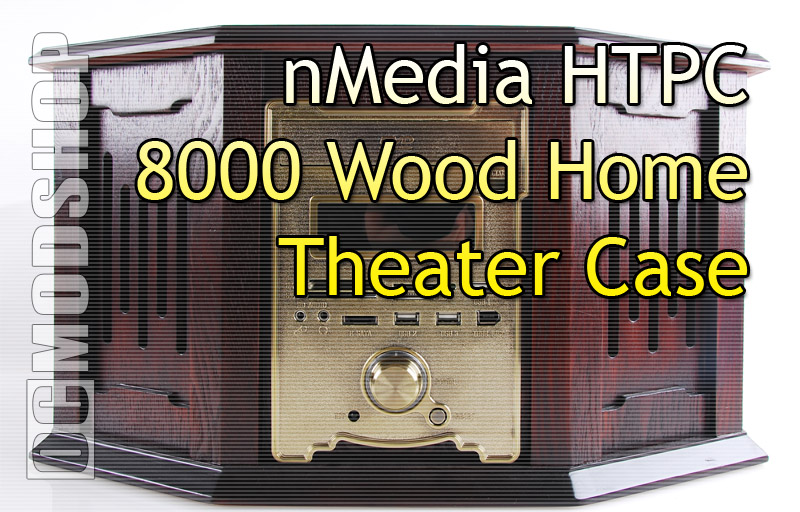
One advantage to a case like this is that it doesn’t look like a typical PC… or home theater amplifier that many other cases try to emulate. Many people who have a serious home theater setup just can’t have a PC obviously sitting in the living room… a fact called the SAF (Spousal Acceptance Factor). Since the HTPC 8000 looks like a 60s-era radio then the SAF may come down to an acceptable level. It does have a retro look, so your spouse may either love or hate the design.
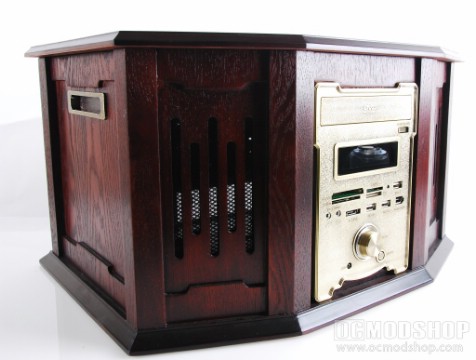
From the outside, the case looks absolutely beautiful. The wood has been stained red and although I cannot make out the specific wood type, it is definitely not pine, which would have a lot of unsightly knot-holes in the grain. The wood is not a square box, as the front is angled to have three faces. The center face has a metallic-plastic gold-tinted front panel, which we’ll explore later. Flanking the center panel on both sides are vents which look a lot like speaker grates, but in fact are merely air intake holes.
The top and bottom of the case are beveled, and there are nice but simple decorative elements all over. The sides of the case have gold handles inserted into the side, so you can easily pick this baby up. Even though it looks rather bulky and is made from wood, it is surprisingly light.
The case is large enough to accommodate most PC hardware, but is bulkier than most other HTPC cases. It can fit on a narrow shelf due to its short 14.4” depth, but its 20” width and 11” height doesn’t make it rack-friendly. Honestly, though you probably won’t want to mix this case in with other hardware, as their looks would most definitely clash.
The front panel is distressed and made to look like an old-time radio, but has obviously modern components like a stealthed DVD drive cover , LCD display and standard HTPC ports. The DVD plate is spring-loaded at the hinge, rather than using a straight spring which I’ve seen cheaper cases employ.
Below this is a 20-character, 2-line LCD display which uses the same iMon system that comes with just about every home theater case sold today. The display will automatically show media pertinent to the task at hand, such as MP3 title, movie chapter, time remaining and other information. When out of a media application the iMon software will display PC stats.
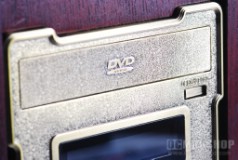
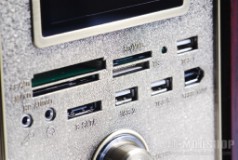
Below the small display are standard 9-in-1 media card slots. Also in this area are three USB ports, microphone and audio jacks (although I’d like to see ¼” ports used today), an eSATA hack and firewire port.
Below the I/O area is a plastic power and reset button. The power button looks like a large volume knob, but in fact does not turn at all. The natural instinct is to try and turn this knob, and since it is plastic it feels like it could snap with enough torque.
A blue “ring of light” appears around the knob when the PC is on, which looks a bit out of place for a PC trying to look retro. A red or green color would be better in my opinion. The reset button is recessed, but honestly I would think that the large power button is more prone to accidental resets, especially if you have toddlers that would be enticed by the large gold button. To the left of the power knob/button is a hard drive activity light. Personally, I leave the HD light disconnected in my home theater installations, because a blinking light is distracting when you’re watching TV.
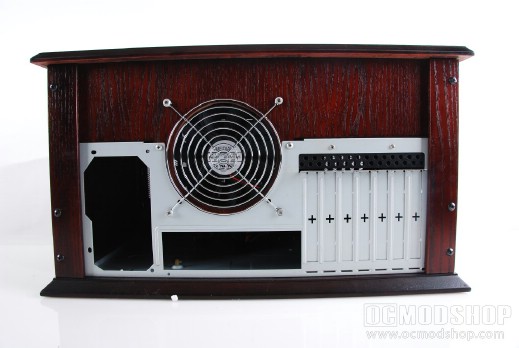
The back of the case is the first clue that this case is not entirely made from our organic friends. The bottom half of the case has standard steel PC components screwed into the wood. There is room for a standard power supply, motherboard I/O panel, and seven card slots. Above the motherboard I/O rectangle is a very large, but low-speed .20A 140mm exhaust fan, with circular fan guard installed. The sticker on the fan states that this fan is made in China by the Don Guan Hengli Hongsheng Electronics Factory.


