
The sleeve and ball bearings currently predominating the fan market exhibit major drawbacks. While conventional sleeve bearings initially have very low noise emissions, they mostly possess unsatisfying long-term stability, which leads to a short overall lifespan and increasing noise after longer operating times.
High grade ball bearings, on the other hand, while providing satisfying long-term stability, operate at slightly higher noise levels from the beginning. The SSO bearing not only surpasses the quietness of conventional sleeve bearings but also the long-term stability of current top-of-the-line ball bearings.
Noctua sent two of their fans a 120mm the NF-S12-1200 and a 80mm the NF-R8. Here are their specs:
 |
 |
 |
||||||||||||||||||||||||||||||||||||||||||||||||||||
|
|
|
||||||||||||||||||||||||||||||||||||||||||||||||||||
 |
|
 |
||||||||||||||||||||||||||||||||||||||||||||||||||||
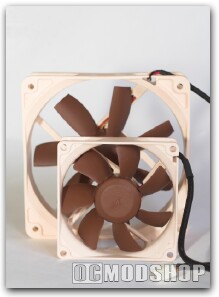
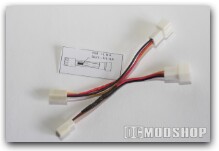
So fans do what they’re made for and move air. I haven’t encountered a lot of silent fans that can move some air but these babies can!. Even though I didn’t use the Ultra Low Noise Adaptor (which is nothing more than a little adapter with a resistor), the fan isn’t noticeable in a normal desktop case, I can’t hear them in my case: as the hard drives make more noise than this fan. The 80mm fan he has 2 of those adapters a L.N.A and U.L.N.A (basically the same stuff but with 2 different resistors in the main line).
Now as with all 80mm fans this one is audible without the use of any of the LNA’s provided but on the other side it does move a lot of air, but just adding one of the resistors is enough to make the fan fade away to the noise of the hard drives.


1 comment
I would like to what is the metered resistance of the LNA & ULNA adapters in ohms. It's simple to do, your ohm meter to resistance and just meter the red wire on each adapter and please let me know.
Comments are closed.