
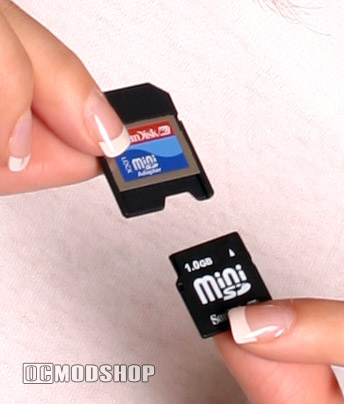
We tried this card in several portable devices, from a Nikon D50 digital camera, a HP 5700 iPAQ Pocket PC, a Toshiba e300 Pocket PC, and 2 different media card readers. There were no compatibility issues with any of these devices. There was no image or file corruption when reading files written from another device.
If you’re buying this card, then it’s probably because you have a media-enabled phone. I found this miniSD solution when browsing for a standard SD card for my digital camera. So far I have no problems with compatibility and will be ready for any new miniSD devices. If the price is the same, go ahead and get a SanDisk miniSD with adapter and be future ready for new miniSD devices. This card is intended to fit the growing mobile phone niche while maintaining compatibility with “legacy” SD devices.

Speed testing
We tested our read and write benchmarks using an internal USB 2.0 card reader. The card reader has more bandwidth than the cards could ever provide, so we were certain the memory was being tested fairly, and not choked for bandwidth. We rebooted between each read and write test to ensure that the information was not cached in system memory. Below are the specifications of our test platform:
- Athlon 64 X2 3800+
- Asus nForce4 motherboard
- 1GB dual-channel OCZ Gold PC4200
- 6-in-1 USB 2.0 floppy/multimedia card reader (internal)
- Windows XP Professional SP2
- HD Tach 2.61
 HD Tach ran great on the SanDisk 1GB module, but would not even run on the older PNY card. Random Access Time 1.1ms, Read Burst Speed of 6.3mbps and a flat speed of 5.8MB per second transfer rate. The benchmark refused to complete with the PNY card, hanging for a minute or two and finally give a “Read/Write Error” with the PNY card. .
We tried to test with SiSoft Sandra, but could not get the File System benchmark to complete with either card. We had to go back to simple testing methods and time the data transfer between our test system and the media card using Explorer and a stopwatch. Media cards do not like to transfer lots of little files and are very slow. Flash media works best with large files, as we discovered as we tried to run our test with Pocket PC data (which consists of thousands of tiny files). Flash memory cards are designed to transfer large files, and work best with large digital photos and MP3s.
 |
 |
 |
|
SD Media Card 79MB transfer (in seconds) |
|
 |
|
 |
Conclusion
The SanDisk 1GB miniSD performs very well, especially against older memory cards. I’m not sure if our PNY card is problematic, or if flash memory has made improvements within the past year, but the results speak for themselves. SD write speed has never been great, but the new SanDisk miniSD outperforms our standard SD multimedia card. This card has been tested in various devices, from professional D-SLR cameras to Pocket PCs and have had no compatibility issues. Performance is more than adequate for the demands of today’s high-megapixel cameras, but a professional photographer would benefit from a faster card.
|
|
|
|||||||||||||||||||||||||||
|
|
|
|||||||||||||||||||||||||||
|
|
|
|||||||||||||||||||||||||||