
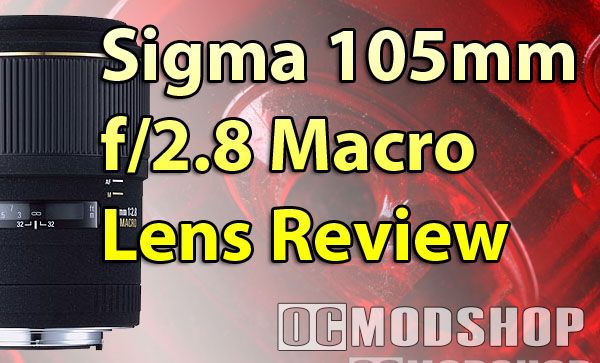
All of Sigma’s EX (“Excellence”) lenses are solidly constructed, made of metal, have metal mounts, and a rugged crinkle style finish (in addition to a three-year warranty). The broad, rubberized focus ring operates very smoothly and is well damped. The lens comes with a barrel-type lens hood and cushioned carry-bad (with belt-loop). The end of the lens is threaded for 58mm filters (an odd choice in my opinion), and does not rotate when focusing , advantageous for circular polarizers or filters whose orientation should remain the same (like gradient ND filters).
The supplied hood screws onto the filter thread, and has a secondary thread of its own. This secondary thread uses a more popular 77mm size, so you can use any existing filters you already have. The only disadvantage to this system is the inability to fit the lens cap while the hood is mounted. Markings on the extending part of the barrel give an indication of the reproduction ratio at it’s current focus range (markings in white for AF, and in gold for Manual Focus). There is also a distance window embedded into the lens body, with a normal Depth-of-Field (DOF) scale.

The lens uses a Dual-Focus (DF) mechanism, which allows the focus ring to decouple from the focusing gear (much like a car’s clutch) by pulling/pushing it back and forth. This would be a great one-step process if the camera body were aware of this change, but you must also change this setting on the camera’s body as well. When the focus ring is in Auto-Focus (AF) mode, the ring spins freely, allowing you to still grip the lens while the lens barrel focuses. The auto-focus speed is slower, but quite usable under normal circumstances, but other lenses from Nikon and Canon are much quicker and quieter. There is a focus “limit switch” which keeps the lens within the short or long range, which helps the auto-focus speed.
Being all metal, this is one of my heavier lenses, but not so heavy that it causes fatigue. The lens balances well, but feels a little front-heavy on my Nikon D80 (which has a plastic body). Being 105mm, the focus length is sufficient that you don’t have to get too close to the subject to fill the frame (advantageous for insect and butterfly macros without scaring them away), and helps prevent shadows from the lens barrel.
