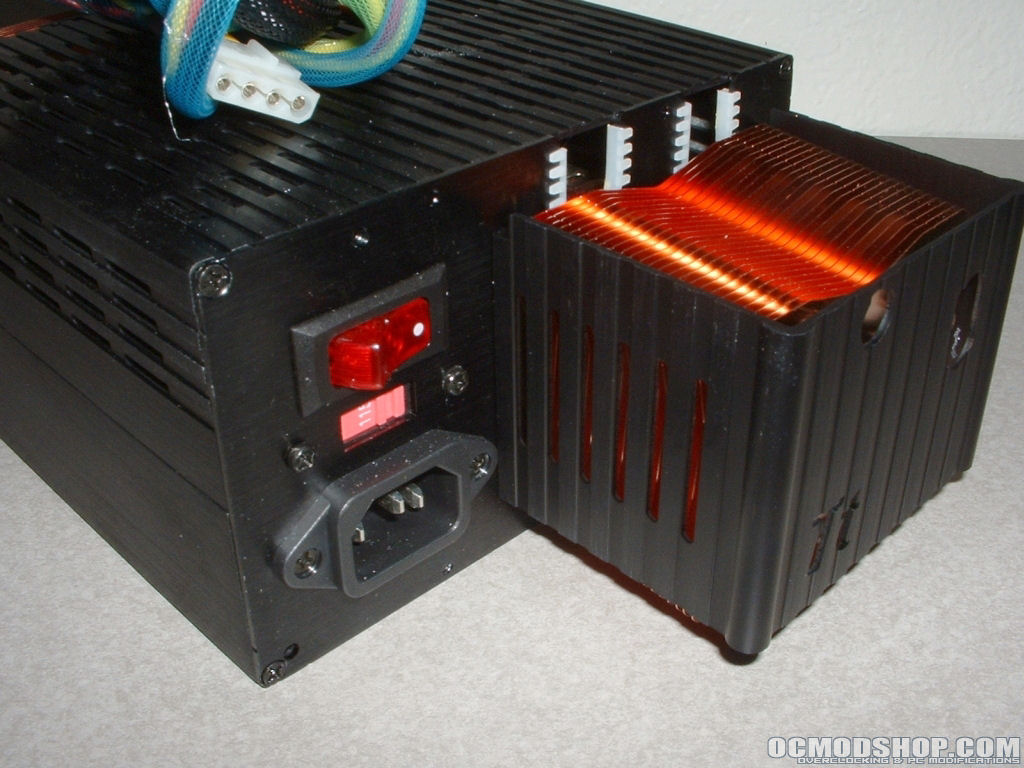
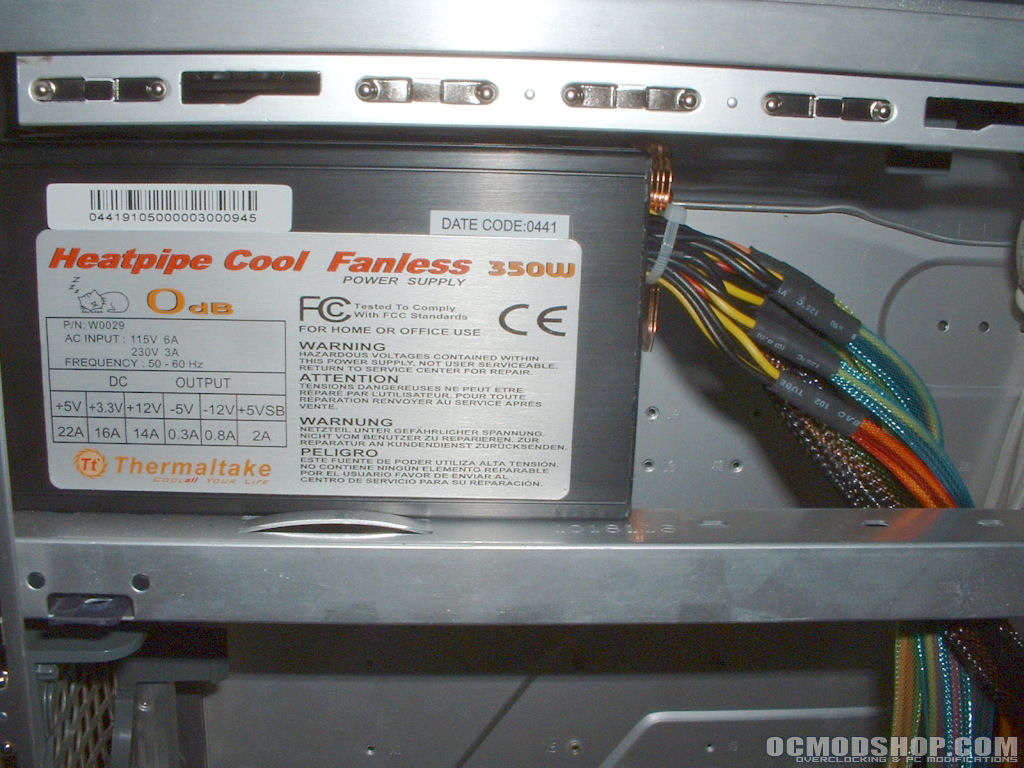
Installation of this power supply was just like any other power supply. If you have a blowhole fan mounted on the inside of your case the front fins may get in the way but I did not have that problem with this particular case which is a Thermaltake aluminum XaserV WinGo V8000A case. With the power supply installed its simply a matter of connecting all of the necessary plugs and hiding the rest. You will also need about two inches behind your case for the external fins to protrude from the back of the case.

Testing
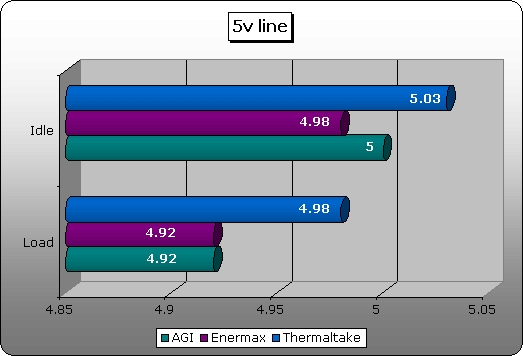
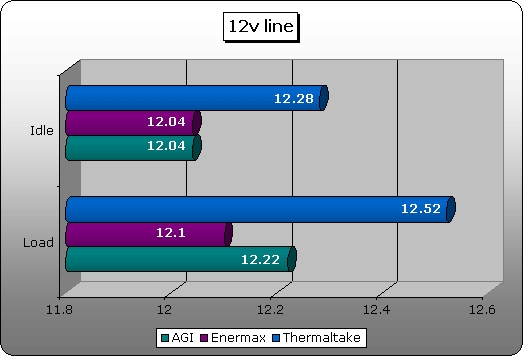
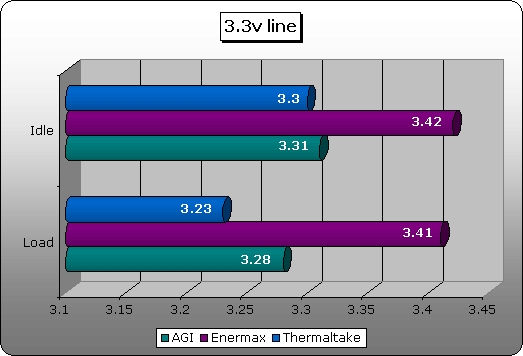
With the power supply installed its time for testing. I will be testing the idle and load voltages of this power supply as well as two others. I pitted this 350w PSU against two others with similar wattages, a 300w AGI 1125BTA and Enermax EG351P-VE. I opted to do the testing in a mid level system rather than a top of the line one since the 350w this PSU does not provide enough wattage for newer hardware such as the nVidia 6800 that likes to have a beefier power supply. In all testing idle voltages were taken while idling in Windows XP and the load voltages were obtained by running Prime95 to get the processors to 100% utilization. Voltage results were obtained with Hardware Monitor Pro.
Testbed
- Albatron KM18G Pro
- AMD Athlon XP 1700+
- PMI 512MB PC3200 Dual Channel kit
- Plextor PX-504A
- 40GB Seagate hard drive
Power supplies tested
- Thermaltake PurePower 350w (passive)
- Enermax EG351P-VE 330w (active)
- AGI 1125BTA 300w (active)
When I switched on the computer the power supply was indeed silent, which was great. I was able to feel air flowing through the aluminum housing of the unit through the vents which is a great design. After running the system for a while I tested the temperature of the power supply and it was only a few degrees hotter than any other power supply. Nothing on the power supply was hot to the touch so I don’t think anything was even close to overheating.
I tested the 5v, 12v, and 3.3v lines of all three power supplies to get a good comparison. With the 5v and 12v testing the Thermaltake power supply did better than the other two however with the 3.3v testing it fell behind both. During idle testing the 3.3v line stayed right at 3.3v where it needed to be but pushing the system to 100% load it dropped to 3.23 which isn’t too bad but could have been higher. I did not encounter any stability or overheating problems with this Thermaltake power supply and it was a joy to not have noise coming from it.
Conclusion
As you should know by now if you have read other articles by me I love a quiet system. Computer noise today in my opinion is unnecessary. While you can go out and buy the biggest baddest fan for your heatsink and video card the benefits of doing so are not enough in my opinion. In most cases the same overclock that you would get from the loud air cooling can be achieved with quiet or silent alternatives such as lower RPM fans or watercooling.
The fact that this power supply is silent makes it perfect for anyone who desires a silent system and would be an ideal candidate for a HTPC or home server. The wattage of this unit it is more than enough for your mid to high end system, however if you are running say a Nvidia 6800 along with other high end hardware you will need more power.
Hopefully Thermalatake and other manufacturers will start making higher wattage PSUs that are 0dB so everyone can take advantage of this silence. The color coded cable sleeving not only looks great but also makes the inside of your case much neater and helps with air flow. In addition to all of this two native SATA connectors are included so you don’t have to use any adapters for your SATA drives.
There is nothing that I found negative in this product and hope to see higher wattage models in the future. Overall I am giving this power supply a 10/10 and awarding it the OCmodshop Seal of Approval. I would like to thank Thermaltake for making this review possible, you will want to buy one of these if you are looking for silence.
Pros

- Completely silent
- Color coded cable sleeves
- Dual heatpipes and copper fins
- Vented aluminum housing
- 2 native SATA plugs
- Excellent passive cooling design
- Strong 5v and 12v lines
Cons
- None