
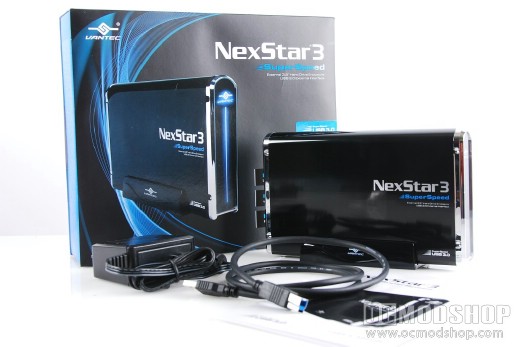
We tested this enclosure with a Seagate 7200.10 250GB SATA Hard Disk Drive. The enclosure was connected to our Vantec SuperSpeed USB 3.0 Host Controller (reviewed here). We used the included USB 3.0 cable, as well as a standard USB cable to test USB 2.0 throughput. Below are the specifications on our test machine:
- Intel Q6600 Core 2 Processor (review here)
- Seagate 7200.10 250GB SATA HDD
- Vantec SuperSpeed USB 3.0 Host Controller (review here)
- Rosewill USB 3.0 Hard Drive Enclosure (read our review here)
- Asus P5W-Deluxe motherboard
- 8GB OCZ DDR2-1000 memory
- Sapphire Radeon ATI 4870 Toxic Video Card (read our review here)
- Asus Xonar PCIe sound card
- Windows 7 (64-bit)
Our Seagate drive was tested in the Vantec NexStar 3 and a Rosewill RX358 USB 3.0 enclosure, which were both tested against USB 3.0 and 2.0. We have previously tested this same drive against our motherboard’s SATA, only to conclude that USB 3.0 performs very similarly. Although the Seagate hard drive is only 250GB, the 7200.10 series uses perpendicular technology, which packs more bits into the same amount of space, which translates into higher throughput per platter spin. Just for kicks and giggles we tried other hard drives we had laying around, but the 7200.10 drive provided the best output in these tests. Any hard drive can easily saturate the bandwidth of USB 2.0, so we used the fastest drive we could to demonstrate if there was a limit to what USB 3.0 could provide.
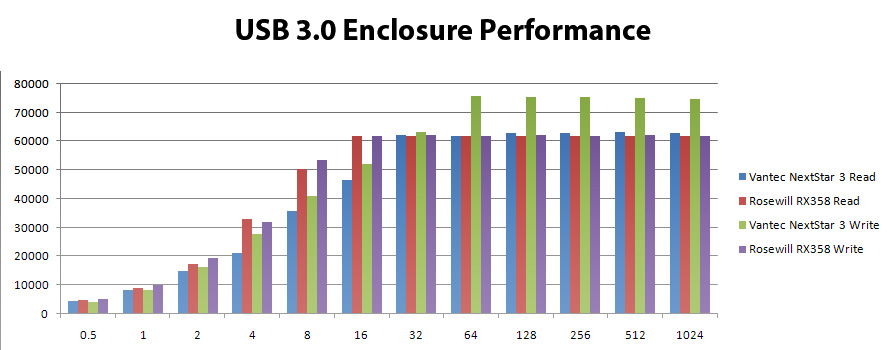
NexStar3 has higher write speeds
We used the ATTO becnhmark as well as Simpli Software’s HDTach 3.0.1. ATTO shows how the drive performs with different file sizes, and HDTach has a good picture of the drive speed with the platter. Once we powered on the drive, Windows 7 immediately recognized it and assigned a drive letter, just as you expect with any USB drive.
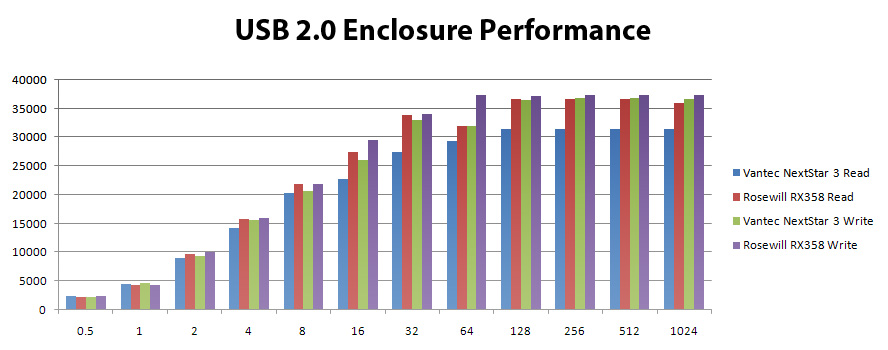
Rosewill has slightly higher performance under USB 2.0
We measured the drive’s temperature with a thermal probe to see how effectively the fan works at cooling your drive. Since the Vantex NexStar 3 is passively cooled (i.e. it has no cooling fan) we were very curious how well the aluminum chassis would work. During installation we noticed that the hard drive does not actually come into contact with any aluminum, only the steel mounting plate, which itself makes minimal contact with the aluminum. Using a thermal probe, our hard drive reached a maximum temperature of 103° F, which is one degree higher than the Rosewill enclosure with its fan off. The ambient room temperature was 76 degrees.
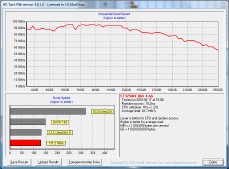
Left: Vantec NexStar3. Right: Rosewill RX358
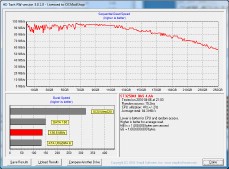
When we used HDTach we could see how the drive performs as the head moves across the platters. It doesn’t take much to saturate USB 2.0’s bandwidth, so nearly every hard drive should max out anywhere between 25 to 30MB a second, which is what we see when we run the enclosure on USB 2.0. When we run the drive on USB 3.0 we can see that the drive does not max out the bandwidth, as the transfer rates have a natural curve as the head moves across the platter. The drive has a slightly less average transfer rate under the SuperSpeed interface than on SATA, but it appears that the drive does not max out the bandwidth and therefore there is room to spare.
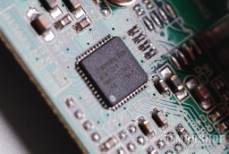
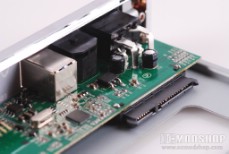
The ASMedia ASM1081 USB 3.0 controller chip
Our tests show that both enclosures perform pretty much the same, although the Vantec NexStar had a major advantage in write speeds with files larger than 32 Kbytes, which are most types of data today. HDTach’s results showed the throughput to be about the same with both enclosures, with a slight (1MB/sec) advantage to the RX368. The fact that there is any variation at all frankly surprises us, as both enclosures use the same ASMedia ASM1081 USB 3.0 controller chip.


2 comments
[…] Vantec NexStar 3 SuperSpeed 3.5″ SATA to USB 3.0 Hard Drive Enclosure @ Review The Tech. You can read OCModShop’s article on the same product right here. […]
When you states "all" hard drive, you mean IDE drives are included? Some reviewers are
not clear. They states sata-drives for this 3.0 usb super speed enclosure.
Comments are closed.