

It seems that Wicked Lasers have taken note of the comments about the previous black Pulsars and have attended to the size of the aperture hole.
No longer does the beam prematurely terminate on the inside of the aperture cap, instead, the light pours out of the front of this laser in a reasonably thick cherry-red stream and without smoke in a moderately lit room, the beam is visible if the laser is shining toward you.
As a focused diode, the Pulsar has that slightly unusual beam profile shared by many diode lasers:
At aperture, it’s circular, with a brighter band across the centre. Further down the beam, it becomes slightly tighter with rings around the spot. Again, like many diode lasers, it has a thin line through the spot which gets longer, the further from the aperture the target is.
I didn’t notice this effect in the previous black Pulsar I’ve played with but it’s not so bad that it detracts greatly from this laser.
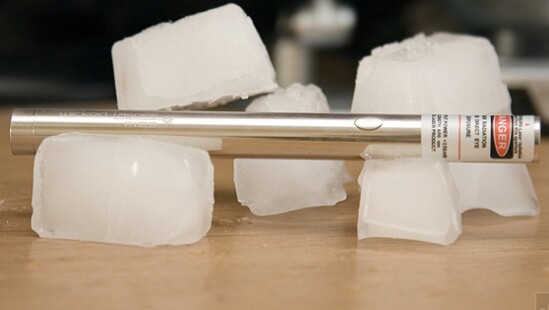
When I was examining the beam profile, I placed a black piece of newspaper in the beam and gradually moved it away from the aperture, watching the shape and intensity of the spot as I did so. When I reached about 3m away from the aperture, the paper started smoking. After that point, the beam spreads a little although the divergence still appears to be quite good for a hand-portable battery powered diode laser.
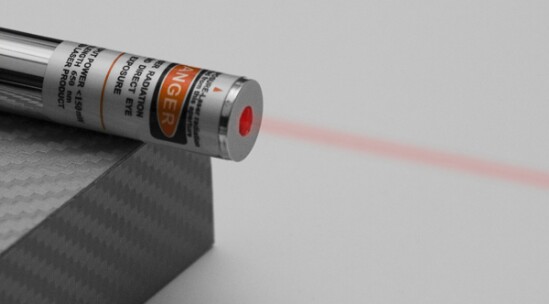
In comparison to green, I’d say it has about the same visibility as about 5mW to 10mW at 532nm (depending upon atmospherics). Add just a little smoke and it’s quite a thick solid beam. It certainly has greater visibility than the Sonar to the naked eye.

I measured the P125 on the Laser Check at two wavelength readings.
The P125 label states 650nm, however previous Pulsars, also labeled as 650nm have been 670nm so I thought it best to take readings at both settings due to the bias that the Laser Check gives to various wavelengths.
@670nm: 108mW
@650nm: 153mW
Both readings taken within seconds of switching on. I allowed the lasers to cool between readings.
The laser didn’t vary in power over successive readings either.
I was using my best NiMHs for the job (and I’ve seen these NiMHs outperform fresh alkaline batteries in a Laser Check reading. Good NiMHs or poor alkaline? I don’t know. I’ve not seen a set of alkaline which will outperform these NiMHs.)
Wicked Lasers seemed to have dispensed with the idea of pocket-clips on their lasers and the last model to have been produced with a pocket clip seems to be the all-black textured casing.
I like this casing because the black surface seems to be harder wearing than the black clipless design which seems to be susceptible to scratches in the surface.
I don’t really feel like deliberately trying to scratch this new chrome P125, however, it must be said that the quality of the surface is good and I expect that it will be quite hard-wearing. The drawback of the nice shiny chrome is that it picks up finger-prints very easily although it only takes a wipe with a soft cloth to remove them and restore the gleaming shine.

In terms of size, this seems to be the same size as my recent Fusion (black clipless with logo) and it fits nicely into the Dragon case as do the other lasers from WL apart from the Spyder and Sonar.
I like the new Pulsar, even if it does pick up fingerprints. Its finish seems harder wearing than the black coating on my Fusion and it will continue to look good long after my Fusion has started to show signs of wear and tear.