

Some of the more successful casual games employ a reward system, and WordJong is structured to reward players with higher scores for coming up with complicated words. There is even an awards tracker, which gives you medals for unlocking certain tasks.
As in Scrabble, each letter has a designated point value, and you get bonuses for using uncommon letters (such as Z, V, and Qu). The points also rack up when using words over 6 letters, so it pays to make words plural or change a noun to a verb whenever possible (“crapping” delivers more points than just plain old “crap”).
The Nintendo DS version of this popular brain teaser adds more fun over its Web-based counterpart. For one, the DS version includes both variations of the game (Daily Puzzle mode is available on the PC, and Temple Challenge Mode is a modified version for cell phones).
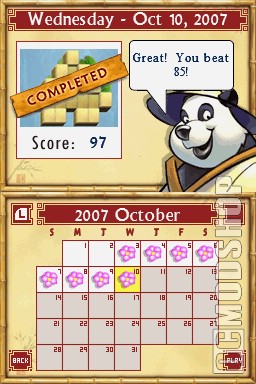
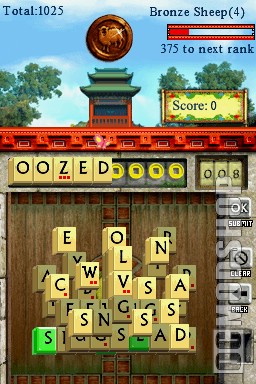
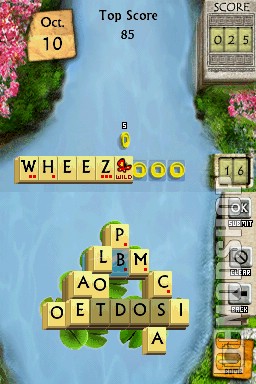
The Daily Puzzle mode gameplay rewards you with a bomb when you create a word that is at least 5 letters long, allowing you to clear out certain tiles. The menu also gives you hundreds of different puzzle layouts, and each puzzle has a predefined top score to conquer.
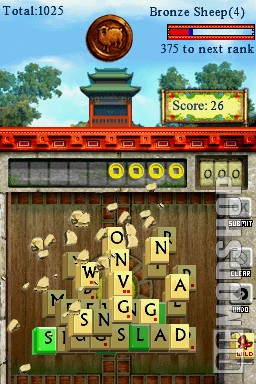
The Temple Challenge Mode has a larger pile of tiles and are randomly generated. There are no bombs, but you can earn a wildcard that can be reused. There are also green multiplier tiles that can dramatically increase your score, and gameplay gets tougher as you progress.
The DS version also uses the platform’s built-in WiFi to battle another person in a one-on-one battle mode. The other person doesn’t even have to own the cartridge; they can just download it from the host DS. In Battle mode there is one shared pile, and the players alternate turns to form words, and the winner is determined by the highest score.
This mode adds a bit of a challenge, as you not only have to worry about getting a higher score, but try to screw up your opponent at the same time. The tiles you pick may allow the competition to blow you away on the next turn. Of course, you also use the DS touchscreen, which has a distinct advantage over the cell-phone keys used in the mobile version. It is also more satisfying than using a mouse on the PC version, too.

