
Well, onto the tests, which will really show us how this card stacks up in 3D gaming. All the tests on this page were run with the card at its default 240MHz Core/500MHz Memory speeds, we will see how good of an overclocker this bad boy is in a moment. Here are the specs of my test rig to start off:
CPU: Athlon XP 1600+ (1400 MHz) at default voltage (1.75)
Motherboard: Epox 8KHA+
Videocard: XFX GeForce 3 Ti500
RAM: 256 Megabytes Micron PC2100 DDR-SDRAM at default voltage
Hard Drives: 80 Gigabyte Western Digital Caviar ATA100
Heatsink: ThermalRight AX-7
CD-ROM: 16x10x40 LiteOn CD-Burner
Sound Card: Creative Labs Sound Blaster Live! Value Digital
Network Interface Card: Linksys LNE100TX 10/100 BaseT/TX
First up, we have Quake 3: Arena. Although the game is getting a little long in the tooth, it is still a good comparison benchmark since almost every review site on the planet uses it for their tests. I am using the 1.17 patch, and I tested it at the 640×480 Normal Quality setting, the 800×600 High Quality setting, and at 1024×768 with graphics maxed out. Here are the results:
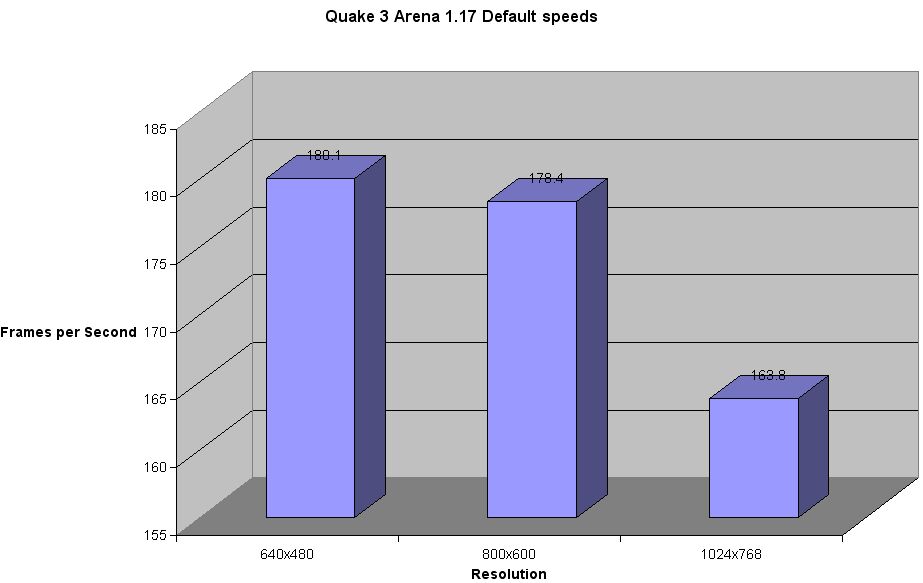
Not shabby at all. And considering that this card was retailing for over $200 a month or two ago, its not surprising to see such high frame rates. I actually don’t think that Quake 3 stressed this card to its max, as you can see that the differences in frame rates between the 3 resolutions is not that great. This test seemed to be limited by my CPU. But since my monitor doesn’t support resolutions higher than 1024×768 that’s all I can really do right now.
Now, on to the Serious Sam benchmarks. Serious Sam is a good test for video cards, as it has very nice graphics and also uses a very solid graphics engine to pump the volume of triangles up to the max. I patched the game up to version 1.05 and used the average FPS to determine the graph. Let’s see how this card fares:
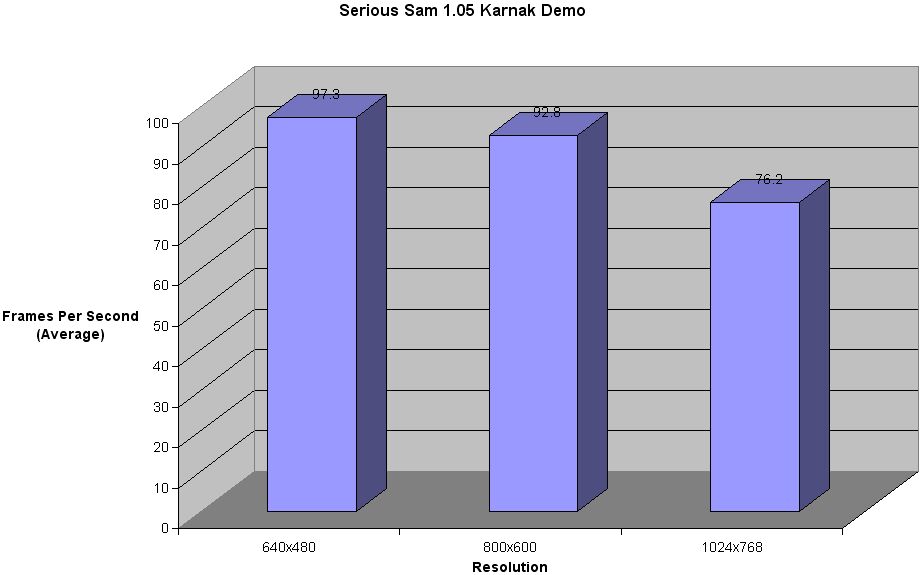
Once again, the framerates don’t really deviate much until we get up into the highest resolution, where the card is more strained than the CPU. Hopefully we can do a video card roundup sometime soon so that we can compare the performance of this card to other cards. But for now, you can just check out the other reviews on the site. :) These scores are very respectable, characteristic of the GeForce3 Series.
Now it is time for 3DMark2001SE. I am using the newest version, build 330, to test this. Test was performed at 1024x768x32bpp, using compressed textures, 24 bit Z-buffer, and triple buffering:
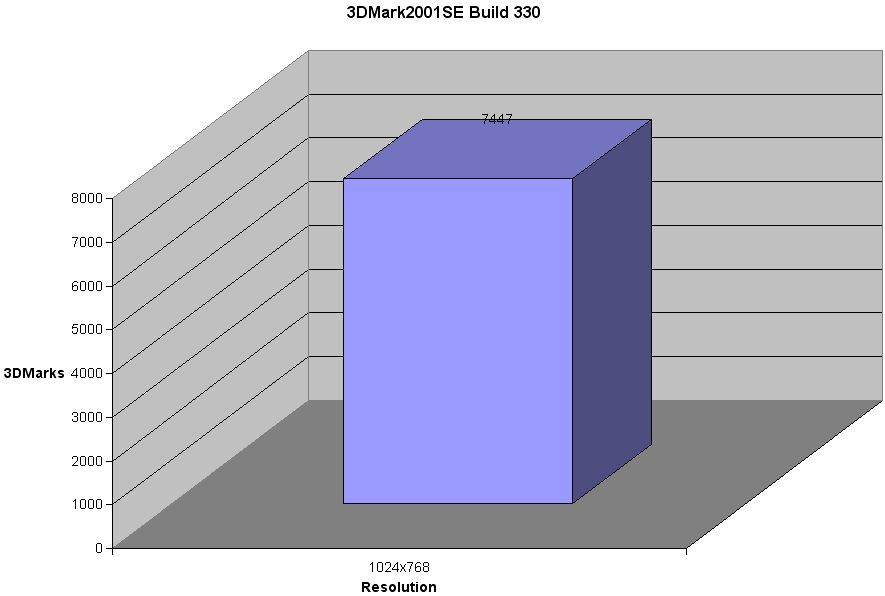
Scores are pretty good for my rig. These scores are comparable to other GF3 Ti500s on the market, so nothing much to really say about them. I’ll let you guys judge if the price and performance ratio meets your needs. All I can say is that this card will definitely run all today’s games perfectly, with features built so you can play tomorrow’s games as well.
Next up is 3DMark2000, which is a good measure of the system as a whole, but focuses mainly on the 3D graphics, like its newer brother 2001SE. I have found it to be a decent measurement of 3D graphics power in the past, so I have included it here. I ran the test in 1024×768 resolution, 32 bits per pixel color, 32 bit textures, and 24 bit Z-buffer:

Breaking the 10,000 point mark is no easy feat in 3DMark2000, and an almost impossible one in 3DMark2001SE, unless you have a beast of a rig with a GeForce 4 (and the $200 – $300 price tag that comes along with it).
Lastly but definitely not leastly :) is the Vulpine GLMark benchmark, made specifically to stress the card as it pertains to OpenGL performance. This test was run with the GeForce3 Features setting enabled, in 32 bit color at 1024×768 resolution, running on quality settings:
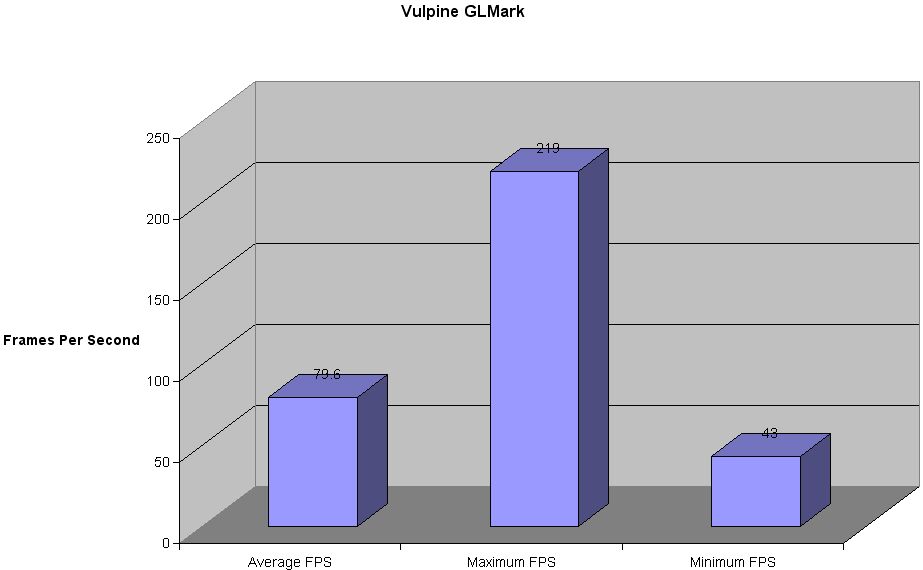
Once again the card performed admirably, never dropping below 40 FPS, which is still a very reasonable frame rate. Also, this test really tests how powerful your card is, and the graphics are really nice as well. In normal games you should not get any slowdown unless your CPU isn’t up to par (I recommend at least a 1.2 GHz CPU to utilize the power of this card fully). Next up, how well does this bad boy overclock?