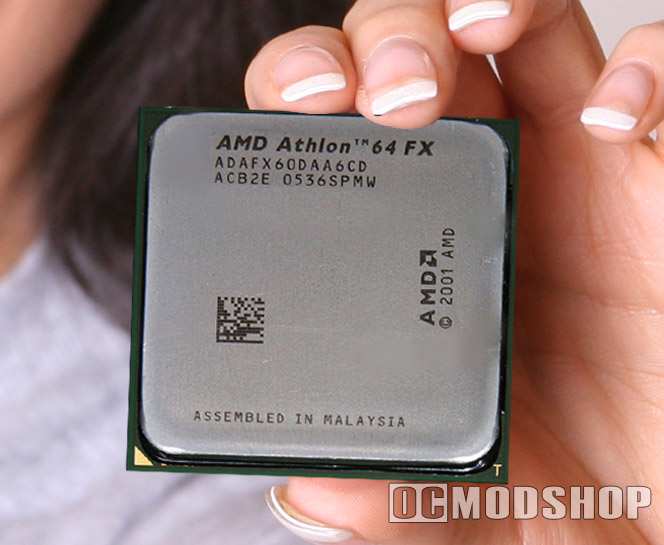
Gamers have enthusiastically embraced the FX line, as it outperforms current Intel processors and overclocks well. Many games are not multi-threaded, so gamers would get little benefit from a multi-core processor. So Why did AMD gamble on a dual-core FX for their target audience instead of releasing an upgraded single-core solution? Here is a quote from AMD on this decision:
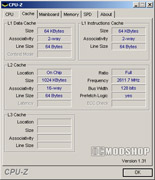
It made great sense for us (AMD) to maintain FX on single core throughout 2005. That was our plan and that was our execution. The benchmarks proved that out as FX has become the defacto CPU to have for ultimate PC gaming. Now it is our intention is for FX to once again stand for the ultimate desktop PC processor, not just the ultimate gaming processor. At 2.6GHz, the FX-60 replaces the FX-55, but it is much more than that. Combining dual-core at this higher frequency (than previous X2s) with our graphics partners’ new dual-core optimized drivers make the FX-60 the perfect processor for not only gaming, but for all those multi-threaded or multi-tasking projects you would have rightfully chosen an X2 processor for. FX-57 will remain and be sold next to FX-60, eventually to be replaced with a dual-core FX at some point in the future as well.
Overclocking
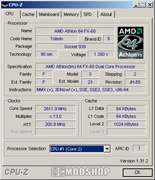
The Athlon 64-FX-60 is very easy to overclock, unlike its X2 siblings. The clock multiplier is unlocked, as in all FX processors, which means the CPU can be overclocked not only by raising the bus frequency, but also by increasing the clock multipler. It is very easy to find the maximum frequency of this CPU by raising the multiplier, as other system components do not share the stress of the CPU. We were looking forward to some good results out of this chip, since the Opteron 170s overclock well, even with air cooling. For our results on air we were only able to obtain a max Overclock of 2.92 (225 HTT X 13) stable in to windows to bench without failing.
The core temperature reached 154 degrees while overclocked, but only 125 degrees at stock ratings. 29 degrees is quite a hefty thermal cost for an extra 320MHz!
Testing
The new nVidia 81.97 drivers were used for the benchmarks, which support dual-core processors. We did notice an improvement over previous drivers, but not all problems have been worked out. For example, the FX-60 must disable multi-threading support if the game already supports multi-threading.
The hype surrounding this processor is immense, with boasted improvements over the existing 4800+. We ran AMD’s new flagship processor through some standard benchmarks to see how it performed against its predecesors. Below are the specs of our test system:
- AMD Athlon 64 FX-60
- AMD Athlon 64 FX-57
- AMD Athlon 64 X2 4800+
- DFI LANParty UT NF4 Ultra-D (NVIDIA nForce4 Ultra)
- 2048MB DDR400 SDRAM (Corsair CMX1024-3500LLPRO, 2 x 1024 MB, 2-3-2-10)
- NVIDIA GeForce 7800 GT 256MB
- Microsoft Windows XP PRO SP2
- DirectX 9.0c
PCMark 05 (total)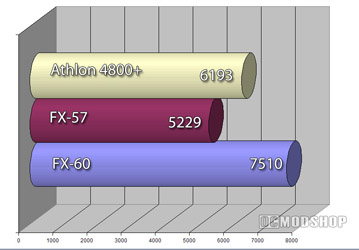 |
MP3 Encoding (iTunes 6.0.1.3), in seconds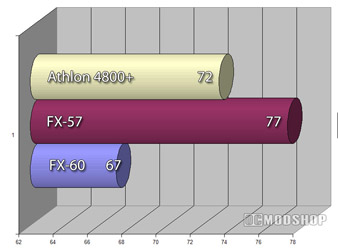 |
| The FX-60 takes the lead in PCMark 05 | Time in seconds to encode an MP3 file. Again, the FX-60 shows some nice improvement. |
Windows Media Encoder 9, MPEG to WMV, in seconds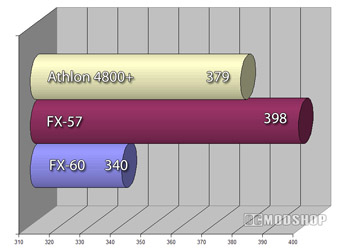 |
F.E.A.R. (Medium Settings) FPS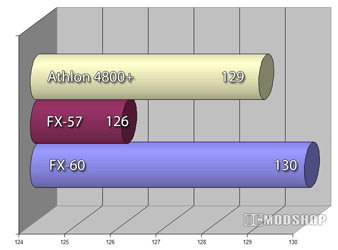 |
| Time in seconds to encode an MPEG file to Windows Media. Time is measured in seconds, and lower is better. | Slight improvement in frame rate for F.E.A.R. |
Quake 4 High Quality FPS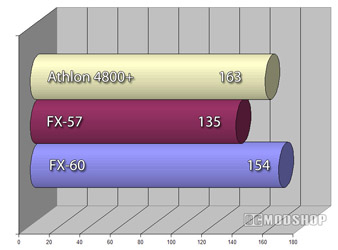 |
|
| Like with other games, the processor speed improves our FPS. | |