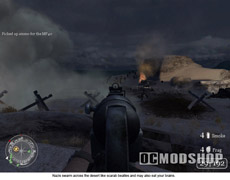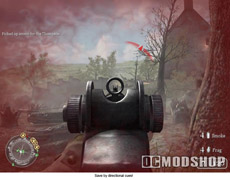
One ability that you do share with your teammates, who press on unless the game needs them to die, is a regenerative health system. Call of Duty 2 does away with the health pack hunts found in the first game. Instead, taking another cue from Halo, your health always regenerates fully—assuming you haven’t died.
A red indicator shows what direction the damage came from, and bloody hues creep around the edges of the screen the closer you are to death. Find cover, avoid further damage, and you’ll be ready to reenter the fray. This system serves the gameplay well, even though it is grossly unrealistic in the historical context. Then again, how realistic is healing your bullet wounds by running over a green box with a red cross on it?
Overall, this health system makes the action much more intense and faster paced. For instance, rather than looking at a hill and balancing how many health packs you remember seeing and how many you expect to find, you can focus solely on desperately scrambling for that next piece of cover.
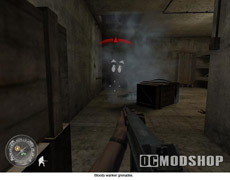
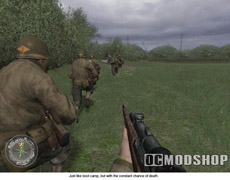
If you’ve played the first Call of Duty and its expansion pack, you’ve seen almost every mission type the sequel uses. Every level involves running around an area on foot or in a vehicle, and the environments are more open-ended than in the previous games.
Your next objective may be to take control of a townhouse, but the path there is not cordoned off by conveniently placed dead-ends and rubble. Some highlights of the British campaign include the nocturnal capture of an Egyptian town and then withstanding the ensuing counterattack.
German soldiers come at you in waves across the dunes like starving rats and before repelling that attack, you must be a spotter for British artillery strikes. Usually, you control one soldier per campaign, but in another British mission you get to shift personas and drive a tank across the open desert while chasing Rommel’s forces.

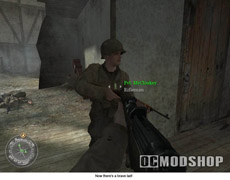
During the brutal and urban Russian campaign, you get to crawl through pipes, repair communication lines, and of course, take part in savage charges where the majority of your comrades are slaughtered. The excellent American campaign features something I thought I may never see again—a new and fresh take on a D-Day landing.
Yes, this time it is at Pointe du Hoc. There you must scale a 30 meter cliff, engage in trench warfare at the top, and then defend a seaside village from Nazi counterattacks. This kind of variety both within a mission and among the different ones keeps the fighting from becoming stale.
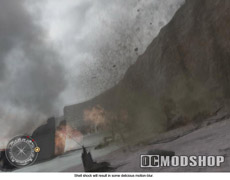
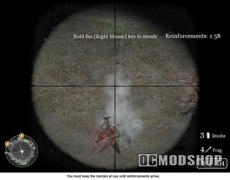
The missions also have versatile scenery, provided by a superb graphics engine. The different environments, namely tundra, desert, and temperate, are all nicely detailed, as are the burned-out buildings that fill the landscape. Much of your squadmates’ believability is carried by their appearance, which features quality textures and commendable facial expressions.
I particularly enjoyed the shell shock effect that can occur anytime an explosive detonates but is used especially well in the D-Day mission. In battle, smoke forms gorgeous, thick clouds, bloods splatters from friend and foe alike, and the bottom line is that game immerses you with graphics that match contemporary titles available for the PC and Xbox 360.