
Sound is the final element locking you into the game. Whether it is dialogue or the ringing left behind by an artillery bombardment, the soundscape is full and vibrant. Listening to your fellow soldiers is a treat, and they become surprisingly identifiable over the course of a campaign.
Of course, their desperate cries for covering fire only add to the thrilling chaos of battle, as do the harsh screams from angry German troops. One of my favorite parts in any World War II game is that entertaining accent and Call of Duty 2 did not disappoint me, although I believe Germans should speak in German.
The sound effects of the weaponry from reloading to unloading are spot-on, but how could they be otherwise? Six years after Medal of Honor, I would be shocked if there isn’t some institution funded by the industry whose only job is to perfect the sounds of 1940s warfare.
The game has some shortcomings, although they do not detract too much from the enjoyable gameplay. The environments may look pretty, but they are highly static, unless scripted otherwise. No matter how many times a grenade lands right in front of those wooden crates, you can keep on using them for cover.
Also, you can just forget about all those doors you see—if the game calls for them to be opened, it will let you know. That heavy scripting can occasionally be foiled by pesky human players like me, and I did have to reload a few times to correct it, although those bugs are less common than they were in the game’s predecessor.
Assuming these complaints are not deal-breakers, a larger problem with the game still lingers. Despite its high polish, there is a strong feeling of déjà vu. I have stated that the game holds interest while playing and is fun, but in between sessions I often thought, “Is there really anything there that I haven’t seen before?” The answer is of course yes, but that certainly does not apply to everything.
By now I’ve heard the delightful ping of the M1 Garand clip hundreds of times as I’ve killed thousands of Nazis and the truth is this game sometimes feels like an expansion pack to the continuing saga that is WWII Foot Soldier Simulator. If it somehow reinvented the genre—how, I don’t know—things would be different, but Call of Duty 2 is content to take a working formula and incrementally up the resolution, variety, and intensity. This phenomenon keeps the game from being a must-play, because chances are you’ve played much of it before.
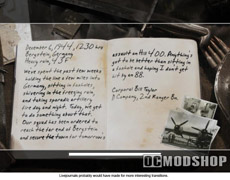
Because of the familiarity, a story would have helped Call of Duty 2 hold your attention across its separate campaigns. Even within campaigns the burden of character development is mostly carried by journal entries that try their best not to look like they were written with a font. How many of these did I read completely? Well, it’s not a negative number, but it’s also not a lot.
The other bits of context are contained within black and white newsreel-style reports of the results of your victories that use actual footage from the era. These are kind of cool, but I wouldn’t sit through them during replays and they aren’t an incentive for getting to the next level. Besides, it’s not like you need to finish the game to find out how the war ended.
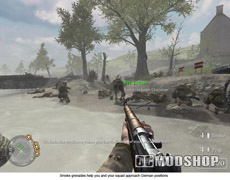
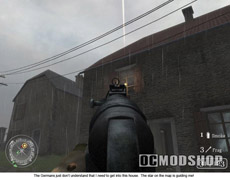
If you do feel like taking a break from the game, there’s no need to save your progress. Call of Duty 2 adopts a checkpoint system (again, similar to the Halo model) that is likely necessitated by the new health system.
Regeneration and quick-saving would make things much too easy, so closely spaced save points have taken the place of traditional saving. For the most part, they work very well, but in case frustration happens too often—or not at all—the game sports four difficulty levels (Halo, anyone?) for you to experiment with (The sweet spot being around the middle two).

