
1200XL
The startup screen of later Atari 8-bit models (XL series onwards) when no program is loaded.The 800 was complex and expensive to build, consisting of multiple circuit boards in various locations inside or outside the massive aluminum shield. Additionally the machine was designed to add RAM only through cards, which required expensive connectors and packaging even though it now shipped fully expanded right from the factory. At the same time the 400 didn’t compete technically with some of the newer machines appearing in the early 1980s, which tended to ship with much more RAM and a real keyboard.
Another major change was the introduction of the FCC ratings specifically for digital devices in homes and offices. One of the ratings, known as Class B, mandated that the device’s RF emissions were to be low enough not to interfere with other devices, such as radios and TVs. Now computers needed just enough shielding to prevent interference (both ways), not prevent emissions from leaking out. This requirement enabled lighter, less expensive shielding than the previous 400 and 800 computers.
In 1982 Atari started the Sweet 16 project to address these issues. The result was an upgraded set of machines otherwise similar to the 400 and 800, but much easier and less costly to produce. Newer fabs allowed a number of chips in the original systems to be condensed into one. For comparison, the original 800 used seven separate circuit boards (many of them small, three of them for RAM and another for ROM), while the new machines used only one. Sweet 16 also addressed problems with the 800 by adding a new expansion chassis as well, although it was to be external. Like the earlier machines, the Sweet 16 was intended to be released in two versions as the 1000 with 16KB and the 1000XL with 64KB. RAM was still expensive enough to make this distinction worthwhile.
When ANTIC needed memory access it halted the CPU. But this required four support chips. Atari later had a custom version of the 6502B to be made with an extra “HALT” pin. Known initially as SALLY, this version later became an official product known as the “6502C” and used in all XL/XE Atari machines.
Atari 1200XLBut when the machines were actually released there was only one version, the 1200XL, an odd hybrid of features from the Sweet 16 project. Notable features were 64kB of RAM (first for an Atari), built-in self test, redesigned keyboard (favored by many users), and redesigned cable port layout. However the 1200XL also included a number of missing or poorly implemented features. For instance it included the expansion chassis connector, but the case did not include a hole for it to be used. A new video chip provided more chroma for a more colorful image, but then someone decided to disconnect that pin in the monitor port, reversing the effect. The +12V pin in the SIO port was also removed, for no obvious reason.
In the end the 1200XL offered little new in comparison to the existing 800, and although it should have been much less expensive, it in fact was sold at the same basic price points. Changes made to the operating system to support the new hardware also had the side effect of making a number of existing programs no longer work. For all of these reasons the 1200XL sold poorly. There is an often-repeated story, perhaps apocryphal, that 800 sales shot up after the release of the 1200XL, as existing owners tried to snap them up before they disappeared. Released in late 1982, the machine was quickly discontinued in 1983.
Newer XL machines
By this point in time Atari was involved in what would soon develop into a full-blown price war. Jack Tramiel of Commodore International watched Texas Instruments enter the home computer market, and decided to push them back out by undercutting their prices. TI had undercut Commodore’s calculator business only a few years earlier, but this time Tramiel’s supply was stronger than TI’s, and he could turn the tables. Although Atari had never been a deliberate target of Tramiel’s wrath, they, along with the rest of the market, were dragged into “his” price war in order to maintain market share.
The timing was particularly bad for Atari; the 1200XL was a flop, and the earlier machines were too expensive to produce to be able to compete at the rapidly falling price points. The solution was to replace the 1200XL with a machine that users would again trust, while at the same time lowering the production costs to the point where they could compete with Commodore.
Starting with the 1200XL design as the basis for a new line, Atari engineers were able to add a number of new IC’s to take over the functions of many of those remaining in the 1200XL. While the 1200XL fit onto a single board, the new designs were even smaller, simpler, and as a result much less expensive. To reduce cost even further, manufacturing of a new series of machines was set up in the far east.
Atari 600XL
Atari 800XLThese versions, the 600XL, 800XL, 1400XL and 1450XLD were announced at the 1983 Summer CES. These machines had Atari BASIC built into the ROM of the computer and a Parallel Bus Interface (PBI). The machines looked similar to the 1200XL, but were smaller back to front, the 600 being somewhat smaller than the 800 front-to-back (a reflection of the Sweet 8 project). The 1400 and 1450 both added a built-in 300 baud modem and a voice synthesizer, and the 1450XLD also included a built-in double-sided floppy disk drive in an enlarged case.
Problems with the new production lines delayed the entry of the machines onto the market. Originally intended to replace the 1200XL in mid-83, the machines did not arrive until late in 1983, far fewer than anticipated during the 1983 Christmas season. Nonetheless, the 800XL was the most popular computer sold by Atari. The 1400XL and the 1450XLD had their delivery dates pushed back, first by the priority given to the 600XL/800XL, and later by the 3600 System. In the end the 1400XL was eventually cancelled outright, and the 1450XLD so delayed that it would never ship.
By late 1983 the price war that had started the year before was now reaching a crescendo. Although the 600/800 were well positioned in terms of price and features, their entry into the market was so delayed that Commodore was able to take the ’83 Christmas season while Atari struggled to get their machines onto the shelves. Combined with the simultaneous effects of the video game crash of 1983, Atari was soon losing millions of dollars a day. Their owners, Warner Communications, became desperate to sell off the division.
Tramiel Era: XE series and XEGS
Although Commodore emerged intact from the computer price wars, fighting inside Commodore soon led to Jack Tramiel’s ousting. Looking to re-enter the market, he soon purchased Atari from Warner for an extremely low price.
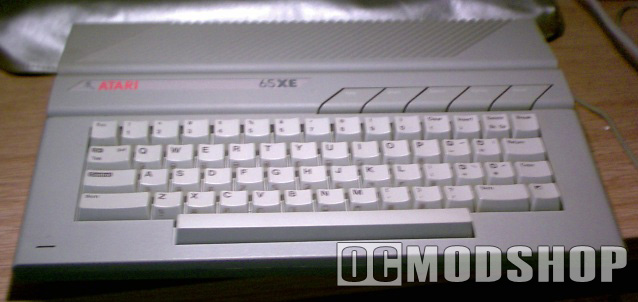
Atari 65XEThe final machines in the 8-bit series were there 65XE and 130XE. They were announced in 1985 at the same time as the initial models in the Atari ST series: the 130ST and 520ST. The 65XE was the replacement for the 800XL. Originally called the 900XLF, the 65XE was functionally equivalent to the 800XL minus the PBI connection. The 65XE (Euro version) and the 130XE had a Enhanced Cartridge Interface (ECI), a variant of the Parallel Bus Interface (PBI). The 130XE came with 128KB of memory, accessible through bank-selection (thanks to FREDDIE and a EMMU chip). An additional 800XE was available in Europe (mostly Eastern Europe), which was essentially a 65XE. XE stood for XL-Expanded.
 The reason for repackaging the 130XE into the 800XE was Atari trying to ride on the popularity of the original 800XL in Europe. Unfortunately, 65XE and 800XE machines sold in Eastern Europe had a buggy GTIA chip, specifically those machines made in China in 1991.
The numbers 65 and 130 were used for the XE series because Atari based their machine-numbers on the amount of RAM they came with, but, unlike the Commodore 64 and 128, Atari decided to use the decimal byte count with a base of 1,000 (sometimes rounded to a more even number) for marketing reasons instead of the traditional base-1,024 used by engineers, as the numbers are larger (64K being 65,536 = 65, instead of 64, and 128K being 131,072, rounded to 130, instead of 128). All subsequent model-numbers used this system, including the 16-bit Atari ST line of computers as well. Interestingly this exact scheme was eventually universally adopted by hard drive manufacturers for the same reason.
Atari XE Game SystemFinally, with the resurgence of the gaming industry brought on by Nintendo, Atari brought out the XE Game System (XEGS), released in 1987. The XEGS was sold bundled with its detachable keyboard (first for an Atari computer), a joystick and a lightgun (XG-1), and a couple of game cartridges. No PBI or ECI, but a complete computer with the keyboard. Bad marketing and a lack of newer releases hampered sales.
On January 1, 1992, Atari Corp. officially dropped all remaining support of their 8-bit line.

