
Computer models
- 400 and 800 (1979) – original machines in beige cases, 400 had membrane keyboard, 800 had full-travel keys, two cartridge ports, monitor output, expandable memory slots (up to 48KB).
- 1200XL (1982) – new aluminum and smoked plastic cases, 64KB of RAM, only two joystick ports. Help key, four function keys. A new OS caused compatibility problems with some older software.
- 600XL and 800XL (1983) – replacements for the 400, 800 and 1200XL sans function keys. 600XL had 16KB of memory, 800XL had 64KB and monitor output. Both had built-in BASIC and an expansion port known as the Parallel Bus Interface (PBI).
- 800XLF – 800XL with FREDDIE chip and BASIC rev. C. Released in Europe only.
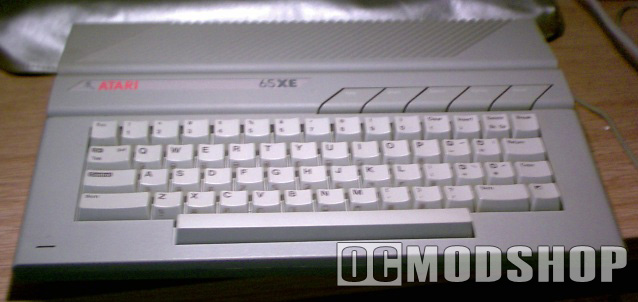
- 65XE and 130XE (1985) – A repackaged 900XLF with new cases and keyboards. The U.S., Canadian version of the 65XE had no PBI or expansion port. 130XE came with 128KB of RAM and a Enhanced Cartridge Interface (ECI) instead of a PBI.
- XEGS (1987) – a game machine in a light beige case, with a detachable full-travel but slightly “mushy” keyboard (Atari ST’ish)
- 800XE – the final machine in the series. Styling the same as 65XE and 130XE. A 130XE with 64KB RAM. Mainly seen in Eastern Europe. Prototypes/Vaporware (Never Officially Released)
- 1400XL – Similar to the 1200XL but with an PBI, FREDDIE chip, built-in modem and speech synthesis chip. Cancelled by Atari.
- 1450XLD – basically a 1400XL with built in 5 1/4″ disk drive and expansion bay for a second 5 1/4″ disk drive. Code named Dynasty. Made it to pre-production, but got abandoned by Tramiel.
- 900XLF – redesigned 800XLF. Became the 65XE.
- 65XEM – 65XE with AMY sound synthesis chip. Cancelled.
- 65XEP – “portable” 65XE with 3.5″ disk drive, 5″ green CRT and battery pack. Never released
- 1090 expansion system, 5 slots in a large case (never released, small numbers leaked out)
Peripherals
Atari’s peripherals were named after the machines they were intended to be used with, so in general they have names like “410” and “1050”. All of them used the proprietary SIO port, which allowed them to be daisy chained together into a single string; a method also used in Commodore’s home computers from the VIC-20 onwards. These “intelligent” peripherials were more expensive than the standard IBM PC devices, which did not need the added SIO electronics.
400/800 series
410 tape drive, 600 bit/s on cassettes 810 5¼” floppy disk, single-density single-sided, 90KB 815 dual 5¼” floppy disks, double-density single-sided, 180KB (only small numbers produced) 820 printer, 40-column dot matrix on adding machine paper 822 printer, 40-column thermal on slightly wider paper 825 printer, 80-column dot matrix (Centronics 737) 830 300-baud modem, using an acoustic coupler, used RS-232 so required an 850 (Novation CAT) 835 300-baud modem, direct connect, basic Hayes compatible with SIO interface 850 expansion system, included four RS-232 ports and one Centronics parallel port CX-85 Numerical Keypad, external keypad that plugs into the joystick ports.
XL series
1010 tape drive, a smaller replacement for the 410 1020 color printer, 40-column plotter with 4 pens 1025 printer, 80-column dot matrix (Okidata ML-80) 1027 printer, 80-column letter quality that printed with a 5-wheels-on-a-drum system kept inked by a top-mounted roller (Mannesmann Tally Riteman LQ) 1029 printer, 80-column lower-quality 7-pin dot matrix sold in Europe (Seikosha mechanism) 1030 300 baud modem, direct connect 1050 5¼” floppy disk, “enhanced density” format single-sided, 130KB 1064 memory module, 64K memory expansion for 600XL XE series
XEP80 80-column display module, parallel port XC11 tape drive XC12 tape drive (small model like the 1010, sold worldwide) XF551 5¼” floppy disk, double-density double-sided, 360KB XMM801 printer, 80-column dot matrix XDM121 printer, 80-column letter quality daisy wheel XM301 300 baud modem SX212 1200 baud modem (also included RS-232 for use on Atari ST computers) Atari also produced a number of other tape drives for use in eastern Europe where they continued to sell into the late 1980s due to their low cost. Some of these included various “high-speed” modes which made them almost as fast as early disk drives.
In addition to the list above, Atari failed to release a huge selection of machines and peripherals that were otherwise completed. See the externally linked FAQ below for details.

