
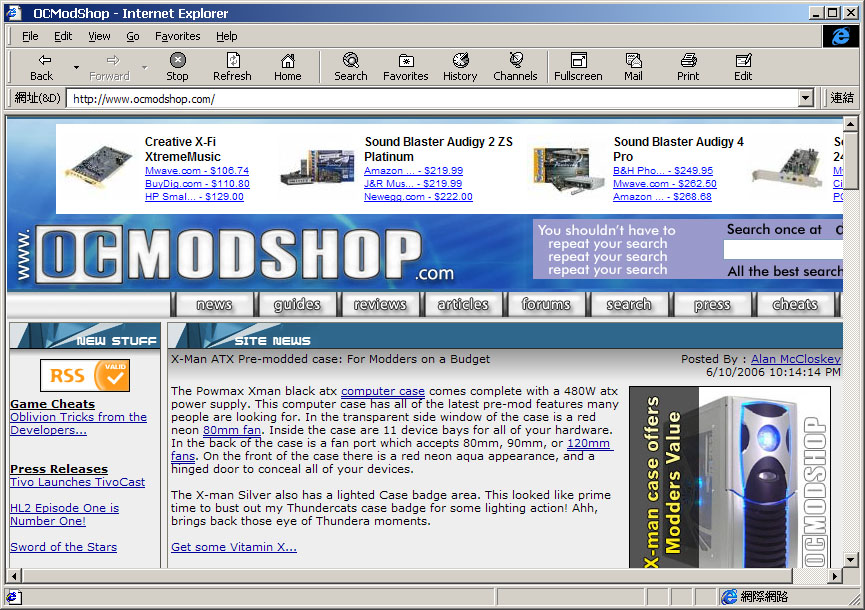
Internet Explorer is subject to a relatively high volume of criticism. Much of this criticism is related to concerns about security: Much of the spam, spyware, adware, and computer viruses across the Internet is made possible by exploitable bugs and flaws in the security architecture of Internet Explorer. While Internet Explorer is not alone in having exploitable vulnerabilities, its ubiquity has resulted in many more affected computers when vulnerabilities are found.
Microsoft has also not responded as quickly as competitors in fixing security holes and making patches available. Not only are there more holes in Explorer, but holes remain unpatched for a longer time. Several companies maintain databases of known security vulnerabilities that exist in Internet Explorer, for which no fixes have been published by Microsoft. As of May 28, 2006, Secunia reports 101 vulnerabilities in Internet Explorer, 21 of which are unpatched. In contrast, Mozilla Firefox, the main competitor to Internet Explorer, is reported to have only 31 security vulnerabilities, of which 4 remain unpatched. Opera, another competitor to Internet Explorer, has 13 vulnerabilities and none of them remain unpatched. Lower numbers are better.
Other criticisms, mostly coming from technically proficient users and developers of websites and browser-based software applications, concern Internet Explorer’s support of open standards, because the browser often uses proprietary extensions to achieve similar functionality. Internet Explorer supports, to some degree, a number of standardized technologies, but has implementation gaps and conformance failures—some minor, some not—that have led to criticism from an increasing number of developers. The increase is attributable, in large part, to the fact that competing browsers that offer relatively thorough, standards-compliant implementations are becoming more widely used. Internet Explorer’s ubiquity, in spite of its perceived inferiority in this area, frustrates developers who want to write standards-compliant, cross-browser code. It can also prevent widespread adoption of new technologies. Web developers must work with the least advanced technology across all browsers they wish to support, and Internet Explorer is often criticized for often having the least advanced support. For a long-standing concrete example, see Internet Explorer’s poor PNG transparency support.
Usage share of Internet Explorer
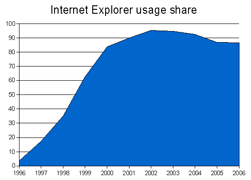 The adoption rate of Internet Explorer seems to be closely related to that of Microsoft Windows, as it is the default web browser that comes with Windows. Since the integration of Internet Explorer 2.0 with Windows 95 OSR 1 in 1996, and especially after version 4.0’s release, the adoption was greatly accelerated: from below 20% in 1996 to about 40% in 1998 and over 80% in 2000. This effect, however, has recently been dubbed the “Microsoft monoculture”, by analogy to the problems associated with lack of biodiversity in an ecosystem. By 2002, Internet Explorer had almost completely superseded its main rival Netscape and dominated the market.
After having fought and won the browser wars of the late 1990s, Internet Explorer began to see its usage share shrink. Having attained a peak of about 96% in 2002, it has since been in a steady decline. Statistics indicate the current most significant competition comes from Gecko-based browsers, in particular Mozilla Firefox.
Nevertheless, Internet Explorer remains the dominant web browser, with a global usage share of around 85% (based on statistics reference). Usage is higher in Asia and lower in Europe. For example, the share is around 94% in Japan, and around 70% in Germany.
Industry adoption
ActiveX is used by many public websites and web applications, including eBay. Similarly, Browser Helper Objects are also used by many search engine companies and third parties for creating add-ons that access their services, for example, search engine toolbars. Because of the use of COM, it is possible to include web-browsing functionality in third-party applications. Hence, there are a number of Internet Explorer shells, and a number of content-centric applications like RealPlayer also use Internet Explorer’s web browsing module for viewing web pages within the applications.

