

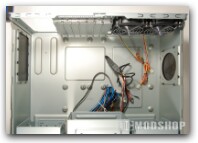
The inside of the case is accessed by opening a lid on top of the case. Inside there appears to be lots of room, accompanied by lots of cables connected to various parts of the front panel. The front panel is actually a 3.25″ module installed in the center drive cage, but is hidden behind an aluminum flap. The VFD, volume knob and media buttons have USB leads coming from the front panel, but more on that later.
The case has two 120mm side air intake/exhaust ports, covered by a non-removable mesh grill. There are no screw holes through the mesh, so fans must be mounted from inside the case. Fortunately, Silverstone includes several long screws used to secure fans to the grill (the fan is sandwiched between the screw head and the case side rather than being directly screwed in).

Depending on your motherboard, you may not be able to fit a standard 120mm fan on the right intake (although you can use a special slim 120mm fan). The second 120mm intake port is positioned right where the power supply is to reside. Most modern power supplies have a 120mm air intake right where this vent is, so your power supply will have access to fresh cool air (assuming you don’t close the door to your rack).
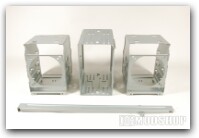
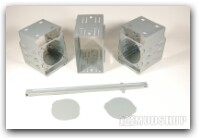
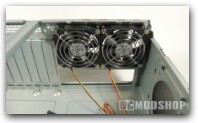
Two quiet 60mm fans assist the expulsion of heat from the back of the case. The drive cages are anchored to the bottom of the case and screwed in the top. The bottom of the cages are indented so they can clear your motherboard when the cages are removed. The central 5.25” cage is the the main design point, which places the stealthed DVD drive, VFD, and USB panel squarely in the center of the case!
Even with these important cooling features, you still need to keep this in mind – Home Theater PCs generate heat; it’s just a fact of life. You should always make sure that hot air does not build up in the equipment rack. If you need to close the door on your rack, make sure there is an exhaust fan or will quickly find your HTPC crashing.
Also make sure there is clearance at the back of your rack for heat to travel (shelves should not be pushed flush against the back wall). My rack is completely open, and I can literally feel the heat coming from the top of the home theater stack. The fact that the heat is expelled and not trapped within the case is a testament to the LC16M’s design.