
I will be using 3DMark2001SE, 3DMark03, Vulpine GLmark, Quake 3, and Unreal Tournament 2003 as benchmarks. All of the testing was done with all the eye candy turned on and everything at it’s highest.
I benchmarked with the resolutions of 1024×768, 1280×1024, and 1600×1200, I did not do 800×600 because I don’t feel that many people out there are using that low of a resolution. I used nVidia’s 41.09 detonator drivers along with DirectX 9.0a. I will be comparing this video card to a Abit Siluro Geforce 4 Ti4200-8X OTES which I reviewed a while back to see which card comes out on top.
Test Bed:
- EPoX 8K9A2+
- 1800+ Athlon XP
- 60GB Seagate Barracuda IV HDD
- Corsair 512MB PC3200
- Abit Geforce 4 Ti4200 OTES 8x AGP 128MB
- PcToys VGA MAXX Heatpipe Cooler
- PcToys NB MAXX
- Koolcase’s Panther
- Generic 300w PSU
- Sound Blaster Live! Value
- ATi TV Wonder VE
- Plextor 40x12x40 CDRW
- Plextor PX-504A DVD+RW (review to come)
- pioneer 16x DVD
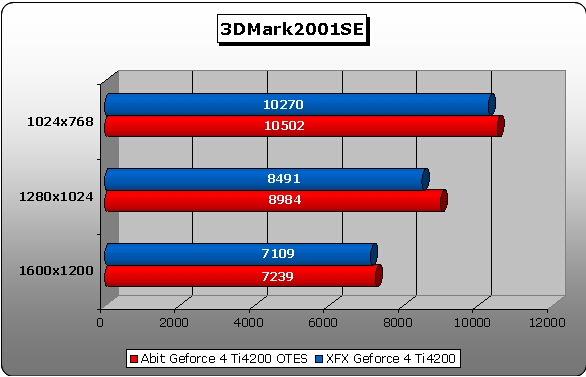
3DMark2001SE is one of the best synthetic benchmarking programs out there and probably used the most for comparison of cards. With all the resolutions the XFX card was just a little bit behind the Abit card. The main reason the Abit scored a little higher is because it comes clocked faster out of the box. At 1024×768 the card was able to break 10,000 marks which is about right for a Ti4200.
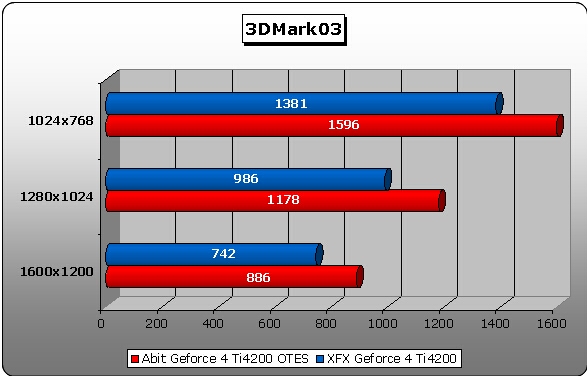
3DMark2003 just came out and its much more strenuous on a system than the old 3DMark2001SE. Personally I think right now that 3DMark03 system requirements are way too high but in time as new hardware comes out scores will improve.
In comparison to other cards out on the market right now the Ti4200 is too weak to produce a decent score on 3DMark03 however that isn’t to say that the card is slow, the program just needs too much in my opinion. The Abit again did better than the XFX card because it is faster.
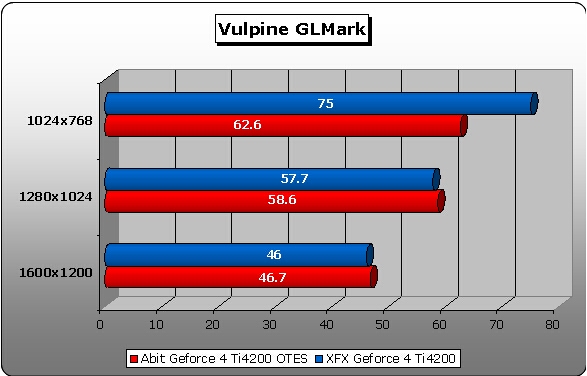
Vulpine GLmark is another synthetic benchmark that is used for video cards, it is not as widely used but I still like it. At 1024×768 the XFX did better than the Abit and with the resolutions above that the was only about 1FPS faster than the XFX card. Even with the Abit card being clocked faster right out of the box the XFX card was able to stay right with it.
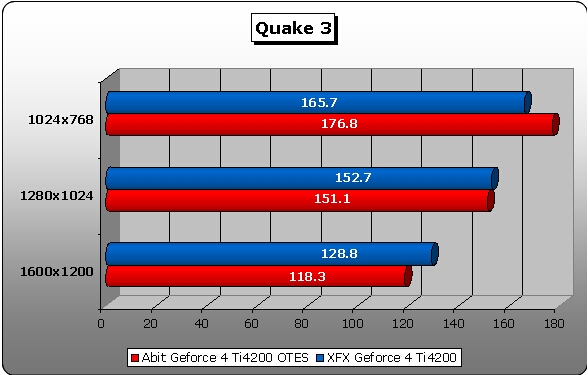
Quake 3 is probably the most used game benchmark around the world and it will be used here as well. All of the graphical and sound settings were set to the highest settings to stress the card as much as possible. At 1024×768 the Abit card was faster than the XFX card by 11.1FPS but at 1280×1024 and 1600×1200 the XFX card was faster 1.6FPS and 10.5FPS.
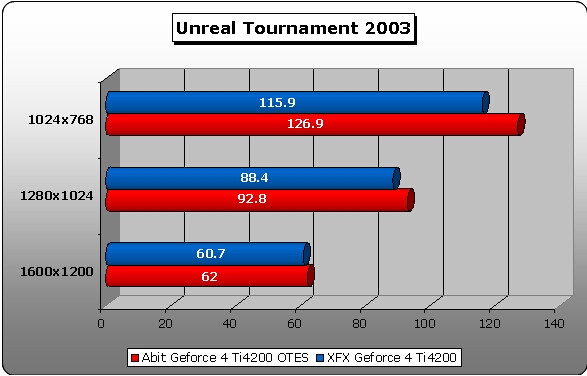
Final testing was done with Unreal Tournament 2003 which is one of the newer and more stressful games. I used the standard benchmarking tool which was included with the game to do this testing so you would be able to more easily compare with the results. The benchmark does a flyby of the map and a bot match benchmark for each resolution.
I only made a graph for the flyby because I felt the bot match benchmark was irrelevant because it is done in 3rd person rather than 1st person like the game is played. With all the tests the Abit card was able to output higher FPS than the XFX card but again this is due to the fact that stock speed of both the core and memory speed on the Abit are faster.