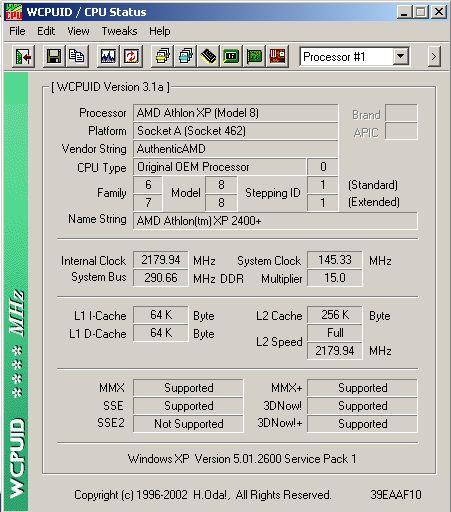
As you have already seen from the BIOS, this motherboard is sorely lacking in the overclocking department. I was only able to raise my Athlon XP 2400+ from 2000 MHz to 2180 MHz. I achieved this by increasing the front-side bus from 133 to 145 MHz, which increased the RAM speed to 212MHz. Since there is no BIOS setting for changing the multiplier of the chip or unlocking the chip in software this was the highest speed I was able to achieve and not have 3DMark03 come crashing down upon me. This was with the most aggressive RAM timings, since it is my feeling that you should not have to sacrifice one area of performance to gain in another area. So here is the WCPUID screen for my overclocked board.
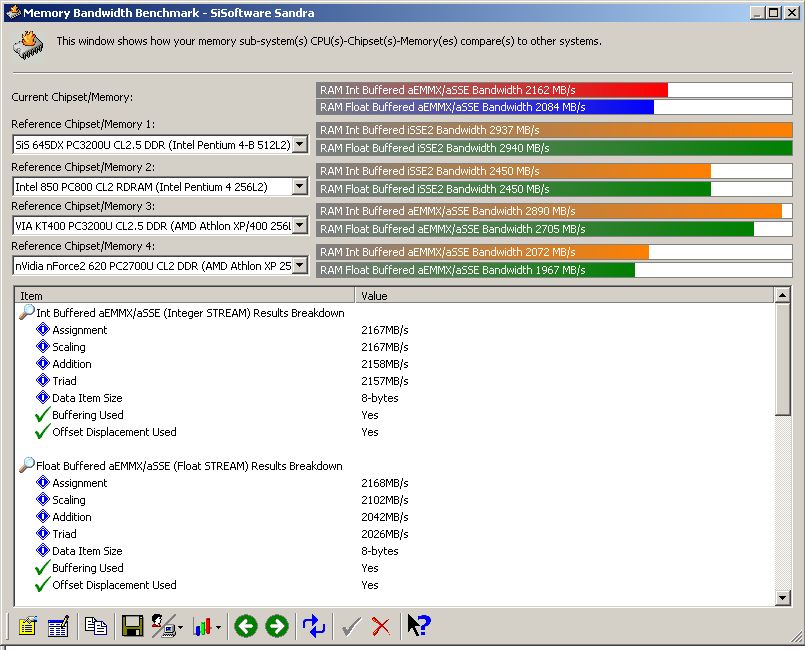
Now here are the scores for SiSoft Sandra’s memory bandwidth benchmark. They scale well with what would be expected from such a minimal increase in bus and CPU speed.
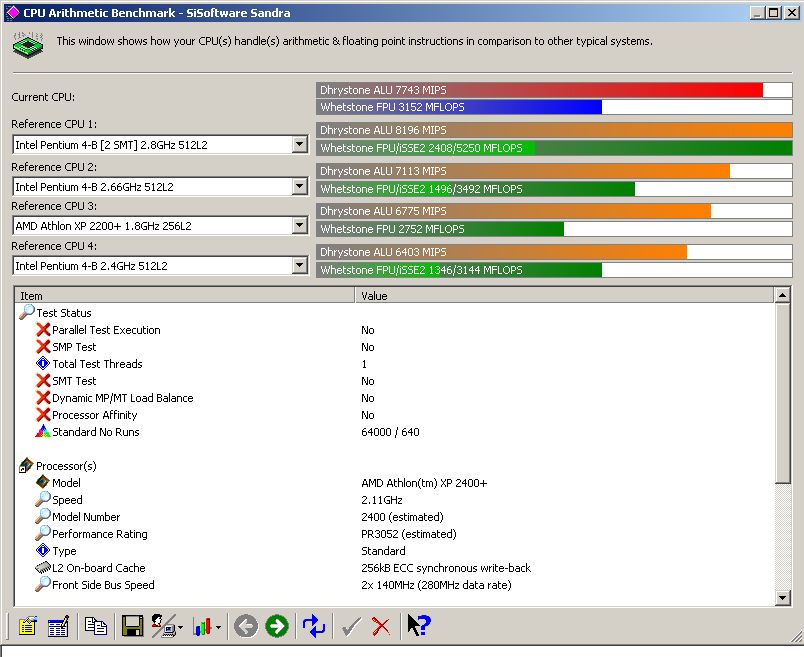
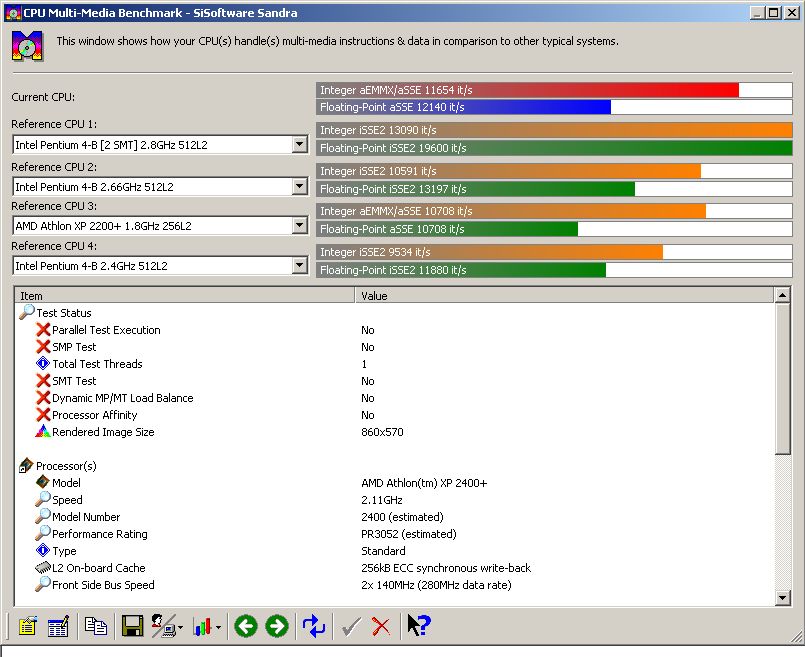
I decided to forego the hard drive benchmark, as it seemed redundant. Overclocking a motherboard should not have any effect on IDE speed, and if it does then something is wrong. I do, however, have the CPU arithmetic and multimedia scores for the overclocked processor. They are nothing special, basically what we would expect. However, this lets us know that the board doesn’t suffer from any serious problems regarding the CPU and overclocking (except that it’s not very good at it).
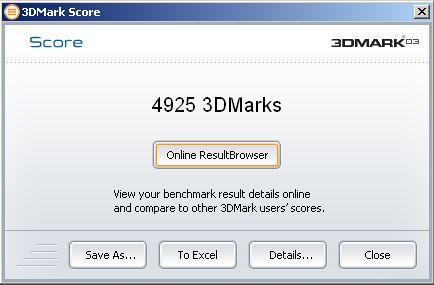
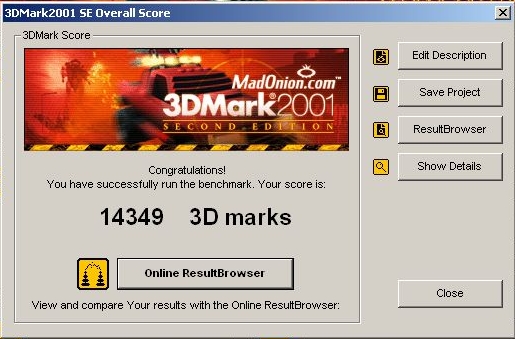
And finally, we have the 3DMark scores for the overclocked system. These actually surprised me, I wasn’t aware of how much the CPU speed affected the overall total, but I guess it’s really not that surprising since the whole system is affected by overclocking. The gains are also indicative that 3DMark2001SE is more CPU bound than its newer brother. I gained almost 2000 3DMarks in 2001SE, but only 105 in 2003.
Conclusion
Overall, this motherboard is a mixed bag. I like the fact that it has so many features, with SATA, RAID, onboard NIC, 6.1 Audio, dual-channel memory capabilities, etc., and I also like that it performs quite well.
But on the other hand, the nForce2 chipset itself seems to have some major problems, as I mentioned earlier with the IDE drivers, and I just don’t feel like this board is quite ready for mainstream consumption. I think that this board could be quite good as time progresses, with a BIOS update from XFX (to add multiplier adjustments) and driver updates(to fix the IDE problem), possibly from XFX as well since nVidia doesn’t seem to be doing so good with them.
I have also had some strange stability issues with the board. On the whole it has been quite stable, but it seems to have some funky issues. For example, whenever I install something, using Windows Update or the install program, it stalls for about 15 minutes and then goes.
I have not been able to find what is causing it. Also, whenever I play X-Com: UFO Defense (Windows version) the system blue screens with an nVidia driver error. I am giving this board a 6.5, and would like to thank XFX technologies for sending this board out for review.
Pros
- Lots of features
- Good onboard sound
- Fast for gaming
- Supports Dual-Channel 400MHz DDR-RAM
- Good layout
Cons
- Lack of overclocking options
- Slightly low benchmark scores
- Instability issues
- Problems with IDE drivers from nVidia