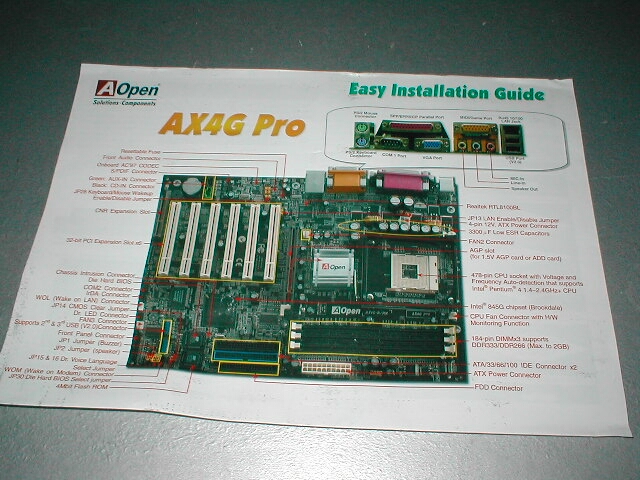
Because this is the only Intel motherboard I have I am not able to put it up against any others, I do however have a comparable AMD setup which I will be using as comparison which is even better in my opinion because we can see who really has more power.
Intel Test Bed
- AOpen AX4G Pro
- 1.6aGhz Pentium 4
- 256MB GEIL 3500 DDR (review to come)
- XFX Geforce 3 Ti500
- 30GB Western Digital hard drive
- Koolcases “Prince” case
AMD Test Bed
- EPoX 8K3A+
- Cooler Master ATC-101 (review to come)
- Athlon XP 1800+ @ 1900+ (1.6Ghz)
- 256MB GEIL 3500 DDR (review to come)
- 80GB Maxtor ATA133 HDD
- XFX Geforce 3 Ti500
- Sound Blaster Live! Value
- Pioneer 16x slot load DVD
- 10/100 NIC
- Floppy
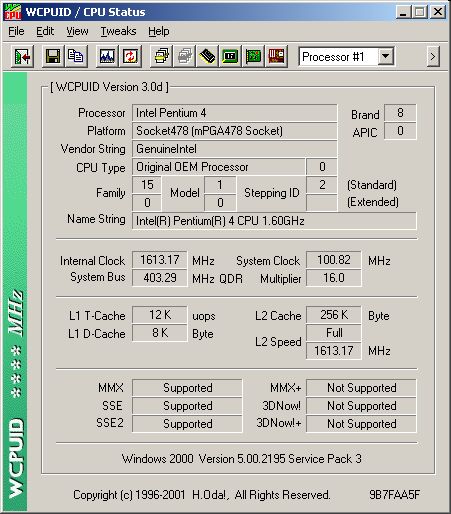
All testing will be done at 32 bit color, vsync is off, AA is off, and all of the memory options are at the most aggressive settings. All of the game testing will have the lowest graphics levels on to test the CPU instead of the video card and all testing will be done at 640×480, Below is a screenshot of the WCPUID for the Intel setup, as you can see.
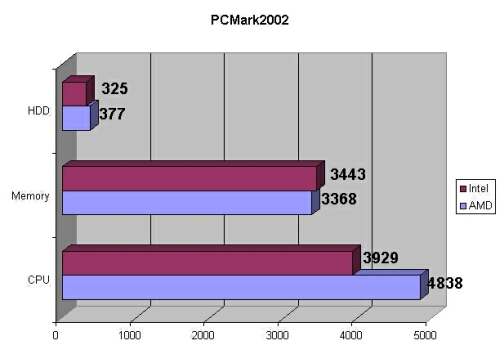
The first benchmark I ran was PCMark2002 which tests the CPU, memory, and hard drive of a system with many different tests. I ran the benchmark on both the AMD setup and the Intel setup and at the end the results ended up being pretty close.
The AMD system beat out the Intel one in the hard drive benchmark probably because the AMD setup had an ATA133 drive while the Intel one had an ATA100 drive.
The Intel setup beat the AMD setup in the memory benchmark by 75 points, not much but it beat it none the less. Finally with the CPU benchmarking the AMD again beat the Intel setup by a little over 900 points.
I ran SiSoft Sandra Pro 2002.6.8.97 and ran the memory bandwidth benchmarking on both the AMD and the Intel setup again. The AMD setup edged out the Intel setup by a little over 200 points on both the float buffered and the int buffered. As you can see the quad pumped memory and 400 FSB on the Intel setup doesn’t make it faster.

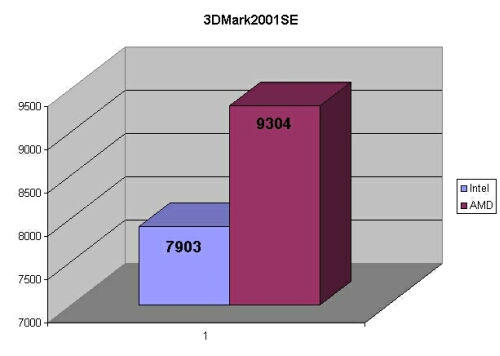
I ran 3DMark2001SE which is a synthetic video benchmark on both machines and again the AMD setup beat out the Intel setup by 1401 points. I was not very surprised to see that the AMD system beat the Intel one because so far that’s been the norm and AMD systems are more geared toward gamers.
I then ran Vulpine GLMark which is another synthetic video benchmark, the AMD system again beat the Intel system by almost 10 FPS which will definitely make a difference while gaming.

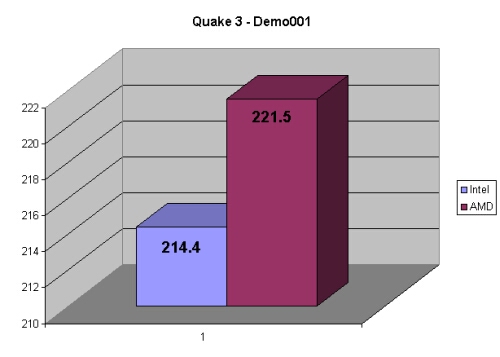
The last benchmark that I ran was Quake 3 – Demo001 which is a very popular game and a very popular benchmarking tool to see how many FPS I could get, once again the AMD setup beat out the Intel setup by about 7 FPS.
Clearly the AMD setup performs better than the Intel one in all of the tests except the memory part of PCMark2002. Because the systems are not exactly the same there is a little margin for error however even with that margin the AMD system won. As for the Pentium 4 let’s see how well it can overclock on this motherboard, I have heard nothing but good stories about overclocking with a 1.6a chip.