
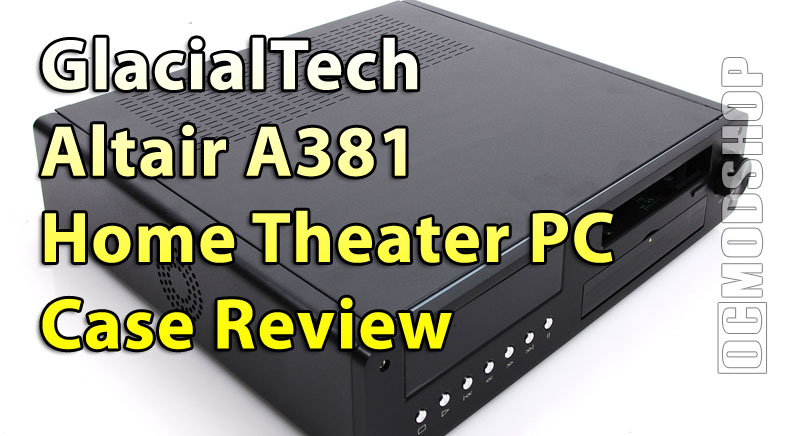
If you’re a fan of low-profile HTPC designs, then you have to choose your PC innards carefully. You pretty much have to take the same considerations of a 1U or 2U server, which means either using low-profile add-in cards, or use a motherboard with all the features you want integrated. If you’ve already decided on this route, then you’re ready to take a look at the Altair A381.
The box includes the case itself, along with a software CD, iMon remote control, case screws, an installation guide, and power cord. The power cord included in our sample was meant for Europe.
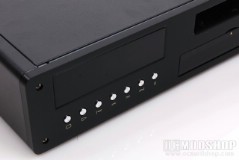
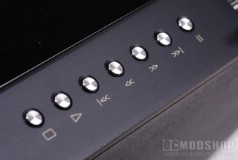
The outside of the case looks like a decent home theater appliance. The entire case is painted black, except for the front panel, which is made of anodized aluminum. The front panel has several features, some of which are stealthed. On the left side of the case is a VFD or LCD display, and below this is an array of standard media control buttons (Home, Display, backward, forward, Play/Pause, Skip, etc.). The ODD bay does not have a pre-installed “stealthed” door, but instead requires an aluminum bezel be taped to the front of your optical drive. While the end result looks fine, I prefer to see a permanently-attached drive door.
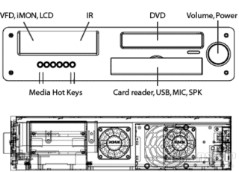
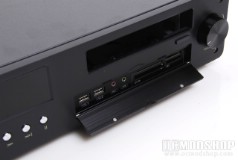
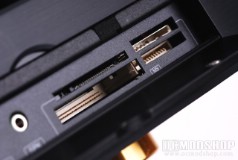
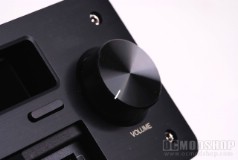
The right side of the case has a slot to access a hidden DVD drive, and to the right of this bay is a volume knob (which doubles as a power button). Below the DVD drive is a panel which conceals a 9-in-1 media card reader, as well as audio and USB ports. The panel is secured close by two small magnets, which is a welcome addition (the panel on this SilverStone LC16 case keeps falling open, no matter what we do).
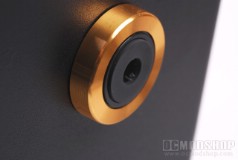
The top of the case has ventillation holes punched near the rear, which will allow heat from the case to naturally escape through convection. The bottom of the case has four circular media-style feet, which use rubber rings to prevent the case from sliding around. The sides of the case have circular ventillation holes stamped out to accomodate internal 40mm exhaust fans.
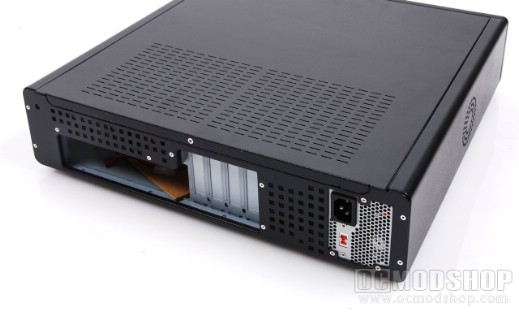
The rear of the case looks like many desktop cases, except for the fact that it is midget-ized. The I/O panel is standard size, but the four card slots to its right are half-sized. To the right of these slots is an exhaust port, and then the integrated 2U power supply. The included power supply apparently was meant for a European audience, as the unit was set for 230W, instead of the standard 115W used in the United States and Canada.
