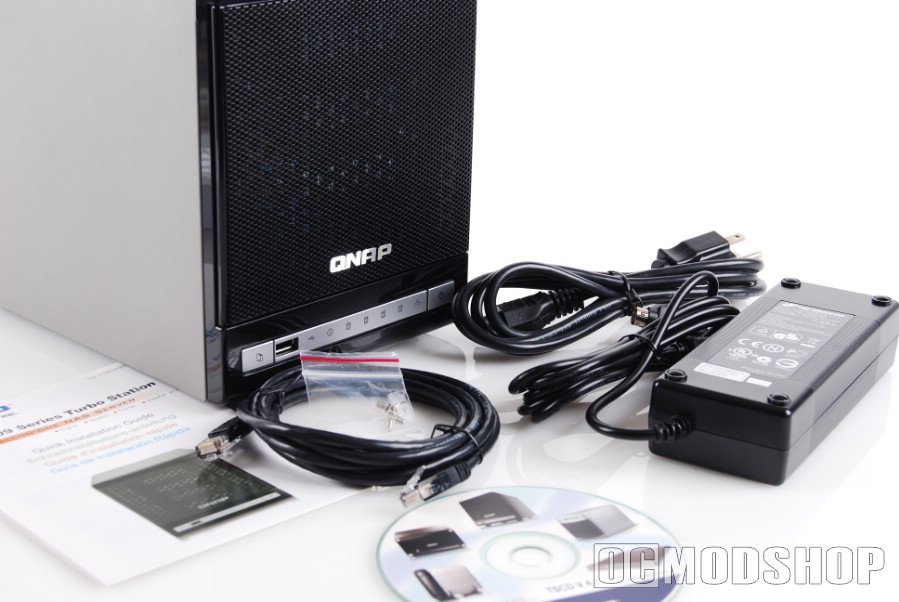
Included in the box is the TS-409 Pro unit itself, a power cable (with power brick), a black network cable, a packet of hard drive mounting screws, a quick-install guide and installation CD. The power brick is by “FSP Group” and can supply 8 amps of power at 12 volts (or 96 watts of power), which is more than enough to run four hard drives and RISC-based processor.
The front of the unit has a black mesh door that swings open to reveal the hot-swappable goodness that lay inside. Underneath this door is a status panel that has a reset button, single USB connector, several status LEDs (showing server status, each hard drive’s status, and network usage), and a power button. The power button is similar to ATX-style computers in that you must press and hold it to power down, but it takes close to 10 seconds while the server powers down gracefully.
The back of the unit shows off the unit’s simple connectivity. There is a sinlge power input jack, a reset button (accessible via a paperclip hole), gigabit network jack, two USB 2.0 ports, and a hole to phyiscally lock the unit with any standard laptop protection kit. The back of the unit also has a thermally controlled exhaust fan, which speeds up or slows down based on internal heat.

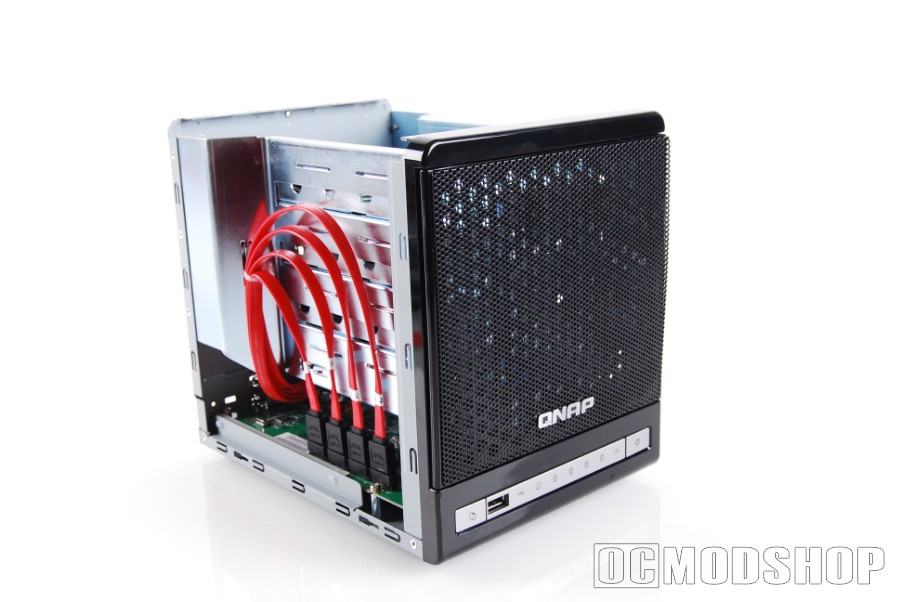
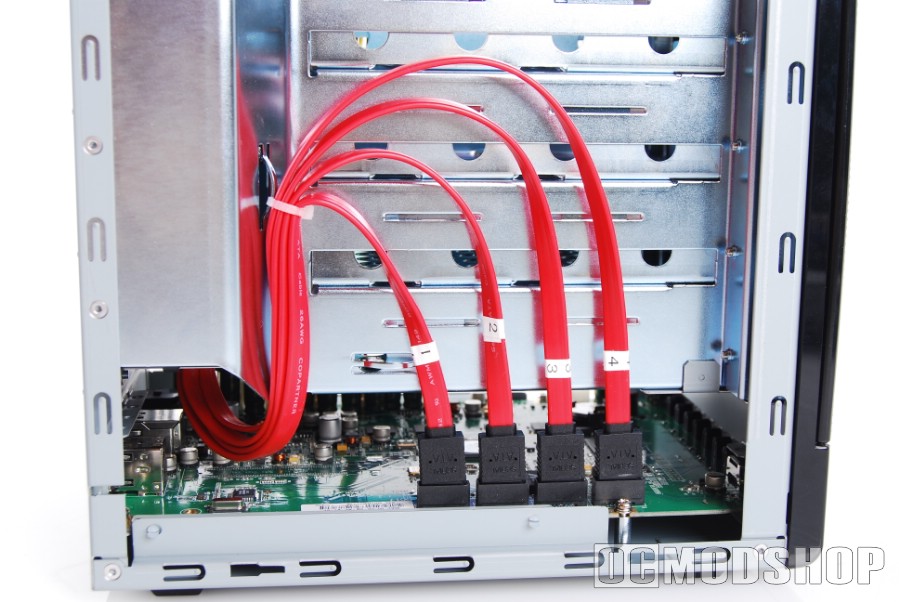
Opening the unit we can see that this unit has a complex yet compact motherboard with four SATA ports. The case is built rather well, and the machining is impecable, which is even more amazing since the inside is never meant to be user-serviceable. A custom 4-bay drive cage hovers above the motherboard, and the back of the cage sits the SATA connectors. Four SATA cables are nearly routed to this connection point, each of them clearly labeled. On the opposite side of the cage is the power connectors for each drive, which are also clearly labeled 1 through 4.

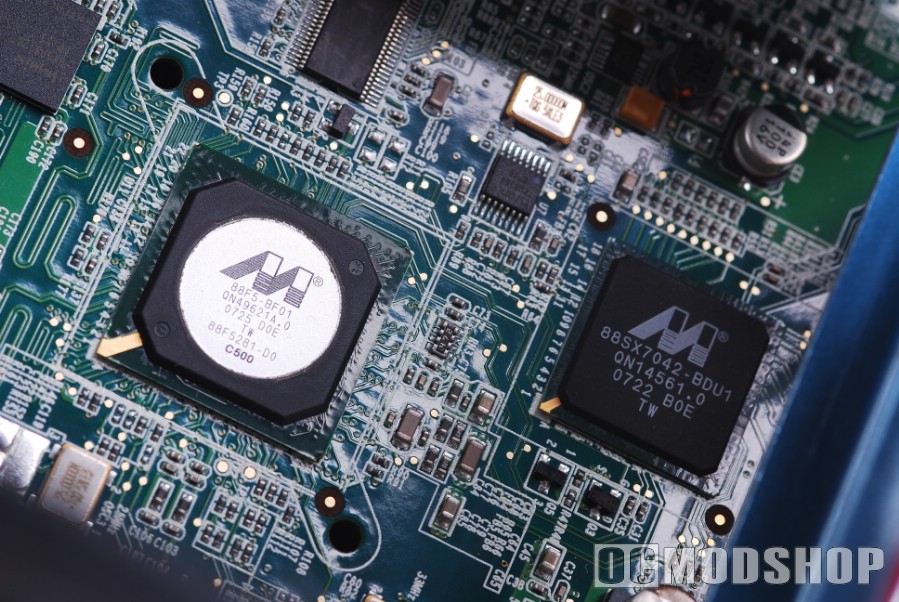
The motherboard itself uses a Marvell 88F5BF01 C500500Mhz SoC (System on a Chip) processor, and does not require a heatsink (althrough there are holes on the motherboard to accomodate one). QNAP has also chosen to use two high-quality Hynix DDR2 memory chips (for a total of 256MB), which are soldered directly on the board. Next to this is an 8MB flash memory chip, which is what allows the device to be upgraded. I could not find any information on the new chip, so it is unclear how much of a performance difference exists between the TS-409 and the TS-109 (which uses a 500Mhz Marvell 88F5182-A2 C500 chip).