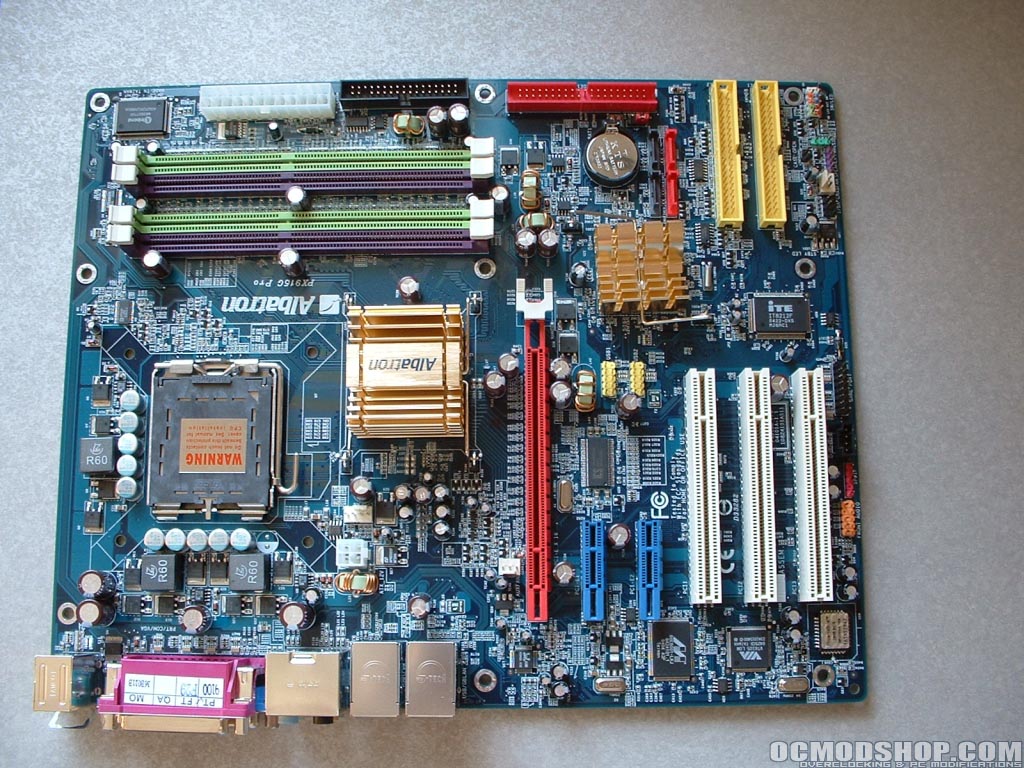
Overclocking was a little tough and I was only able to reach 2956MHz which was a 11MHz FSB increase. To achieve this I had to increase the core voltage to 1.5v, DDR voltage +0.3v, and northbridge voltage +0.2v. Pushing the FSB any higher would cause the motherboard not to boot. Along with increasing the voltages I also relaxed the memory timings much as possible which didn’t change anything. The biggest thing lacking from this motherboard in the overclocking section is a good DDR:CPU divider which made things harder than they needed to be.

Conclusion
Because the LGA775 factor is in its infancy right now the complimentary technology is still a bit behind. PCI-Express holds a lot of good potential I feel but at this point AGP is still in charge.
Because PCI-Express is not ready to take over AGP there are not many video cards to choose from right now. Even with a slower video card like the PCX5750 many of the application benchmarks are better or close to that of the AMD system that I compared against.
The game benchmarks are not as easily comparable because of the clock speed difference in the two video cards used. I really do feel though that with equal video cards that the PX915G Pro would have done better in all of the testing. In the future I will be reviewing other LGA775 motherboards and PCI-Express at which time an equal playing field can be setup.
Overall I am impressed with this motherboard and am going to give it a 9/10 and award it the OCmodshop Seal of Approval. I would like to thank Albatron for sending me this motherboard to review.
Pros

- PCI-Express
- Impressive memory scores
- Gigabit and 10/100 NICs
- Onboard video for non-gamers
- 8 channel audio
- Impressive memory scores
- Blue PCB
Cons
- Not the best overclocker
- LGA775 still might be a little premature