

LGA 2011, aka Socket R, is another Intel socket that was released in late 2011 to replace the LGA 1366 and LGA 1567 intended for high-end performance and server motherboards. It is called the 2011 because it has that many contact points, not because it was released in 2011. It uses QPI (Quick Path Interconnect) to connect the CPU to additional CPUs.
It supports Sandy Bridge-E chipsets, an eight-core processor based on the Sandy Bridge microarchitecture, with four memory channels of DDR3-1600. It also boasts 40x PCIe 2.0 or 3.0 lanes. LGA 2011 motherboards can have either 4 or 8 DIMM slots which would support a maximum 32Gb, 64GB, or 128GB of RAM. It will be compatible with future Ivy Bridge-E processors and ensures platform scalability beyond eight cores and 20MB of cache.
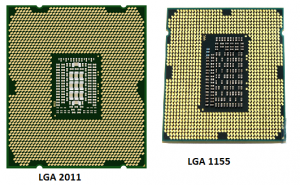
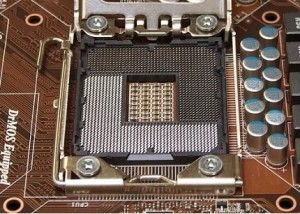
A list of compatible CPUs is as follows:
Desktop Models:
| Name | Cores | Threads | Frequency | Turbo Boost | Multiplier | L2 Cache | L3 Cache | TDP |
|---|---|---|---|---|---|---|---|---|
| Core i7 3960X Extreme Edition | 6 | 12 | 3.30 Ghz | 3.90 Ghz | Unlocked | 6 x 256kb | 15MB | 130W |
| Core i7 3930K | 6 | 12 | 3.20 Ghz | 3.80 Ghz | Unlocked | 6 x 256kb | 12MB | 130W |
| Core i7 3820 | 4 | 8 | 3.60 Ghz | 3.80 Ghz | Partially Unlocked | 4 x 256kb | 10MB | 130W |
Server Models:
| Name | Cores | Threads | Frequency | Turbo Boost | Multiplier | L2 Cache | L3 Cache | TDP |
|---|---|---|---|---|---|---|---|---|
| Xeon E5 1620 | 4 | 8 | 3.60 Ghz | 3.90 Ghz | 38 | 4 x 256kb | 10MB | 130W |
| Xeon E5 1650 | 6 | 12 | 3.20 Ghz | 3.80 Ghz | 38 | 6 x 256kb | 12MB | 130W |
| Xeon E5 1660 | 6 | 12 | 3.30 Ghz | 3.90 Ghz | 39 | 6 x 256kb | 15MB | 130W |
| Xeon E5 2603 | 4 | 4 | 1.8 Ghz | N/A | 18 | ? | 10MB | 80W |
| Xeon E5 2609 | 4 | 4 | 2.4 Ghz | N/A | 24 | ? | 10MB | 80W |
| Xeon E5 2620 | 6 | 12 | 2.0Ghz | 2.5Ghz | 25 | ? | 15MB | 95W |
| Xeon E5 2630 | 6 | 12 | 2.3Ghz | 2.8Ghz | 28 | ? | 15MB | 95W |
| Xeon E5 2640 | 6 | 12 | 2.5Ghz | 3.0Ghz | 30 | ? | 15MB | 95W |
| Xeon E5 2650 | 8 | 16 | 2.0Ghz | 2.8Ghz | 28 | ? | 20MB | 95W |
| Xeon E5 2660 | 8 | 16 | 2.2Ghz | 3.0Ghz | 30 | ? | 20MB | 95W |
| Xeon E5 2665 | 8 | 16 | 2.4Ghz | 3.1Ghz | 31 | ? | 20MB | 115W |
| Xeon E5 2670 | 8 | 16 | 2.6Ghz | 3.3Ghz | 33 | ? | 20MB | 115W |
| Xeon E5 2680 | 8 | 16 | 2.7Ghz | 3.5Ghz | 35 | ? | 20MB | 130W |
| Xeon E5 2690 | 8 | 16 | 2.9Ghz | 3.8Ghz | 38 | ? | 20MB | 135W |
On the next page we move into the AMD sockets. A lot of my friends give me crap for using AMD, but I’ve been a supporter of their CPUs for as long as I can remember and don’t plan on stopping anytime soon. They’ve always seemed like the underdog to me, but seem to delight in producing powerful processors sometimes at a fraction of what Intel charges. Don’t get me wrong, I do like Intel. The laptop I’m writing this on right now has an Intel processor. My netbook is also an Intel, as is the computer I built for my kids to keep unknown stickiness off this laptop. But my baby, the PC I built for my 3D modeling projects, is AMD. And I wouldn’t trade it for any of the other computers in my house.
Now we move on to AMD sockets. On the next page we look at the Socket FM1…


1 comment
Comments are closed.