

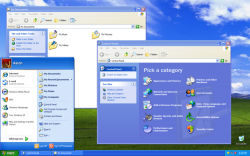
The successor to Windows 2000 was Windows XP (the Windows Experience), and was even more accessible to the average person than Windows 2000. If Windows 2000 is NT 5.0, then XP has to be 6.0, right? Forget about that whole Windows 95/98/98SE/Me should be version 4.x even when Windows NT 4.0 already existed.
During the Windows XP time, Microsoft also released different flavors for Media Center PCs (XP Media Center Edition). This is all well and good, but they released a new version of it every year (MCE 2003, MCE 2004, and MCE 2005).
The next version of Windows was Windows Vista, which Microsoft would like to pretend never existed. According to our existing NT tally, Windows Vista should be NT version 7. Wait, isn’t Windows 7 version 7? Is Microsoft trying to pawn off that Windows Vista was just a “preview” of Windows 7? Or do they consider Vista to be a subversion of XP (NT version 6)?
The Server Confusion
If all of this isn’t confusing enough, we have to consider the Server flavors of all of these Operating Systems. Instead of naming the Server edition of XP “Windows XP Server” (like they did with Windows NT 4.0), Microsoft dubbed it “Windows Server 2003”. This distanced the name from XP (the consumer version, which was really the professional codebase) and their Server line (the professional version). Should the Server line be considered a subversion of XP, even though Microsoft obviously marketed it as a completely different version?
64-bit versions
Last but not least, we also have to consider the 64-bit versions of the operating systems. By the Rules of Versioning, any new hardware architecture gets its own version number. 64-bit versions of Windows XP supported the (relatively) new AMD 64 processors, and since then all general-purpose PC processors are 64-bit capable. But at the time the 64-bit version of XP was created to support a whole new hardware architecture. Should it get its own version number? What about the 64-bit versions of Vista, Windows 7, and Windows 8?
What about Windows 8 RT? The RT version only supports the ARM processor inside Microsoft’s new Surface tablet, which again is a completely different hardware architecture.



9 comments
Comments are closed.